D'Souza Randall F, Bjørnsen Thomas, Zeng Nina, Aasen Kirsten M M, Raastad Truls, Cameron-Smith David, Mitchell Cameron J
Liggins Institute, University of AucklandAuckland, New Zealand.
Department of Public Health, Sport and Nutrition, Faculty of Health and Sport Sciences, University of AgderKristiansand, Norway.
Front Physiol. 2017 Jun 7;8:383. doi: 10.3389/fphys.2017.00383. eCollection 2017.
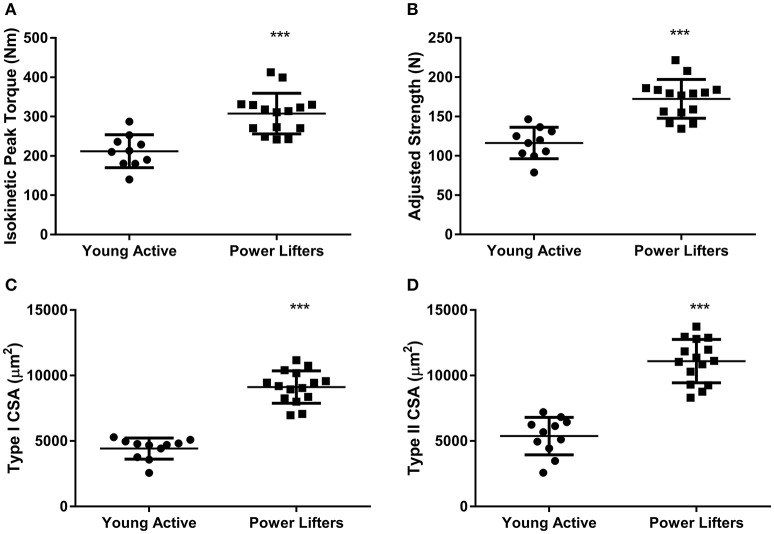
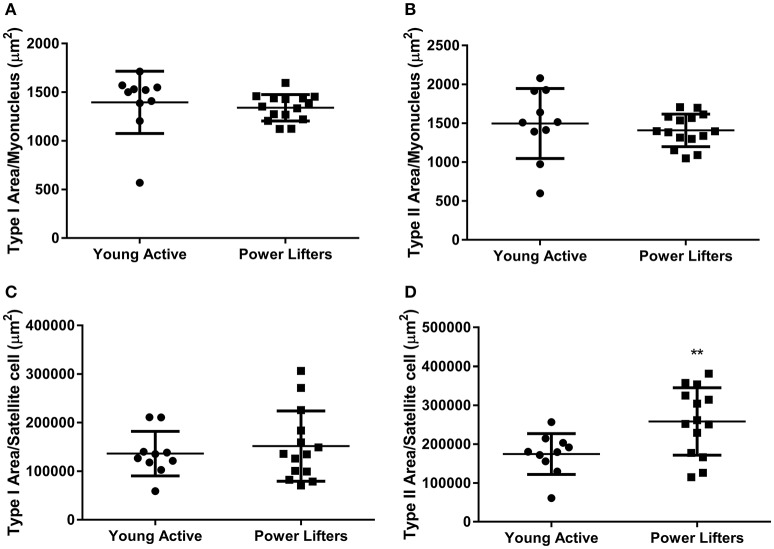
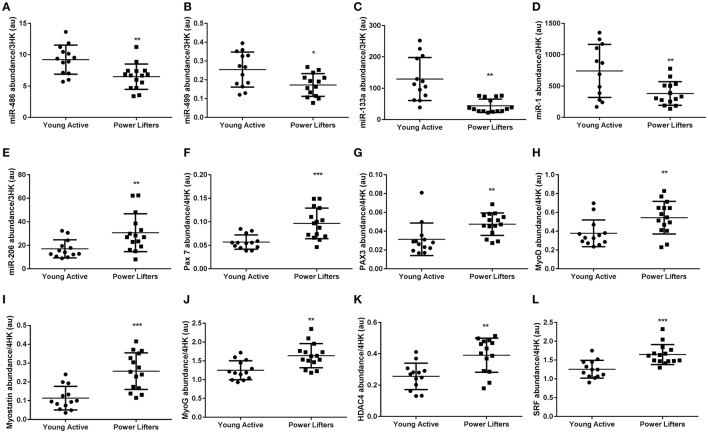
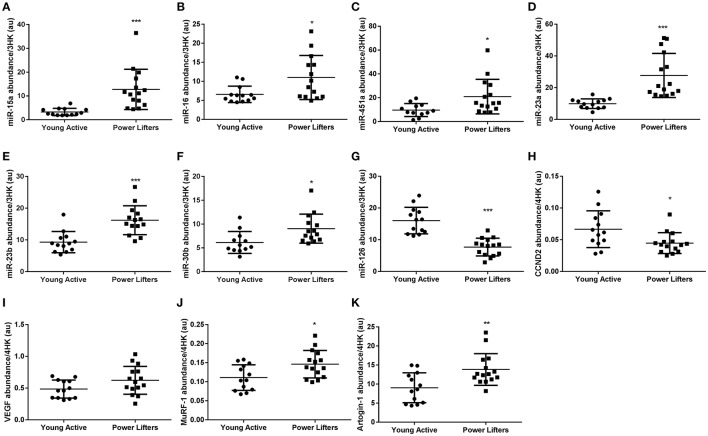
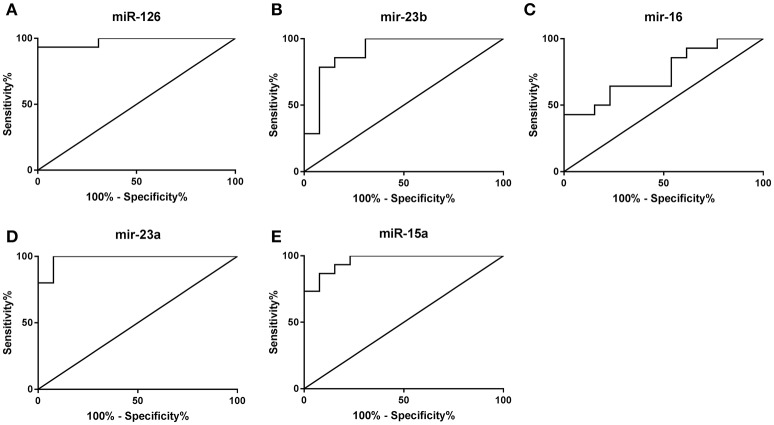
Powerlifters are the epitome of muscular adaptation and are able to generate extreme forces. The molecular mechanisms underpinning the significant capacity for force generation and hypertrophy are not fully elucidated. MicroRNAs (miRs) are short non-coding RNA sequences that control gene expression via promotion of transcript breakdown and/or translational inhibition. Differences in basal miR expression may partially account for phenotypic differences in muscle mass and function between powerlifters and untrained age-matched controls. Muscle biopsies were obtained from m. vastus lateralis of 15 national level powerlifters (25.1 ± 5.8 years) and 13 untrained controls (24.1 ± 2.0 years). The powerlifters were stronger than the controls (isokinetic knee extension at 60°/s: 307.8 ± 51.6 Nm vs. 211.9 ± 41.9 Nm, respectively < 0.001), and also had larger muscle fibers (type I CSA 9,122 ± 1,238 vs. 4,511 ± 798 μm < 0.001 and type II CSA 11,100 ± 1,656 vs. 5,468 ± 1,477 μm < 0.001). Of the 17 miRs species analyzed, 12 were differently expressed ( < 0.05) between groups with 7 being more abundant in powerlifters and five having lower expression. Established transcriptionally regulated miR downstream gene targets involved in muscle mass regulation, including myostatin and MyoD, were also differentially expressed between groups. Correlation analysis demonstrates the abundance of eight miRs was correlated to phenotype including peak strength, fiber size, satellite cell abundance, and fiber type regardless of grouping. The unique miR expression profiles between groups allow for categorization of individuals as either powerlifter or healthy controls based on a five miR signature (miR-126, -23b, -16, -23a, -15a) with considerable accuracy (100%). Thus, this unique miR expression may be important to the characterization of the powerlifter phenotype.
力量举运动员是肌肉适应的典范,能够产生极大的力量。支撑其强大力量生成和肌肉肥大能力的分子机制尚未完全阐明。微小RNA(miR)是短的非编码RNA序列,通过促进转录本降解和/或翻译抑制来控制基因表达。基础miR表达的差异可能部分解释了力量举运动员与未受过训练的年龄匹配对照组在肌肉质量和功能上的表型差异。从15名国家级力量举运动员(25.1±5.8岁)和13名未受过训练的对照组(24.1±2.0岁)的股外侧肌获取肌肉活检样本。力量举运动员比对照组更强壮(60°/s等速膝关节伸展:分别为307.8±51.6 Nm和211.9±41.9 Nm,P<0.001),并且肌纤维也更大(I型横截面积9,122±1,238 vs. 4,511±798μm,P<0.001;II型横截面积11,100±1,656 vs. 5,468±1,477μm <0.001)。在所分析的17种miR中,12种在两组之间表达不同(P<0.05),其中7种在力量举运动员中更为丰富,5种表达较低。参与肌肉质量调节的已确定转录调控的miR下游基因靶点,包括肌肉生长抑制素和肌分化抗原(MyoD),在两组之间也存在差异表达。相关性分析表明,无论分组如何,8种miR的丰度与表型相关,包括峰值力量、纤维大小、卫星细胞丰度和纤维类型。两组之间独特的miR表达谱允许基于五个miR特征(miR-126、-23b、-16、-23a、-15a)以相当高的准确性(100%)将个体分类为力量举运动员或健康对照组。因此,这种独特的miR表达可能对力量举运动员表型的特征描述很重要。