Department of Neurology The Affiliated Hospital of Qingdao University Qingdao China.
Department of Neurology The Affiliated Hospital of Wei fang Medical University Weifang China.
Brain Behav. 2017 May 10;7(6):e00694. doi: 10.1002/brb3.694. eCollection 2017 Jun.
The pathogenesis and progression of branch atheromatous disease (BAD), which differs from lipohyalinotic degeneration (LD), remains controversial. Few studies have investigated the lipid indices and glycometabolism status factors for BAD in first-ever penetrating artery infarction (PAI).
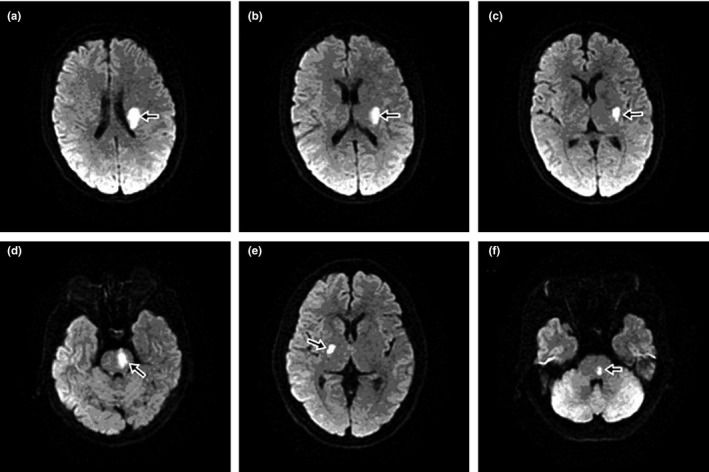
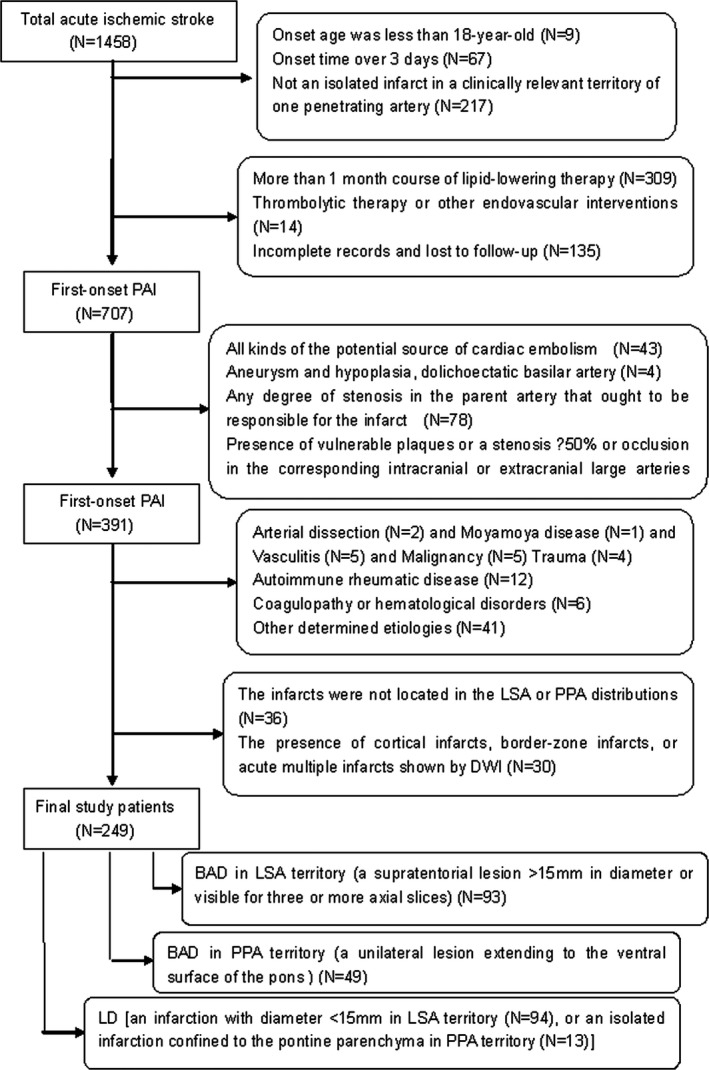
We retrospectively examined acute stroke patients with PAI admitted within 3 days after stroke. All patients underwent diffusion weight magnetic resonance imaging (DWI) and magnetic resonance angiography (MRA) and/or computed tomography angiography (CTA). Progression was defined as an increase by 2 point or higher in the National Institutes of Health Stroke Scale score. The characteristics, clinical data were statistically analyzed.
BAD and LD were diagnosed in 142 (57%) and 107 (43%) patients, respectively. Patients with BAD had higher low-density lipoprotein cholesterol (LDL-C) compared with those with LD (= .013). Elevated LDL-C was related to early neurological deterioration in patients with BAD (= .045). The percentage of lenticulostriate arterial (LSA) infarction was greater than that of the pontine penetrating arterial (PPA) infarction in acute PAI (75.1% vs. 24.9%; < .001). PPA infarction was more prevalent in the BAD group compared with the LD group (34.5% vs. 12.1%, < .001). The PPA infarction had older age at onset and higher HbA1c concentrations than those with the LSA infarction (= .014, = .036 respectively) in the BAD and LD patients, respectively.
LDL-C may be associated with both the pathogenesis and progression of intracranial BAD. The LSA infarction was the most frequently subtypes in PAI. Age at onset and HbA1c seem to be closely associated with the PPA infarction of first-ever PAI.
不同于脂透明变性(LD),分支动脉粥样硬化性疾病(BAD)的发病机制和进展仍存在争议。很少有研究调查过首发穿支动脉梗死(PAI)中 BAD 的血脂指数和糖代谢状态因素。
我们回顾性检查了发病后 3 天内入院的急性脑卒中伴 PAI 的患者。所有患者均行弥散加权磁共振成像(DWI)和磁共振血管造影(MRA)和/或计算机断层血管造影(CTA)。进展定义为美国国立卫生研究院卒中量表评分增加 2 分或以上。对特征、临床资料进行统计学分析。
BAD 和 LD 在 142 例(57%)和 107 例(43%)患者中分别诊断。BAD 患者的低密度脂蛋白胆固醇(LDL-C)水平高于 LD 患者(=0.013)。在 BAD 患者中,升高的 LDL-C 与早期神经功能恶化有关(=0.045)。急性 PAI 中,豆纹动脉(LSA)梗死的比例大于脑桥穿支动脉(PPA)梗死(75.1%比 24.9%;<0.001)。与 LD 组相比,BAD 组 PPA 梗死更为常见(34.5%比 12.1%,<0.001)。BAD 和 LD 患者中,PPA 梗死的发病年龄更大,HbA1c 浓度更高(=0.014,=0.036)。
LDL-C 可能与颅内 BAD 的发病机制和进展均有关。LSA 梗死是 PAI 中最常见的亚型。发病年龄和 HbA1c 似乎与首发 PAI 的 PPA 梗死密切相关。