Zhao Junling, Li Miao, Chen Jinkun, Wu Xiaomei, Ning Qin, Zhao Jianping, Xu Yongjian, Xie Jungang, Yu Jun
Department of Respiratory and Critical Care Medicine, National Clinical Research Center of Respiratory Disease, Tongji Hospital, Tongji Medical College, Huazhong University of Science and Technology, Wuhan, China Acadia Junior High School, Winnipeg, Manitoba, Canada Department of Infectious Disease, Institute of Infectious Disease, Tongji Hospital of Tongji Medical College, Huazhong University of Science and Technology Department of Thoracic Surgery, Tongji Hospital, Tongji Medical College, Huazhong University of Science and Technology, Wuhan, China.
Medicine (Baltimore). 2017 Jun;96(25):e7283. doi: 10.1097/MD.0000000000007283.
We conducted this study to identify the influences and synergistic effects of smoking status and polymorphisms in hedgehog interacting protein (HHIP) on chronic obstructive pulmonary disease (COPD) and lung function decline.
A cohort containing 306 COPD patients and 743 healthy subjects was recruited from 25,000 subjects. All selected subjects had chronic cough for over 2 years or a smoking history above 20 pack-years. After 8 years, all subjects were divided into 2 cohorts according to whether they had quit smoking or not. A follow-up of all patients was completed after another period of 10 years. Three variants in HHIP were genotyped to investigate the impacts of gene susceptibility on the development of COPD and lung function decline.
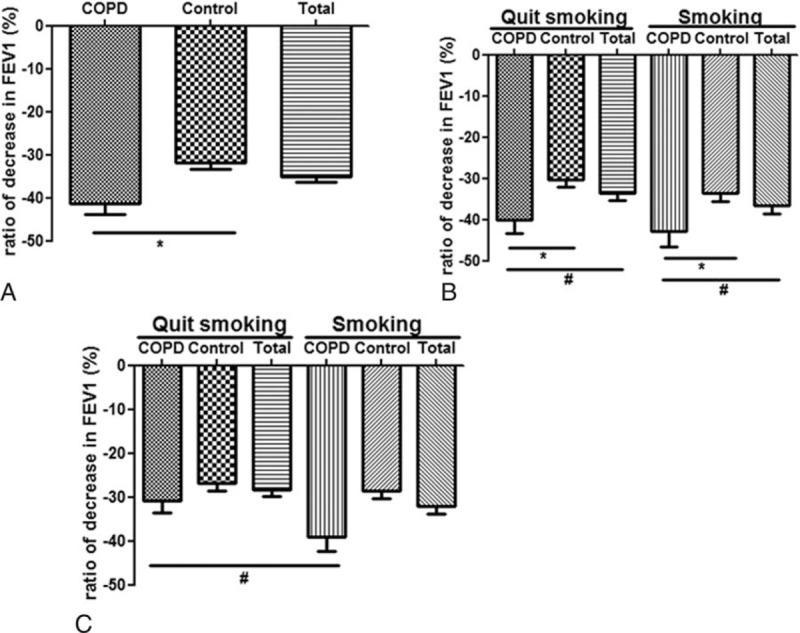
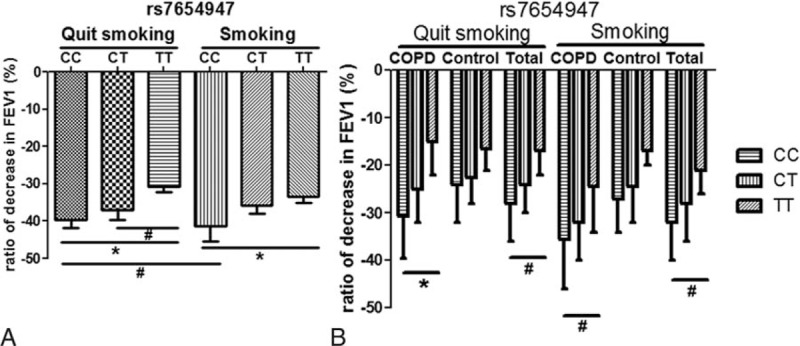
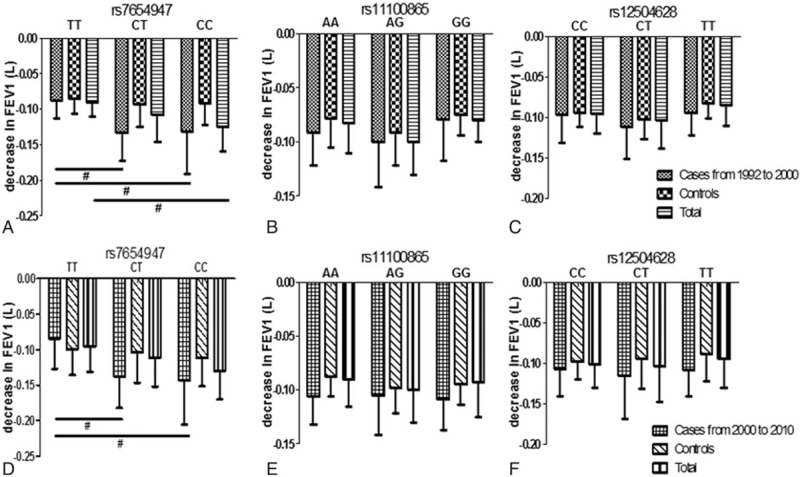
During the follow-up tests, forced expiratory volume in 1 s (FEV1) ratios decreased more significantly in COPD patients than in healthy subjects. For variant rs7654947, FEV1 decreased more significantly in CC and CT subjects than in TT subjects. FEV1 in COPD patients with a CC genotype from smoking cohorts reduced markedly when compared to ex-smoking cohorts (case, 30.75% vs. 35.5%; total, 28% vs. 32%).
Our results showed that smoking and HHIP variant rs7654947 were associated with COPD development and lung function decline. Moreover, we found that cigarette smoking and gene susceptibility have cooperative effects on COPD risk and lung function decline.
我们开展这项研究以确定吸烟状况和刺猬相互作用蛋白(HHIP)基因多态性对慢性阻塞性肺疾病(COPD)及肺功能下降的影响和协同效应。
从25000名受试者中招募了一个包含306例COPD患者和743名健康受试者的队列。所有入选受试者均有超过2年的慢性咳嗽或吸烟史超过20包年。8年后,根据是否戒烟将所有受试者分为两个队列。在再过10年之后完成了对所有患者的随访。对HHIP中的三个变异进行基因分型,以研究基因易感性对COPD发生发展及肺功能下降的影响。
在随访测试期间,COPD患者1秒用力呼气容积(FEV1)比值下降比健康受试者更显著。对于变异rs7654947,CC和CT受试者的FEV1下降比TT受试者更显著。吸烟队列中CC基因型的COPD患者的FEV1与戒烟队列相比显著降低(病例组,30.75%对35.5%;总体,28%对32%)。
我们的结果表明,吸烟和HHIP变异rs7654947与COPD的发生发展及肺功能下降有关。此外,我们发现吸烟和基因易感性对COPD风险及肺功能下降具有协同作用。