Castellana Stefano, Fusilli Caterina, Mazzoccoli Gianluigi, Biagini Tommaso, Capocefalo Daniele, Carella Massimo, Vescovi Angelo Luigi, Mazza Tommaso
IRCCS Casa Sollievo della Sofferenza, Bioinformatics unit, San Giovanni Rotondo (FG), Italy.
IRCCS Casa Sollievo della Sofferenza, Department of Medical Sciences, Division of Internal Medicine, San Giovanni Rotondo (FG), Italy.
PLoS Comput Biol. 2017 Jun 22;13(6):e1005628. doi: 10.1371/journal.pcbi.1005628. eCollection 2017 Jun.
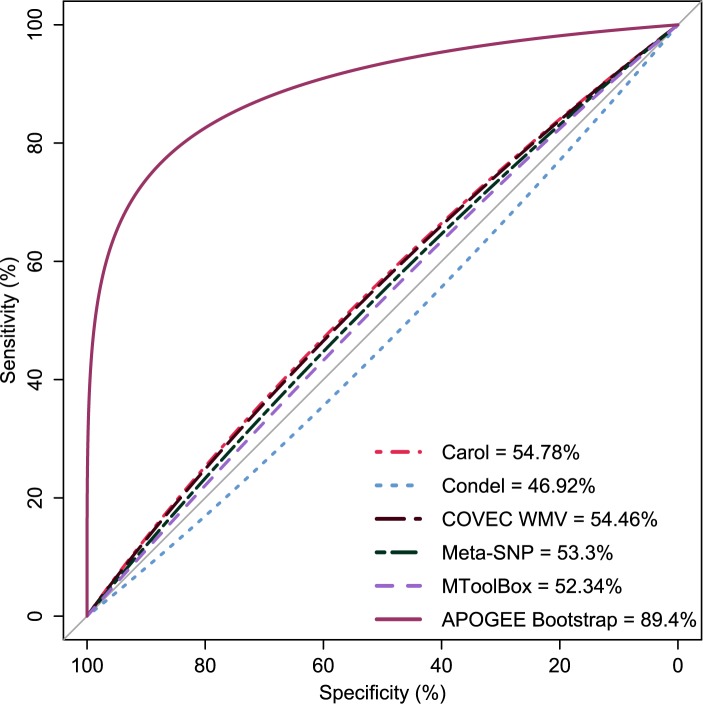
24,189 are all the possible non-synonymous amino acid changes potentially affecting the human mitochondrial DNA. Only a tiny subset was functionally evaluated with certainty so far, while the pathogenicity of the vast majority was only assessed in-silico by software predictors. Since these tools proved to be rather incongruent, we have designed and implemented APOGEE, a machine-learning algorithm that outperforms all existing prediction methods in estimating the harmfulness of mitochondrial non-synonymous genome variations. We provide a detailed description of the underlying algorithm, of the selected and manually curated training and test sets of variants, as well as of its classification ability.
24189个是所有可能潜在影响人类线粒体DNA的非同义氨基酸变化。到目前为止,只有一小部分经过了确定的功能评估,而绝大多数的致病性仅通过软件预测器进行了计算机模拟评估。由于这些工具被证明相当不一致,我们设计并实施了APOGEE,这是一种机器学习算法,在估计线粒体非同义基因组变异的有害性方面优于所有现有的预测方法。我们提供了基础算法、所选并经人工整理的变异训练集和测试集及其分类能力的详细描述。