Maas Fiona, Arends Suzanne, Wink Freke R, Bos Reinhard, Bootsma Hendrika, Brouwer Elisabeth, Spoorenberg Anneke
Rheumatology and Clinical Immunology, University Medical Center Groningen, University of Groningen, Groningen, The Netherlands.
Rheumatology, Medical Center Leeuwarden, Leeuwarden, The Netherlands.
PLoS One. 2017 Jun 22;12(6):e0177231. doi: 10.1371/journal.pone.0177231. eCollection 2017.
To investigate the influence of patient characteristics on the course of spinal radiographic progression in a large prospective longitudinal cohort study of ankylosing spondylitis (AS) patients treated long-term with TNF-α inhibitors.
Consecutive patients from the Groningen Leeuwarden AS (GLAS) cohort starting TNF-α inhibitors with spinal radiographs at least available at baseline and 6 years of follow-up were included. Radiographs were scored using mSASSS by two independent readers. Generalized estimating equations (GEE) were used to explore the associations between baseline characteristics and spinal radiographic progression. The course of radiographic progression in patients with and without risk factors for poor radiographic outcome was investigated using different time models (linear and non-linear). Single linear imputation was used in case of missing radiographic data at the intermediate (2 or 4 years) follow-up visits.
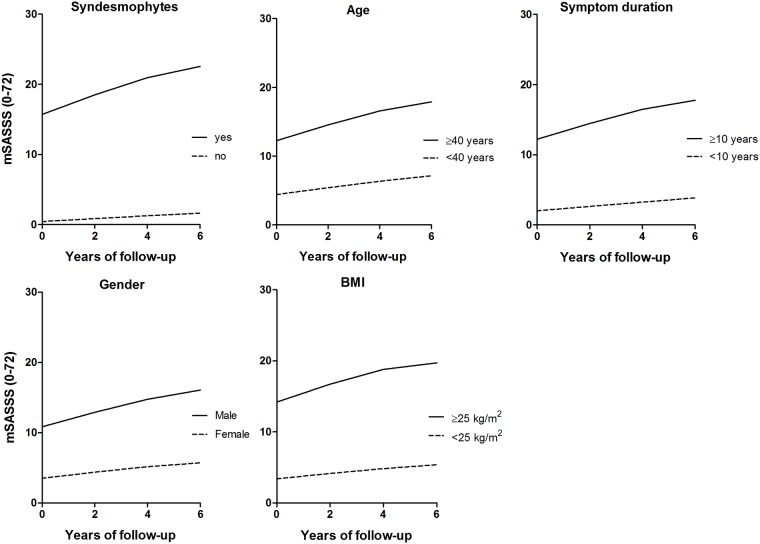
80 AS patients were included with mean baseline mSASSS 8.7±13.3. Baseline syndesmophytes, male gender, older age, longer symptom duration, smoking, and higher BMI were significantly associated with more radiographic damage over time. GEE analysis in patients with these risk factors revealed that radiographic progression followed a non-linear course with mean mSASSS progression rates reducing from max. 2.8 units over 0-2 years to min. 0.9 units over 4-6 years. The GEE model revealed a linear course with overall very low progression (≤1 mSASSS units/2yrs) in patients without risk factors. Complete case analysis in 53 patients showed similar results.
AS patients at risk of poor radiographic outcome showed the highest but diminishing spinal radiographic progression during long-term treatment with TNF-α inhibitors.
在一项对长期接受肿瘤坏死因子-α(TNF-α)抑制剂治疗的强直性脊柱炎(AS)患者进行的大型前瞻性纵向队列研究中,调查患者特征对脊柱放射学进展过程的影响。
纳入来自格罗宁根 - 吕伐登强直性脊柱炎(GLAS)队列的连续患者,这些患者开始使用TNF-α抑制剂治疗,且至少在基线和随访6年时有脊柱X线片。由两名独立阅片者使用改良斯托克强直性脊柱炎脊柱评分(mSASSS)对X线片进行评分。使用广义估计方程(GEE)来探索基线特征与脊柱放射学进展之间的关联。使用不同的时间模型(线性和非线性)研究有无放射学预后不良危险因素的患者放射学进展过程。对于中期(2年或4年)随访时缺失放射学数据的情况,采用单线性插补法。
纳入80例AS患者,平均基线mSASSS为8.7±13.3。基线时的骨桥形成、男性、年龄较大、症状持续时间较长、吸烟和较高的体重指数与随时间推移更多的放射学损伤显著相关。对有这些危险因素的患者进行GEE分析显示,放射学进展呈非线性过程,平均mSASSS进展率从0至2年的最高2.8个单位降至4至6年的最低0.9个单位。GEE模型显示,无危险因素的患者呈线性进展过程,总体进展非常缓慢(≤1个mSASSS单位/2年)。对53例患者进行的完整病例分析显示了类似结果。
在长期接受TNF-α抑制剂治疗期间,有放射学预后不良风险的AS患者脊柱放射学进展最初最高,但随后逐渐降低。