Centre for Systems Genomics, School of BioSciences, The University of Melbourne, Parkville, Victoria, Australia.
Department of Pathology, The University of Melbourne, Parkville, Victoria, Australia.
PLoS Genet. 2017 Jun 22;13(6):e1006328. doi: 10.1371/journal.pgen.1006328. eCollection 2017 Jun.
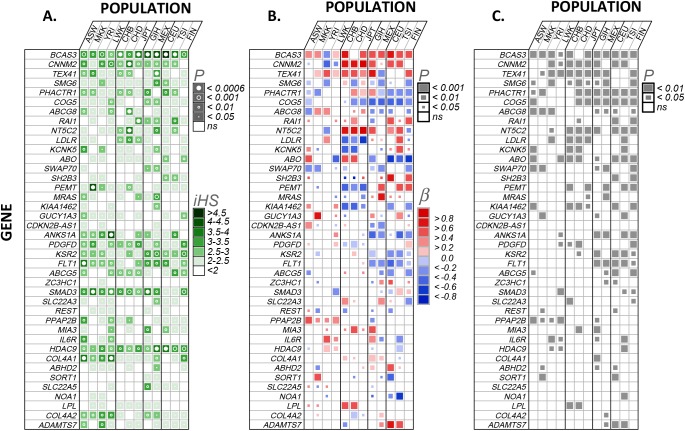
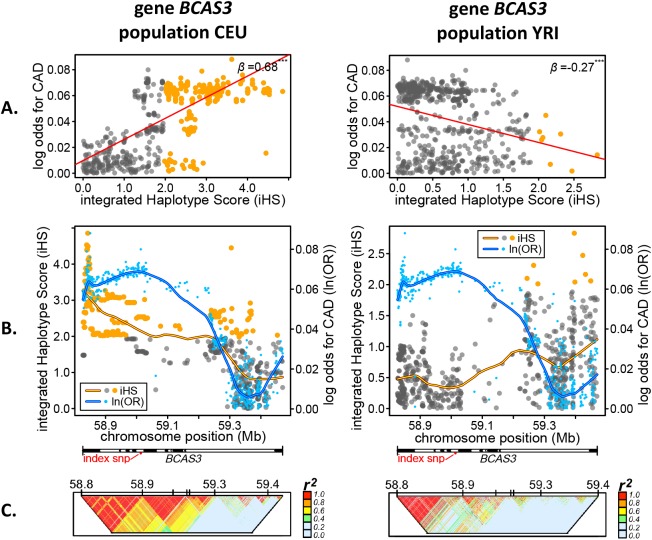
Traditional genome-wide scans for positive selection have mainly uncovered selective sweeps associated with monogenic traits. While selection on quantitative traits is much more common, very few signals have been detected because of their polygenic nature. We searched for positive selection signals underlying coronary artery disease (CAD) in worldwide populations, using novel approaches to quantify relationships between polygenic selection signals and CAD genetic risk. We identified new candidate adaptive loci that appear to have been directly modified by disease pressures given their significant associations with CAD genetic risk. These candidates were all uniquely and consistently associated with many different male and female reproductive traits suggesting selection may have also targeted these because of their direct effects on fitness. We found that CAD loci are significantly enriched for lifetime reproductive success relative to the rest of the human genome, with evidence that the relationship between CAD and lifetime reproductive success is antagonistic. This supports the presence of antagonistic-pleiotropic tradeoffs on CAD loci and provides a novel explanation for the maintenance and high prevalence of CAD in modern humans. Lastly, we found that positive selection more often targeted CAD gene regulatory variants using HapMap3 lymphoblastoid cell lines, which further highlights the unique biological significance of candidate adaptive loci underlying CAD. Our study provides a novel approach for detecting selection on polygenic traits and evidence that modern human genomes have evolved in response to CAD-induced selection pressures and other early-life traits sharing pleiotropic links with CAD.
传统的全基因组正选择扫描主要揭示了与单基因性状相关的选择清除。虽然数量性状的选择更为常见,但由于其多基因性质,很少有信号被检测到。我们在全球人群中搜索冠心病 (CAD) 的正选择信号,使用新的方法来量化多基因选择信号与 CAD 遗传风险之间的关系。我们确定了新的候选适应性基因座,这些基因座似乎由于与 CAD 遗传风险的显著关联而直接受到疾病压力的影响,因此它们似乎已被直接修饰。这些候选基因座都与许多不同的男性和女性生殖特征显著相关,这表明选择也可能针对这些特征,因为它们直接影响适应性。我们发现,与人类基因组的其他部分相比,CAD 基因座在终生生殖成功方面明显更为丰富,并且有证据表明 CAD 与终生生殖成功之间的关系是拮抗的。这支持了 CAD 基因座上存在拮抗多效性权衡,并为 CAD 在现代人类中的存在和高流行率提供了一个新的解释。最后,我们发现使用 HapMap3 淋巴母细胞系,正选择更倾向于 CAD 基因调控变异,这进一步突出了候选适应性基因座在 CAD 下的独特生物学意义。我们的研究提供了一种检测多基因性状选择的新方法,并提供了证据表明,现代人类基因组已经进化以应对 CAD 诱导的选择压力和与 CAD 具有多效性联系的其他早期生命特征。