Murad Cintia Gaio, de Andrade Suellen Nunes, Disconzi Lucio Ramos, Munchow Eliseu Aldrighi, Piva Evandro, Pascotto Renata Correa, Moura Sandra Kiss
Department of Restorative Dentistry, School of Dentistry, University North of ParanáLondrinaPRBrazil.
Department of Restorative Dentistry, School of Dentistry, UNICESUMARMaringáPRBrazil.
Acta Biomater Odontol Scand. 2016 Mar 4;2(1):49-54. doi: 10.3109/23337931.2016.1152901. eCollection 2016 Dec.
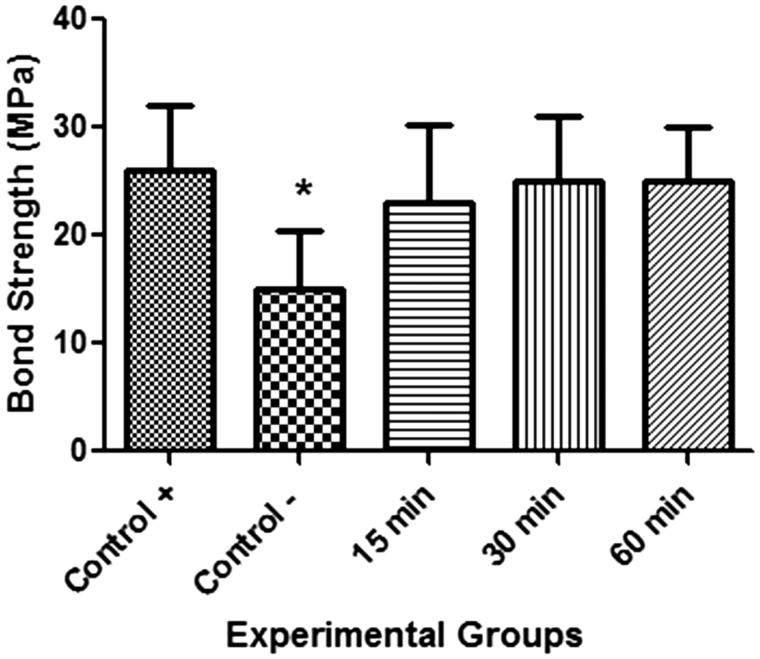
To analyze bond strength to bleached enamel following application of 10% sodium ascorbate gel. Forty third molars were allocated into five groups ( = 8): GP - unbleached specimens restored with composite resin; GN - specimens restored immediately after bleaching; and G15; G30 and G60 (test groups) - bleached specimens treated with 10% sodium ascorbate gel for 15, 30 and 60 min before restoration. The teeth were sectioned and the buccal and lingual faces were restored. After storage in distilled water (37 °C/24 h), sticks of ±0.8 mm were tested in tensile (0.5 mm/min). Fractures were observed and classified. Data (in MPa) were analyzed with one-way ANOVA and Tukey tests ( = 0.05). No differences were found among GP (26 ± 6.0), G15 (23 ± 7.3), G30 (25 ± 6.1) and G60 (25 ± 5.1), with GN (15 ± 5.5) showing the lowest bond strength ( < 0.0001). The application of 10% sodium ascorbate gel for 15 min after bleaching with 37.5% hydrogen peroxide restored the bonding to enamel.
分析应用10%抗坏血酸钠凝胶后与漂白牙釉质的粘结强度。将40颗第三磨牙分为五组(每组n = 8):GP组——用复合树脂修复的未漂白标本;GN组——漂白后立即修复的标本;以及G15、G30和G60组(试验组)——在修复前用10%抗坏血酸钠凝胶处理15、30和60分钟的漂白标本。将牙齿切片并修复颊面和舌面。在蒸馏水中储存(37℃/24小时)后,测试±0.8毫米的棒材的拉伸强度(0.5毫米/分钟)。观察并分类骨折情况。用单因素方差分析和Tukey检验分析数据(α = 0.05)。在GP组(26±6.0)、G15组(23±7.3)、G30组(25±6.1)和G60组(25±5.1)之间未发现差异,而GN组(15±5.5)显示出最低的粘结强度(P < 0.0001)。用37.5%过氧化氢漂白后应用10%抗坏血酸钠凝胶15分钟可恢复与牙釉质的粘结。