Alam Mafruha, D'Este Catherine, Banwell Cathy, Lokuge Kamalini
National Centre for Epidemiology and Population Health, Research School of Population Health, The Australian National University, Canberra, Australia.
BMC Health Serv Res. 2017 Jun 24;17(1):434. doi: 10.1186/s12913-017-2361-6.
Mobile phones are gradually becoming an integral part of healthcare services worldwide. We assessed the association between Aponjon mobile phone based messaging services and practices regarding childbirth and care of mother and neonates in selected areas in Bangladesh.
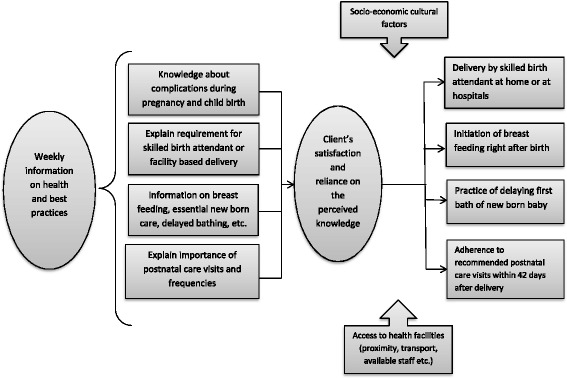
In early 2014, 476 subscriber mothers whose last born child's age was between 3 and 18 months, were recruited to the study by Dnet from selected areas of Bangladesh. One group of mothers received the early warning messages from Aponjon during pregnancy (exposed; n = 210) while the other group of new mothers did not receive the messages during pregnancy as they had enrolled in the service after childbirth (non-exposed; n = 266). We undertook regression analyses to investigate the relationship between timing of exposure to Aponjon messages and socio-economic factors and outcomes of safe delivery, immediate breastfeeding post birth, delayed bathing of the neonate, and number of postnatal care (PNC) visits.
Women reported delivering babies at home without a skilled birth attendant (SBA) (n = 58, 12%), at home with SBA (n = 111, 23%) and at health facilities (n = 307, 65%). Most (n = 443, 93%) women breastfed babies immediately post birth. Babies were bathed after 72 h (n = 294, 62%), between 48 and 72 (n = 100, 21%) and between 0 and 47 (n = 80, 17%) hours after birth. PNC frequencies were reported as none (n = 273, 57%), 1 (n = 79, 17%), 2 (n = 54, 11%), 3 (n = 34, 7%) and 4 (n = 36, 8%). There was no significant association between exposure to Aponjon messages during pregnancy and presence of a SBA at birth, breastfeeding practices, and postnatal care visits, although delayed bathing up to 48 h was significant at the 10% but not 5% level (RRR 1.7; 95% CI 0.93-3.0; p = 0.083). Women with higher education, from higher income, older in age, with birth order 1 or 2 were more likely to birth at health facilities. Facility based delivery was an independent factor for delayed bathing and having postnatal care visits.
Low cost mobile phone messages may have the potential to positively influence maternal and child healthcare behaviours, such as delayed timing of first bath, in resource-poor settings. Further studies are needed, with adequate sample size to detect significant change.
手机正逐渐成为全球医疗服务中不可或缺的一部分。我们评估了基于Aponjon手机短信服务与孟加拉国选定地区的分娩以及母婴护理实践之间的关联。
2014年初,Dnet从孟加拉国选定地区招募了476名最后一个孩子年龄在3至18个月之间的订阅用户母亲。一组母亲在孕期收到了来自Aponjon的预警信息(暴露组;n = 210),而另一组新妈妈在孕期未收到这些信息,因为她们是在分娩后才注册该服务的(非暴露组;n = 266)。我们进行了回归分析,以调查接触Aponjon信息的时间与社会经济因素以及安全分娩、产后立即母乳喂养、新生儿延迟沐浴和产后护理(PNC)就诊次数之间的关系。
女性报告在家中分娩且无熟练接生员(SBA)(n = 58,12%)、在家中有SBA接生(n = 111,23%)以及在医疗机构分娩(n = 307,65%)。大多数(n = 443,93%)女性在产后立即母乳喂养。婴儿在出生后72小时后沐浴(n = 294,62%)、在48至72小时之间沐浴(n = 100,21%)以及在0至47小时之间沐浴(n = 80,17%)。PNC就诊频率报告为无(n = 273,57%)、1次(n = 79,17%)、2次(n = 54,11%)、3次(n = 34,7%)和4次(n = 36,8%)。孕期接触Aponjon信息与出生时是否有SBA、母乳喂养实践以及产后护理就诊之间无显著关联,尽管延迟沐浴至48小时在10%水平有显著差异,但在5%水平无显著差异(相对风险比1.7;95%置信区间0.93 - 3.0;p = 0.083)。受过高等教育、收入较高、年龄较大、生育顺序为1或2的女性更有可能在医疗机构分娩。基于医疗机构的分娩是延迟沐浴和进行产后护理就诊的独立因素。
低成本的手机短信在资源匮乏地区可能有潜力对母婴保健行为产生积极影响,例如延迟首次沐浴时间。需要进一步开展研究,要有足够的样本量以检测出显著变化。