Greimel Felix, Scheuerer Christine, Gessner Andre, Simon Michaela, Kalteis Thomas, Grifka Joachim, Benditz Achim, Springorum Hans-Robert, Schaumburger Jens
Department of Orthopedics, University Medical Center Regensburg, Asklepios Klinikum Bad Abbach, Bad Abbach.
Institute of Clinical Microbiology and Hygiene, University Medical Center Regensburg, Regensburg, Bavaria, Germany.
Drug Des Devel Ther. 2017 Jun 14;11:1729-1736. doi: 10.2147/DDDT.S138888. eCollection 2017.
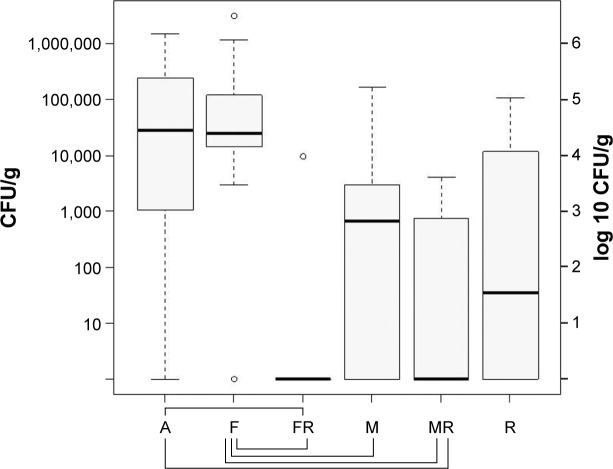
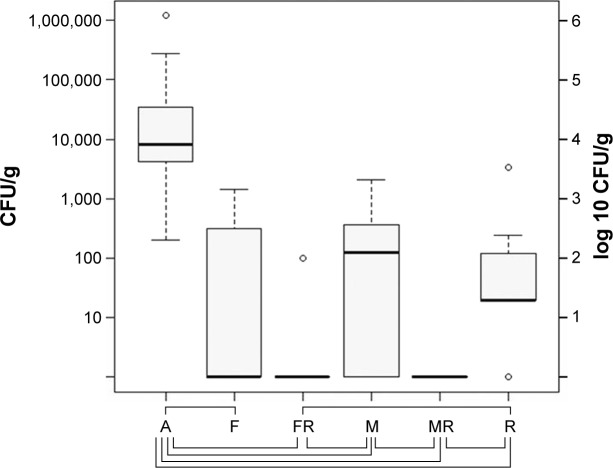
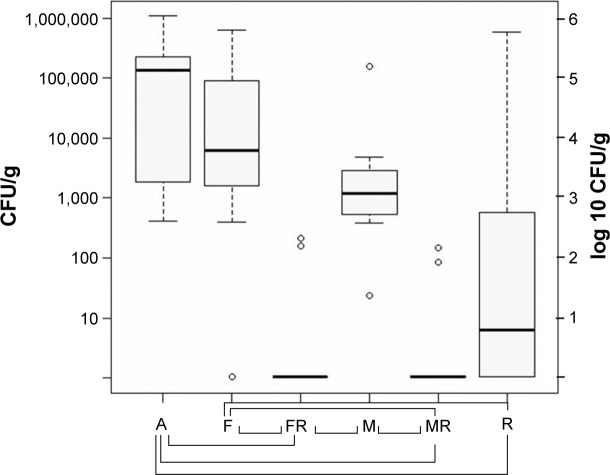
The efficacy of antibiotic monotherapy and combination therapy in the treatment of implant-associated infection by was evaluated in an animal study. The femoral medullary cavity of 66 male Wistar rats was contaminated with (ATCC 29213) and a metal device was implanted, of which 61 could be evaluated. Six treatment groups were studied: flucloxacillin, flucloxacillin in combination with rifampin, moxifloxacin, moxifloxacin in combination with rifampin, rifampin, and a control group with aqua. The treatment was applied for 14 days. After euthanasia, the bacterial counts in the periprosthetic bone, the soft tissue, and the implant-associated biofilm were measured. Both antibiotic combination treatments (moxifloxacin plus rifampin and flucloxacillin plus rifampin) achieved a highly significant decrease in microbial counts in the bone and soft tissue and in the biofilm. Mono-antibiotic treatments with either moxifloxacin or flucloxacillin were unable to achieve a significant decrease in microbial counts in bone and soft tissue or the biofilm, whilst rifampin was able to reduce the counts significantly only in the biofilm. Antibiotic resistance was measured in 1/3 of the cases in the rifampin group, whereas no resistance was measured in all other groups. The results show that combinations of both moxifloxacin and flucloxacillin plus rifampin are adequate for the treatment of periprosthetic infections due to infections with , whereas monotherapies are not effective or not applicable due to the rapid development of antibiotic resistance. Therefore, moxifloxacin is an effective alternative in combination with rifampin for the treatment of implant-associated infections.
在一项动物研究中评估了抗生素单一疗法和联合疗法治疗植入物相关感染的疗效。66只雄性Wistar大鼠的股骨髓腔被金黄色葡萄球菌(ATCC 29213)污染,并植入金属装置,其中61只可进行评估。研究了六个治疗组:氟氯西林、氟氯西林联合利福平、莫西沙星、莫西沙星联合利福平、利福平以及用生理盐水的对照组。治疗持续14天。安乐死后,测量假体周围骨、软组织和植入物相关生物膜中的细菌计数。两种抗生素联合治疗(莫西沙星加利福平以及氟氯西林加利福平)均使骨、软组织和生物膜中的微生物计数显著大幅下降。单用莫西沙星或氟氯西林的单一抗生素治疗无法使骨、软组织或生物膜中的微生物计数显著下降,而利福平仅能使生物膜中的计数显著降低。在利福平组1/3的病例中检测到抗生素耐药性,而在所有其他组中均未检测到耐药性。结果表明,莫西沙星以及氟氯西林加利福平的联合用药适用于治疗由金黄色葡萄球菌感染引起的假体周围感染,而单一疗法由于抗生素耐药性的快速发展无效或不适用。因此,莫西沙星与利福平联合是治疗植入物相关感染的有效替代方案。