Uppalapati Chandana K, Gutierrez Kimberley D, Buss-Valley Gina, Katzif Sam
Department of Microbiology and Immunology, Midwestern University, Glendale, AZ, 85308, USA.
Department of Immunology, University of Washington, Seattle, WA, 98109, USA.
BMC Res Notes. 2017 Jun 27;10(1):232. doi: 10.1186/s13104-017-2557-1.
Research involving the cold shock gene cspA of the medically important bacterium Staphylococcus aureus is steadily increasing as the relationships between the activity of this gene at 37 °C and a spectrum of virulence factors (e.g., biofilm formation, capsule production) as well as stress-related genes (e.g., alkaline shock protein, asp-23 and the alternative sigma factor, sigB) are distinguished. Fundamental to each of these discoveries is defining the regulation of cspA and the production of its protein product CspA.
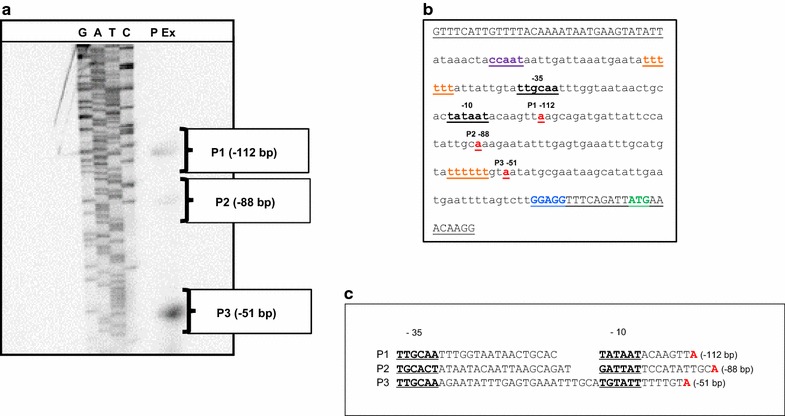
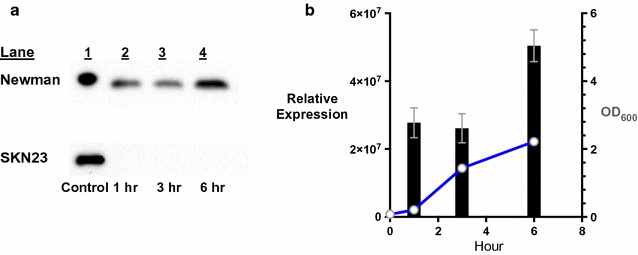
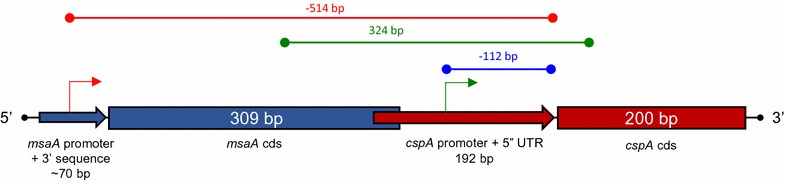
In this paper, primer extension analysis was used to identify a transcriptional start point at 112 bp upstream of the initiation codon of the cspA coding sequence from S. aureus Newman RNA collected at 37 °C. Based on the location of the putative -10 and -35 sites as well as putative cold shock protein binding sites, a 192 bp sequence containing an 80 bp promoter + a 112 bp 5' UTR was generated by polymerase chain reaction. The activity of this 192 bp sequence was confirmed in a pLL38 promoter::xylE reporter gene construct. In addition, Western blots were used to confirm the production of CspA at 37 °C and demonstrated that production of the protein was not constitutive but showed growth-dependent production with a significant increase at the 6 h time point.
The results presented identify another regulatory region for the cold shock gene cspA of S. aureus and show growth-dependent activity of both this cspA regulatory sequence, presented as a 192 bp sequence of promoter + 5' UTR and the production of the CspA protein at 37 °C. The presence of two active transcription start points, a -112 bp sequence defined in this work and a second previously defined at -514 bp upstream of the cspA initiation codon, suggests the possibility of interactions between these two regions in the regulation of cspA. The growth-dependent production of the cold shock protein CspA supports the availability of this protein to be a modulator of virulence and stress factor genes at 37 °C.
随着医学上重要的细菌金黄色葡萄球菌的冷休克基因cspA在37°C时的活性与一系列毒力因子(如生物膜形成、荚膜产生)以及应激相关基因(如碱性休克蛋白、asp - 23和替代西格玛因子sigB)之间的关系被明确,涉及该基因的研究正在稳步增加。这些发现的基础是确定cspA的调控及其蛋白质产物CspA的产生。
在本文中,引物延伸分析用于从37°C收集的金黄色葡萄球菌纽曼RNA中鉴定cspA编码序列起始密码子上游112 bp处的转录起始点。基于推定的 -10和 -35位点以及推定的冷休克蛋白结合位点的位置,通过聚合酶链反应生成了一个192 bp的序列,其中包含一个80 bp的启动子 + 一个112 bp的5'非翻译区。该192 bp序列的活性在pLL38启动子::xylE报告基因构建体中得到证实。此外,蛋白质免疫印迹用于确认37°C时CspA的产生,并表明该蛋白质的产生不是组成型的,而是显示出与生长相关的产生,在6小时时间点有显著增加。
本文给出的结果确定了金黄色葡萄球菌冷休克基因cspA的另一个调控区域,并显示了该cspA调控序列(以192 bp的启动子 + 5'非翻译区序列表示)以及37°C时CspA蛋白产生的生长依赖性活性。存在两个活性转录起始点,一个是本研究中定义的 -112 bp序列,另一个是先前在cspA起始密码子上游 -514 bp处定义的,这表明这两个区域在cspA调控中可能存在相互作用。冷休克蛋白CspA与生长相关的产生支持了该蛋白在37°C时作为毒力和应激因子基因调节剂的可用性。