Département d'Anesthésie et Réanimation, APHP Hôpital Tenon, 4 rue de la Chine, 75020, Paris, France.
APHP Hôpital Tenon, Unité de Réanimation Médico-Chirurgicale, Paris, France.
Crit Care. 2017 Jun 28;21(1):161. doi: 10.1186/s13054-017-1746-6.
Rapid diagnostic tests detecting microbial resistance are needed for limiting the duration of inappropriateness of empirical antimicrobial therapy (EAT) in intensive care unit patients, besides reducing the use of broad-spectrum antibiotics. We hypothesized that the betaLACTA® test (BLT) could lead to early increase in the adequacy of antimicrobial therapy.
This was a case-control study. Sixty-one patients with BLT-guided adaptation of EAT were prospectively included, and then matched with 61 "controls" having similar infection characteristics (community or hospital-acquired, and source of infection), in whom EAT was conventionally adapted to antibiogram results. Endpoints were to compare the proportion of appropriate (primary endpoint) and optimal (secondary endpoint) antimicrobial therapies with each of the two strategies, once microbiological sample culture results were available.
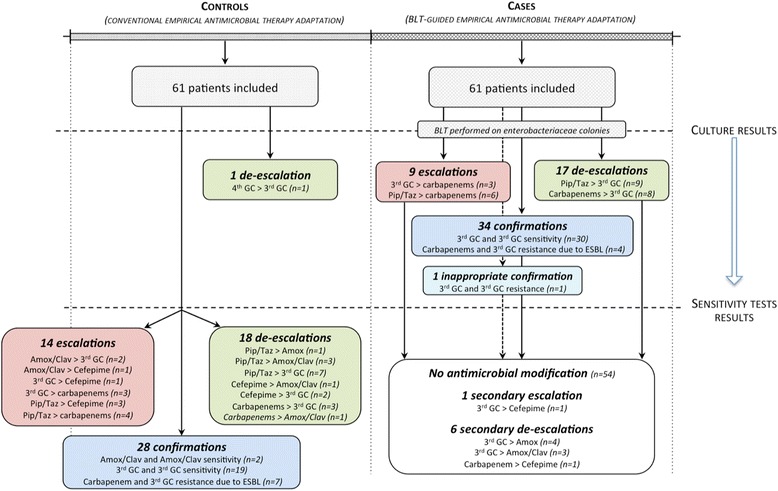
Characteristics of patients, infections and EAT at inclusion were similar between groups. Nine early escalations of EAT occurred in the BLT-guided adaptation group, reaching 98% appropriateness vs. 77% in the conventional adaptation group (p < 0.01). The BLT reduced the time until escalation of an inappropriate EAT from 50.5 (48-73) to 27 (24-28) hours (p < 0.01). Seventeen early de-escalations occurred in the BLT-guided adaptation group, compared to one in the conventional adaptation group, reducing patients' exposure to broad-spectrum beta-lactam such as carbapenems. In multivariate analysis, use of the BLT was strongly associated with early appropriate (OR = 18 (3.4-333.8), p = 0.006) and optimal (OR = 35.5 (9.6-231.9), p < 0.001) antimicrobial therapies. Safety parameters were similar between groups.
Our study suggests that a BLT-guided adaptation strategy may allow early beta-lactam adaptation from the first 24 hours following the beginning of sepsis management.
快速诊断检测微生物耐药性的测试对于限制重症监护病房患者经验性抗菌治疗(EAT)的不适当持续时间以及减少广谱抗生素的使用非常重要。我们假设 betaLACTA® 测试(BLT)可以导致抗菌治疗的充分性早期增加。
这是一项病例对照研究。前瞻性纳入了 61 例 BLT 指导的 EAT 适应性改变的患者,并与 61 例具有相似感染特征(社区或医院获得性,以及感染源)的“对照”患者相匹配,这些患者的 EAT 是根据抗生素药敏试验结果常规适应性改变的。主要终点是比较两种策略下,一旦获得微生物样本培养结果,适当(主要终点)和最佳(次要终点)抗菌治疗的比例。
两组患者的特征、感染和 EAT 纳入时相似。在 BLT 指导的适应性改变组中,有 9 例早期升级 EAT,达到 98%的适当性,而常规适应性改变组为 77%(p<0.01)。BLT 将不适当 EAT 升级的时间从 50.5 小时(48-73 小时)缩短到 27 小时(24-28 小时)(p<0.01)。BLT 指导的适应性改变组中有 17 例早期降级,而常规适应性改变组只有 1 例,减少了患者暴露于广谱β-内酰胺类抗生素,如碳青霉烯类抗生素。多变量分析显示,BLT 的使用与早期适当(OR=18(3.4-333.8),p=0.006)和最佳(OR=35.5(9.6-231.9),p<0.001)抗菌治疗密切相关。两组的安全性参数相似。
我们的研究表明,BLT 指导的适应性策略可能允许在脓毒症管理开始后的头 24 小时内早期调整β-内酰胺类药物。