Department of Oncology, Jinan Central Hospital, Shandong University, Jinan, Shandong 250013, P.R. China.
Soochow University College of Medicine, Suzhou, Jiangsu 215000, P.R. China.
Mol Med Rep. 2017 Aug;16(2):1643-1652. doi: 10.3892/mmr.2017.6830. Epub 2017 Jun 21.
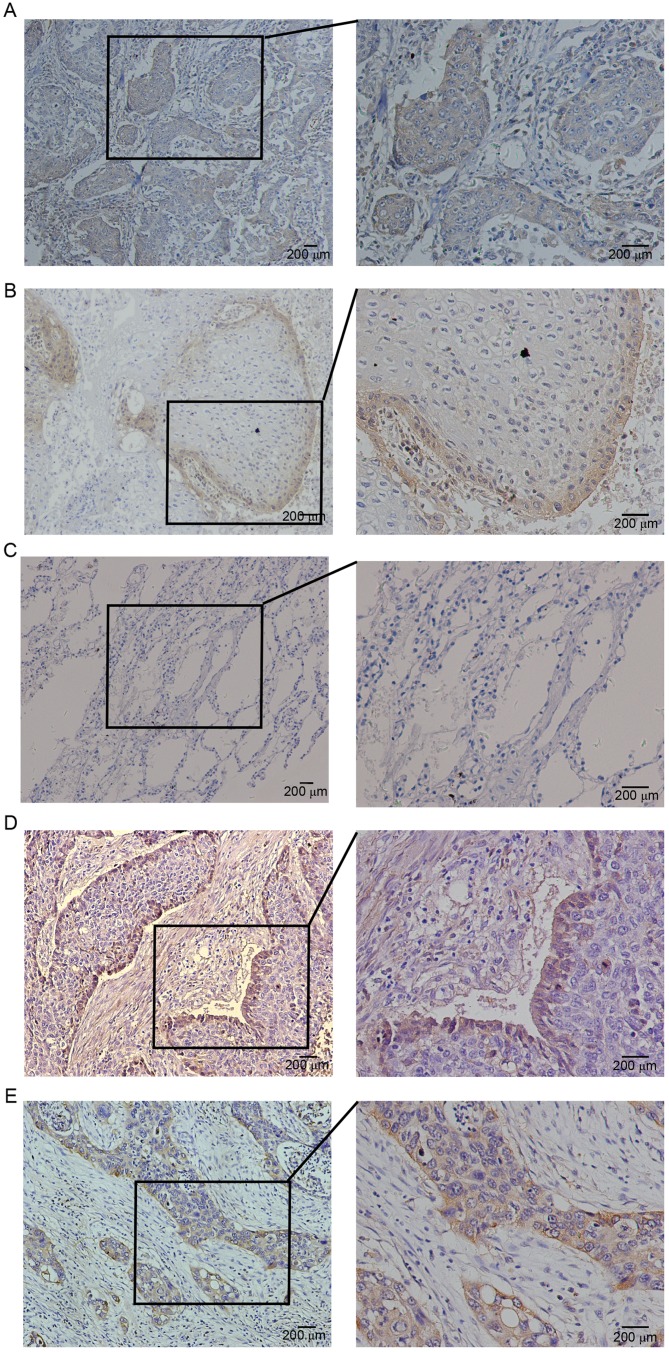
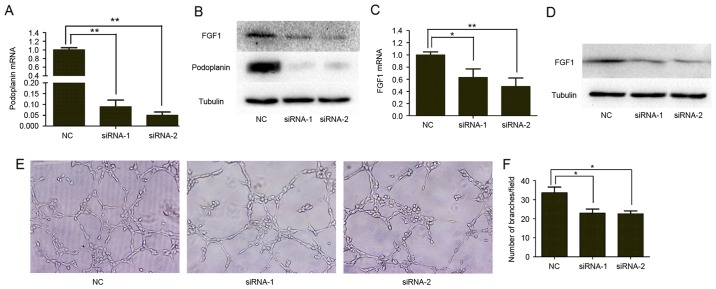
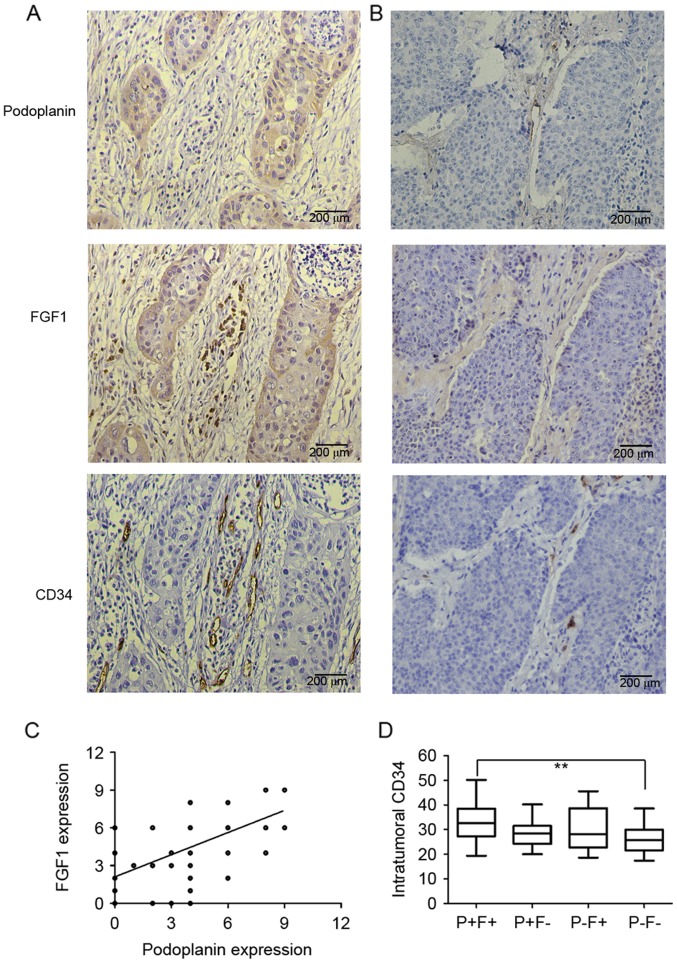
Podoplanin and fibroblast growth factor (FGF) 1 have been detected more frequently in lung squamous cell carcinoma (SQCC) compared with lung adenocarcinoma. Furthermore, it has been previous demonstrated that FGF1 is located on the edge of tumor nests in certain lung SQCC sections, which resembles the characteristic expression pattern of podoplanin. Podoplanin and FGF1 have roles in lymphangiogenesis and angiogenesis. Based on their consistently specific expression in lung SQCC and similar localization patterns, the present study aimed to investigate whether the expression of podoplanin in tumor cells is correlated with FGF1 expression in lung SQCC and whether their co‑expression has clinicopathological significance, particularly for lymphangiogenesis/angiogenesis. The correlation between podoplanin and FGF1 expression in tumor cells of 82 lung SQCC cases was investigated by immunohistochemical staining and the association between the co‑expression of podoplanin and FGF1, and clinicopathological factors such as microvessel density (MVD), was examined in these samples. In addition, the prognostic value of co‑expression of podoplanin and FGF1 in tumor cells was determined, and the regulation of FGF1 expression and angiogenesis by podoplanin was examined in vitro in a human lung SQCC cell line. Immunohistochemical analysis demonstrated that there was a significant correlation between podoplanin and FGF1 expression in lung SQCC tumor cells (R=0.591; P<0.0001). Co‑expression of podoplanin and FGF1 was significantly associated with larger primary tumor size, advanced TNM stage and higher intratumoral MVD. Survival analysis demonstrated that cases with podoplanin and FGF1 double‑positive staining had a significantly lower survival rate compared with cases with double‑negative staining. In vitro experiments revealed that podoplanin regulated FGF1 expression and affected tube formation of human umbilical vein endothelial cells. Combined, the results demonstrated that podoplanin was co‑expressed with FGF1 in lung SQCC and this co‑expression was correlated with poor prognosis.
在肺鳞状细胞癌(SQCC)中,与肺腺癌相比,波形蛋白和纤维母细胞生长因子(FGF)1 的表达更为频繁。此外,先前的研究表明,在某些肺 SQCC 切片的肿瘤巢边缘存在 FGF1,其类似于波形蛋白的特征性表达模式。波形蛋白和 FGF1 在淋巴管生成和血管生成中起作用。基于它们在肺 SQCC 中一致的特异性表达和类似的定位模式,本研究旨在探讨肿瘤细胞中波形蛋白的表达是否与肺 SQCC 中的 FGF1 表达相关,以及它们的共表达是否具有临床病理意义,特别是在淋巴管生成/血管生成方面。通过免疫组织化学染色检测 82 例肺 SQCC 病例肿瘤细胞中波形蛋白和 FGF1 的表达相关性,并在这些样本中检查波形蛋白和 FGF1 共表达与微血管密度(MVD)等临床病理因素之间的关联。此外,还确定了肿瘤细胞中波形蛋白和 FGF1 共表达的预后价值,并在人肺 SQCC 细胞系中研究了波形蛋白对 FGF1 表达和血管生成的调节作用。免疫组织化学分析表明,肺 SQCC 肿瘤细胞中存在波形蛋白和 FGF1 表达的显著相关性(R=0.591;P<0.0001)。波形蛋白和 FGF1 的共表达与较大的原发肿瘤大小、较晚的 TNM 分期和较高的肿瘤内 MVD 显著相关。生存分析表明,与双阴性染色病例相比,波形蛋白和 FGF1 双阳性染色病例的生存率显著降低。体外实验表明,波形蛋白调节 FGF1 表达并影响人脐静脉内皮细胞的管形成。综合结果表明,在肺 SQCC 中,波形蛋白与 FGF1 共表达,这种共表达与预后不良相关。