Department of Rheumatology and Immunology, West China Hospital of Sichuan University, Chengdu, Sichuan 610041, P.R. China.
Department of Rheumatology and Immunology, The First Affiliated Hospital of Sichuan Medical University, Luzhou, Sichuan 646000, P.R. China.
Mol Med Rep. 2017 Aug;16(2):1801-1809. doi: 10.3892/mmr.2017.6839. Epub 2017 Jun 22.
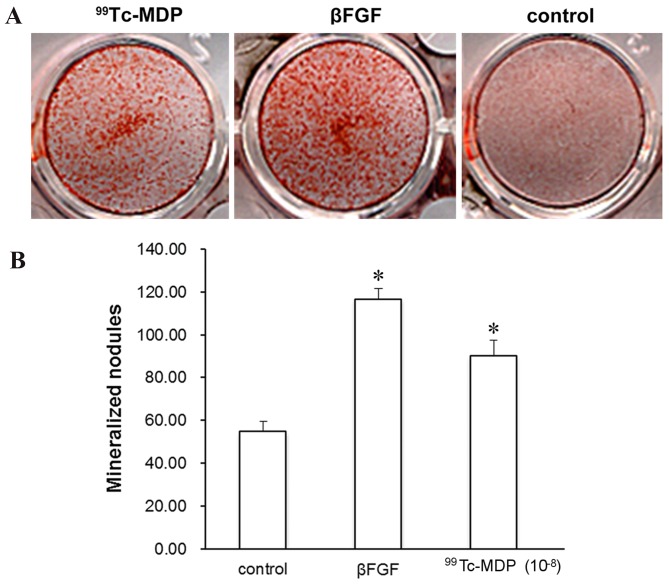
The aim of the present study was to examine the influence of technetium methylenediphosphonate (99Tc-MDP) on the proliferation and differentiation of human osteoblasts. Human iliac cancellous bone was isolated and cultured with either 99Tc‑MDP, β fibroblast growth factor (as a positive control) or medium only (as a negative control). Proliferation was assessed by direct cell counting, CCK‑8 assay and bromodeoxyuridine staining. The cell cycle and rate of apoptosis was assessed by propidium iodide staining and flow cytometry. Alkaline phosphatase (ALP) activity was assessed by the p‑nitrophenyl phosphate method and mineralized nodules were stained with Alizarin Red. Expression of osteocalcin (OCN) and bone morphogenetic protein‑2 (BMP‑2) was assessed by reverse transcription‑quantitative polymerase chain reaction (RT‑qPCR), and expression levels of osteoprotegerin (OPG) and receptor activator of NF‑κB ligand (RANKL) were assessed by RT‑qPCR and ELISA. Isolated human osteoblasts stained positively for ALP and developed mineralized nodules. Treatment with 10‑5‑10‑10 M 99Tc‑MDP enhanced proliferation and 48 h incubation with 10‑8 M 99Tc‑MDP increased the proportion of cells in S‑phase, decreased the proportion in G0/G1 phase, and increased the cell proliferation index. The rate of apoptosis also increased, but the increase was not significant. Cells incubated with 10‑6‑10‑9 M 99Tc‑MDP for 3‑9 days exhibited increased ALP activity and mineralized nodule development. 10‑8 M 99Tc‑MDP increased BMP‑2 and OPG expression levels and OPG secretion, but OCN mRNA expression levels and RANKL secretion were not significantly altered at 72 h. 99Tc‑MDP treatment induced osteoblast proliferation and differentiation without affecting apoptosis. These findings provide proof of concept for the future use of 99Tc‑MDP in the treatment of bone‑destructive diseases.
本研究旨在探讨锝亚甲基二膦酸盐(99Tc-MDP)对人成骨细胞增殖和分化的影响。分离人髂骨松质骨,分别用 99Tc-MDP、β成纤维细胞生长因子(阳性对照)或培养基(阴性对照)培养。通过直接细胞计数、CCK-8 测定和溴脱氧尿苷染色评估增殖。通过碘化丙啶染色和流式细胞术评估细胞周期和凋亡率。碱性磷酸酶(ALP)活性通过对硝基苯磷酸法评估,矿化结节用茜素红染色。通过逆转录定量聚合酶链反应(RT-qPCR)评估骨钙素(OCN)和骨形态发生蛋白-2(BMP-2)的表达,通过 RT-qPCR 和酶联免疫吸附试验(ELISA)评估核因子-κB 受体激活剂配体(RANKL)和骨保护素(OPG)的表达水平。分离的人成骨细胞 ALP 染色阳性,并形成矿化结节。10-5-10-10 M 99Tc-MDP 处理增强增殖,48 h 孵育 10-8 M 99Tc-MDP 增加 S 期细胞比例,减少 G0/G1 期细胞比例,增加细胞增殖指数。凋亡率也增加,但增加不显著。用 10-6-10-9 M 99Tc-MDP 孵育 3-9 天的细胞显示 ALP 活性和矿化结节发育增加。10-8 M 99Tc-MDP 增加 BMP-2 和 OPG 表达水平和 OPG 分泌,但 72 h 时 OCN mRNA 表达水平和 RANKL 分泌没有明显改变。99Tc-MDP 处理诱导成骨细胞增殖和分化,而不影响凋亡。这些发现为 99Tc-MDP 在治疗骨破坏性疾病中的未来应用提供了概念验证。