Marek Rachel F, Thorne Peter S, Herkert Nicholas J, Awad Andrew M, Hornbuckle Keri C
Department of Occupational and Environmental Health, The University of Iowa , 100 CPHB, S341A, 145 N. Riverside Dr., Iowa City, Iowa 52242, United States.
Environ Sci Technol. 2017 Jul 18;51(14):7853-7860. doi: 10.1021/acs.est.7b01910. Epub 2017 Jun 28.
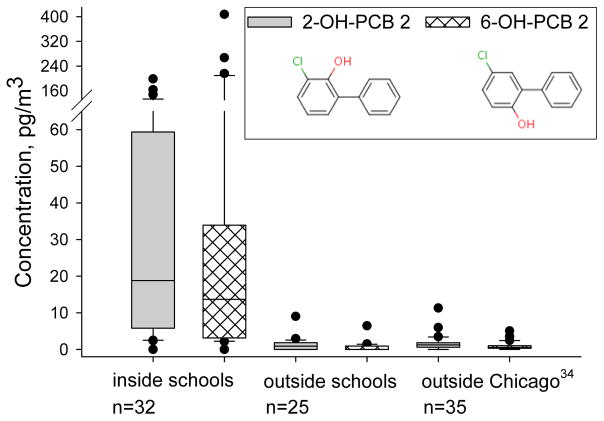
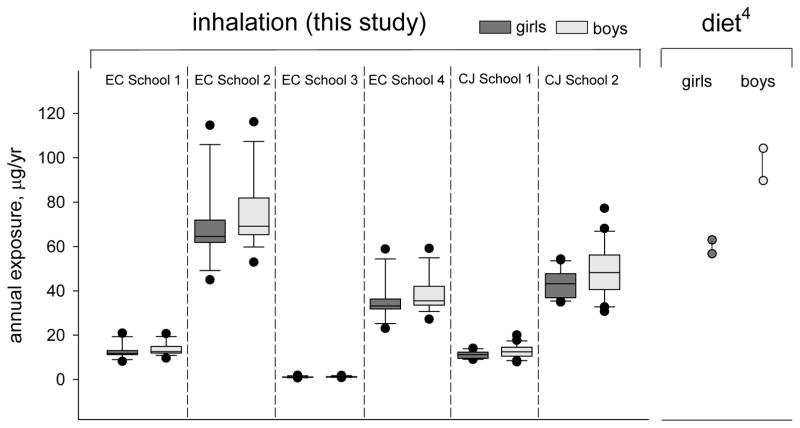
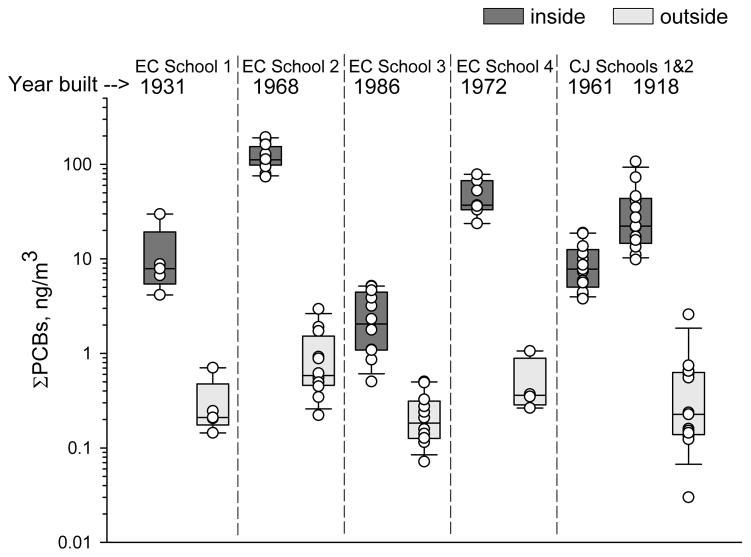
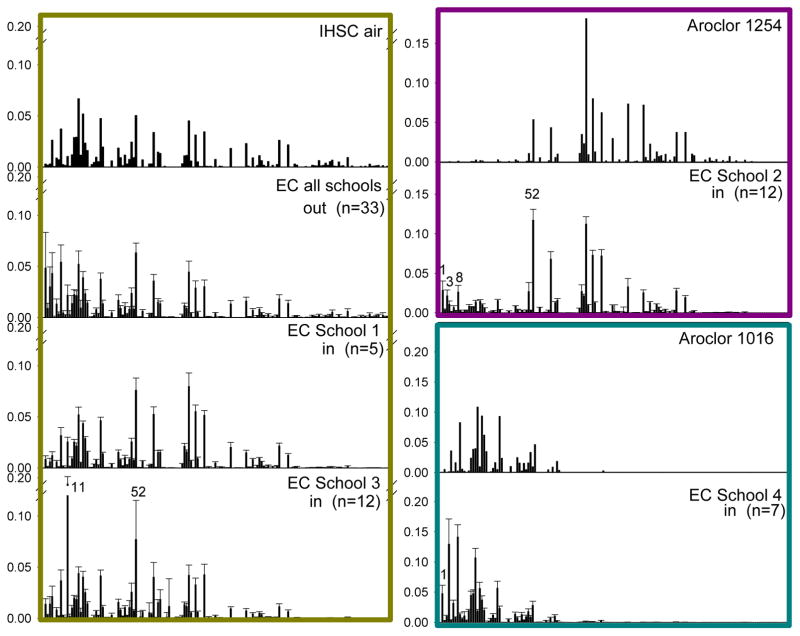
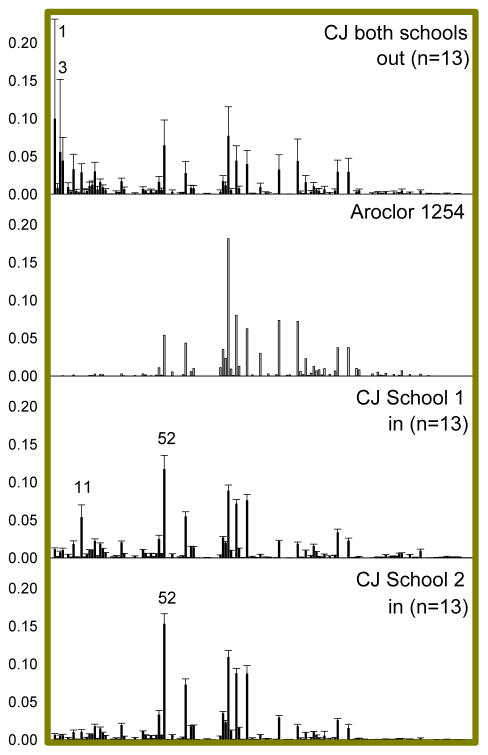
PCBs appear in school air because many school buildings were built when PCBs were still intentionally added to building materials and because PCBs are also present through inadvertent production in modern pigment. This is of concern because children are especially vulnerable to the toxic effects of PCBs. Here we report indoor and outdoor air concentrations of PCBs and OH-PCBs from two rural schools and four urban schools, the latter near a PCB-contaminated waterway of Lake Michigan in the United States. Samples (n = 108) were collected as in/out pairs using polyurethane foam passive air samplers (PUF-PAS) from January 2012 to November 2015. Samples were analyzed using GC/MS-MS for all 209 PCBs and 72 OH-PCBs. Concentrations inside schools were 1-2 orders of magnitude higher than outdoors and ranged from 0.5 to 194 ng/m (PCBs) and from 4 to 665 pg/m (OH-PCBs). Congener profiles were similar within each sampling location across season but different between schools and indicated the sources as Aroclors from building materials and individual PCBs associated with modern pigment. This study is the first cohort-specific analysis to show that some children's PCB inhalation exposure may be equal to or higher than their exposure through diet.
多氯联苯出现在学校空气中,是因为许多学校建筑是在多氯联苯仍被有意添加到建筑材料时建造的,还因为多氯联苯也通过现代颜料中的无意生产而存在。这令人担忧,因为儿童尤其容易受到多氯联苯毒性影响。在此我们报告了两所农村学校和四所城市学校室内和室外空气中多氯联苯及羟基多氯联苯的浓度,后者位于美国密歇根湖一条受多氯联苯污染的水道附近。2012年1月至2015年11月期间,使用聚氨酯泡沫被动空气采样器(PUF - PAS)以进出对的形式采集了样本(n = 108)。使用气相色谱/质谱 - 质谱联用仪对所有209种多氯联苯和72种羟基多氯联苯进行了分析。学校内的浓度比室外高1 - 2个数量级,范围为0.5至194纳克/立方米(多氯联苯)和4至665皮克/立方米(羟基多氯联苯)。在每个采样地点,同系物分布在不同季节相似,但在不同学校之间不同,表明其来源为建筑材料中的氯丹以及与现代颜料相关的个别多氯联苯。这项研究是首次针对特定人群的分析,表明一些儿童通过吸入多氯联苯的暴露量可能等于或高于通过饮食的暴露量。