Colombelli Andrea, Belluati Alberto, Rizqallah Yousef, Guerra Giovanni, Busatto Carlo
.
Acta Biomed. 2017 Jun 7;88(2S):45-47. doi: 10.23750/abm.v88i2-S.6511.
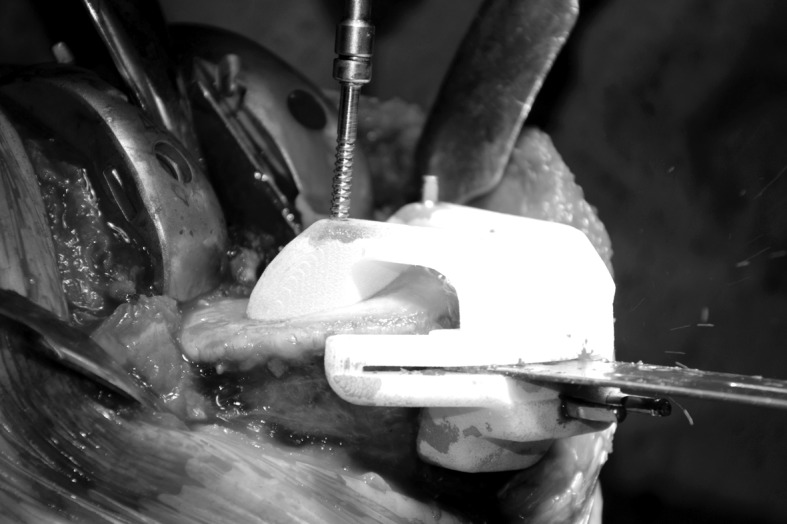
The international literature and analysis of the prosthetic registers highlight a significant relationship between the alignment of the components and the survival of prosthetic implants of the knee. The patient specific instrumentation (PSI) technology exploits the data obtained with the MRN for the production of cutting blocks (CB) useful to a TKA. Revisiting the recent international literature, comparing the results of the conventional method and PSI, numerous studies confirm a statistically significant difference of inliers (± 3 degrees) for HKA. The purpose of this retrospective study was to investigate whether these statistically significant difference is also present in our group.
Postoperative radiographic measures of alignment based on a mechanical limb axis (hip-knee-ankle angle, HKA) of 180° were sought. A range of 180° ± 3° varus/valgus was defined as optimal for mechanical axis.
The percentage of knees that had a HKA within ±3° of the desired value was 92.2.
the CB did accurately produce the desired HKA. The PS system is an effective and reproducible, whose organizational effort is fully justified.
国际文献及假体登记分析表明,膝关节假体组件的对线与假体植入物的存活之间存在显著关联。患者特异性器械(PSI)技术利用通过磁共振成像(MRN)获得的数据来生产对全膝关节置换术(TKA)有用的截骨模块(CB)。回顾近期国际文献,比较传统方法和PSI的结果,众多研究证实,髋膝踝角(HKA)的力线良好(±3度)存在统计学显著差异。本回顾性研究的目的是调查我们的研究组中是否也存在这些统计学显著差异。
基于180°的机械肢体轴线(髋膝踝角,HKA)进行术后对线的影像学测量。将180°±3°的内翻/外翻范围定义为机械轴线的最佳范围。
HKA在所需值±3°范围内的膝关节百分比为92.2。
截骨模块确实准确产生了所需的HKA。PSI系统是有效且可重复的,其组织工作完全合理。