Nakao Yoshio, Tanigawa Tohru, Shibata Rei
Department of Otolaryngology, Yoshida General Hospital, Hiroshima Department of Otolaryngology, Aichi Medical University, Aichi Department of Cardiology, Nagoya University, Nagoya, Japan.
Medicine (Baltimore). 2017 Jun;96(26):e7394. doi: 10.1097/MD.0000000000007394.
Tick infestation of the external auditory canal (EAC) constitutes <1% of all patients presenting with ear complaints. Consequently, parameters for the diagnosis and management of ticks in the EAC have not been established.
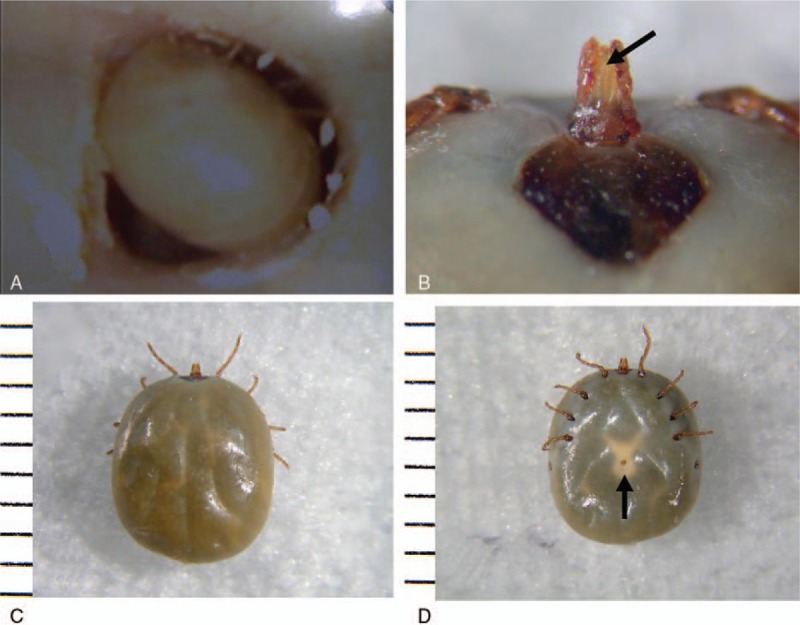
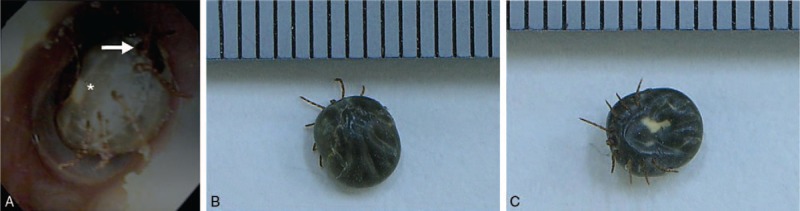
We report 2 cases of EAC infestation by Amblyomma testudinarium in 2 female patients, aged 12- and 72 years old.
In both patients, otoscopic examination revealed engorged ticks attached to the ear canal. The 12-year-old girl had a narrow EAC, necessitating slight dislodging of the tick to determine if its mouth parts were embedded in the EAC skin. The tick's mouth parts were confirmed to be free, enabling complete removal of the tick. The 72-year-old woman had a wide EAC, enabling tick removal using Hartman's forceps because the tick's mouth parts were confirmed to be free of the skin. Prophylactic tetracycline (200 mg/day) was administered to each patient for 7 days; neither showed any signs of fever or rash.
This report describes 2 patients with A testudinarium infestation of the EAC, and proposes a simple, noninvasive protocol for determining if the tick is anchored to the ear canal.
外耳道蜱虫感染在所有耳部不适患者中占比不到1%。因此,外耳道蜱虫的诊断和处理参数尚未确立。
我们报告了2例龟形花蜱感染外耳道的病例,患者为2名女性,年龄分别为12岁和72岁。
诊断、干预措施及结果:两名患者经耳镜检查均发现耳道内有饱血的蜱虫。12岁女孩的外耳道狭窄,需要稍微移动蜱虫以确定其口器是否嵌入外耳道皮肤。确认蜱虫口器未嵌入后,将蜱虫完整取出。72岁女性的外耳道较宽,确认蜱虫口器未与皮肤相连后,用哈特曼氏镊将蜱虫取出。每位患者均接受了7天的预防性四环素治疗(200毫克/天);两人均未出现发热或皮疹迹象。
本报告描述了2例龟形花蜱感染外耳道的患者,并提出了一种简单的非侵入性方案,用于确定蜱虫是否附着于耳道。