Liu Ye, Qingjuan Shang, Gao Zongwei, Deng Chun, Wang Yan, Guo Chunbao
Department of Neonatal, Children's Hospital, Chongqing Medical University, Chongqing Department of Pathology, Linyi People's Hospital, Linyi, Shandong Province Department of Pediatric General Surgery Ministry of Education Key Laboratory of Child Development and Disorders, Children's Hospital, Chongqing Medical University Department of Neonatology, Yongchuan Hospital, Chongqing Medical University, Chongqing, P.R. China.
Medicine (Baltimore). 2017 Jun;96(26):e7400. doi: 10.1097/MD.0000000000007400.
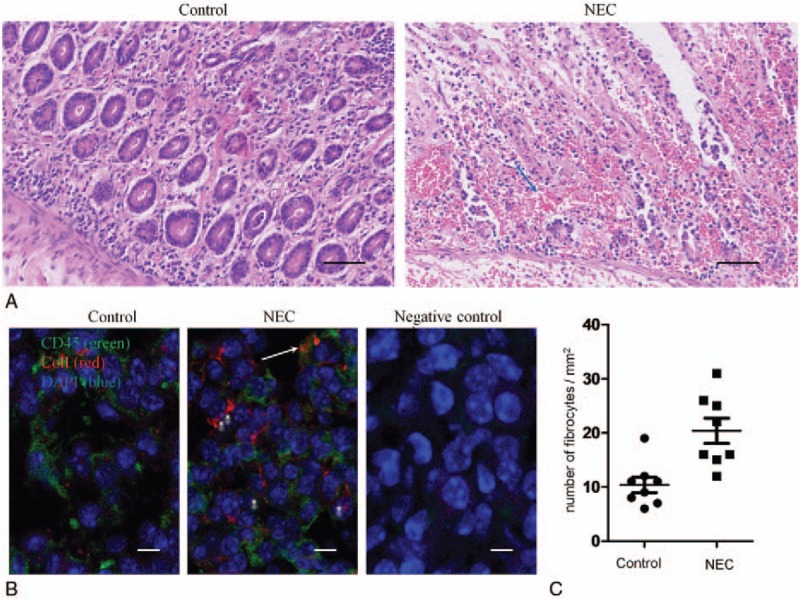
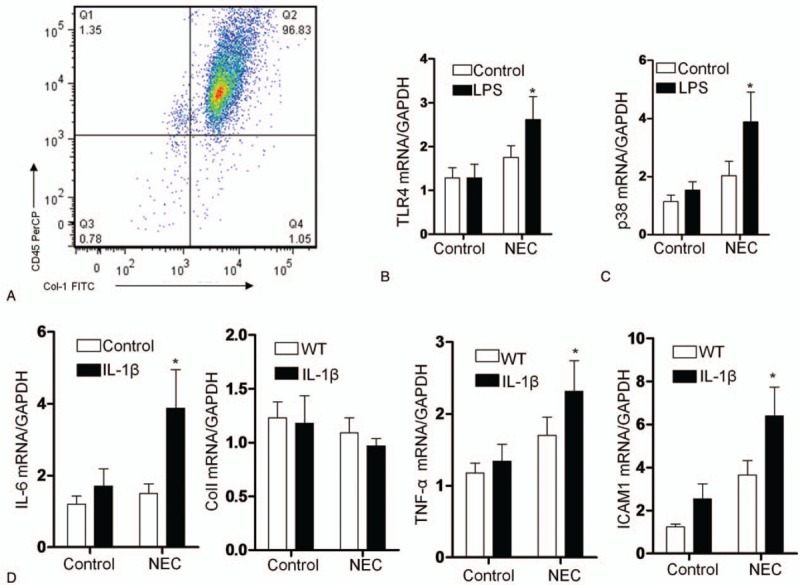
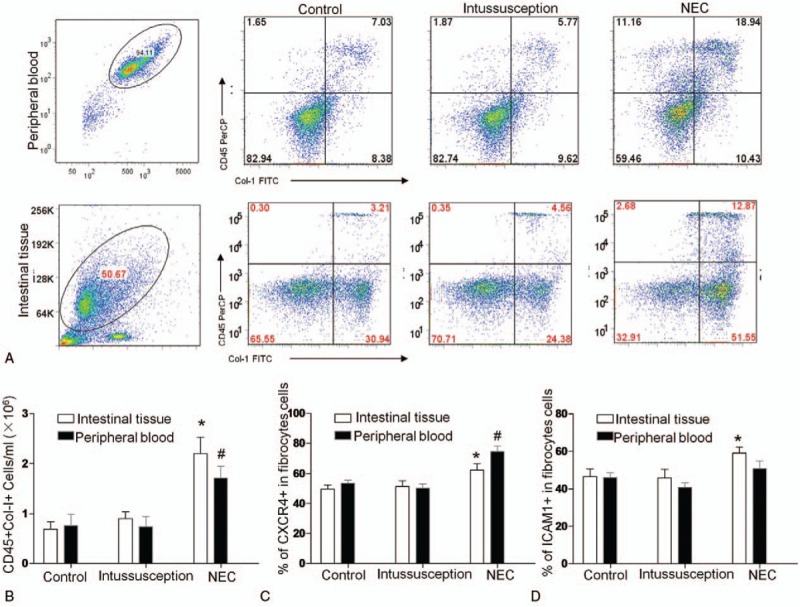
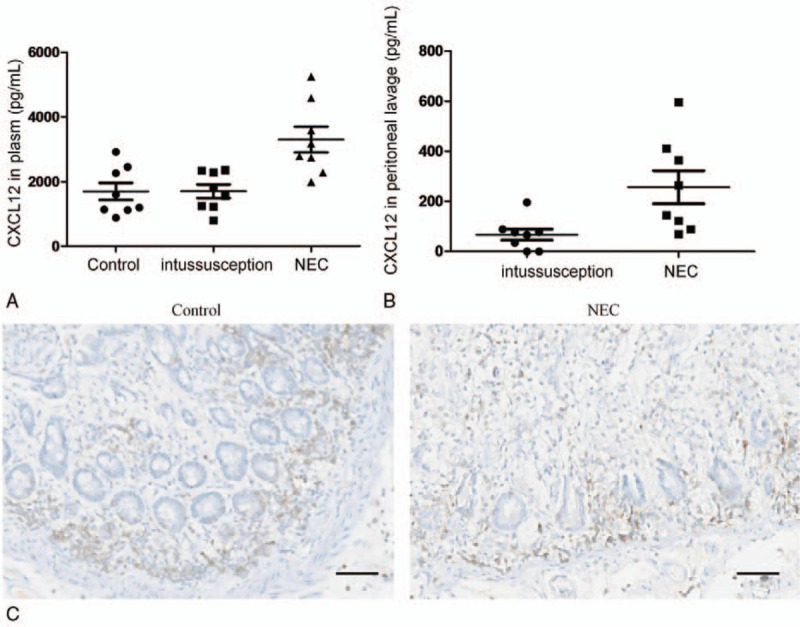
Fibrocytes, ahematopoietic stem cell source of fibroblasts/myofibroblasts, were previously implicated to infiltrate into the intestinal and enhance inflammation.The aims of the present study were to elucidate the role of fibrocytes in necrotizing enterocolitis (NEC) pathogenesis and to explore the mechanisms by which fibrocytes contributed to the inflammatory responses.We investigated circulating and intestinal local fibrocytes from 32 patients with NEC, 8 patients with noninflammatory conditions of the gastrointestinal tract and 12 normal subjects.Significantly higher numbers of circulating fibrocytes were found in the peripheral blood from NEC patients than the controls (P < .01). Numerous fibrocytes were found infiltrating the NEC intestinal mucous membranes. The percentage of fibrocytes to total leukocytes in the NEC inflammatory lesions was significantly increased compared with the percentage in the noninflammatory gastrointestinal tract. The fibrocyte attractant chemokine C-X-C motif chemokine ligand 12 (CXCL12) was significantly increased in the plasma and was detectable in 80% of the peritoneal lavage fluid from NEC patients but not the controls. Furthermore, chemokine expression was increased in fibrocytes infiltrating and trafficking to leukocyte sites. In culture, lipopolysaccharide (LPS) induced a significant increase in the expression of the Toll-like receptor (TLR4) signal, with the upregulation of p38 in both the isolated fibrocytes and macrophages. Similarly, interleukin (IL)-1β induced increased the upregulation of the IL-6, tumor necrosis factor (TNF)-α, and intercellular cell adhesion molecule-1 mRNAs but downregulated ColI in fibrocytes isolated from NEC patients compared with the controls.These findings indicate that circulating fibrocytes are increased in NEC patients and may be recruited to the inflammatory intestinal track, most likely through the CXCR4/CXCL12 axis. These cells may contribute to intestinal inflammation through TLR4 signaling by producing the TNF-α and IL-6 cytokines.
纤维细胞是成纤维细胞/肌成纤维细胞的造血干细胞来源,先前被认为会浸润肠道并加剧炎症。本研究的目的是阐明纤维细胞在坏死性小肠结肠炎(NEC)发病机制中的作用,并探索纤维细胞促成炎症反应的机制。我们调查了32例NEC患者、8例胃肠道非炎症性疾病患者和12名正常受试者的循环纤维细胞和肠道局部纤维细胞。发现NEC患者外周血中循环纤维细胞的数量明显高于对照组(P<0.01)。在NEC肠道黏膜中发现有大量纤维细胞浸润。与非炎症性胃肠道相比,NEC炎症病变中纤维细胞占总白细胞的百分比显著增加。纤维细胞趋化因子C-X-C基序趋化因子配体12(CXCL12)在血浆中显著增加,在80%的NEC患者腹腔灌洗液中可检测到,但在对照组中未检测到。此外,趋化因子在浸润并转运至白细胞部位的纤维细胞中表达增加。在培养中,脂多糖(LPS)诱导Toll样受体(TLR4)信号表达显著增加,分离的纤维细胞和巨噬细胞中的p38均上调。同样,与对照组相比,白细胞介素(IL)-1β诱导NEC患者分离的纤维细胞中IL-6、肿瘤坏死因子(TNF)-α和细胞间细胞黏附分子-1 mRNA上调,但ColI下调。这些发现表明,NEC患者的循环纤维细胞增加,可能通过CXCR4/CXCL12轴被招募到炎症肠道。这些细胞可能通过产生TNF-α和IL-6细胞因子,通过TLR4信号传导促进肠道炎症。