Aoyagi Tomo, Hamai Takaya, Hori Tomoyuki, Sato Yuki, Kobayashi Mikio, Sato Yuya, Inaba Tomohiro, Ogata Atsushi, Habe Hiroshi, Sakata Takeshi
Environmental Management Research Institute, National Institute of Advanced Industrial Science and Technology (AIST), 16-1 Onogawa, Tsukuba, Ibaraki, 305-8569, Japan.
Metals Technology Center, Japan Oil, Gas and Metals National Corporation (JOGMEC), 9-3 Furudate, Kosaka-kozan, Kosaka, Akita, 017-0202, Japan.
AMB Express. 2017 Dec;7(1):142. doi: 10.1186/s13568-017-0440-z. Epub 2017 Jun 27.
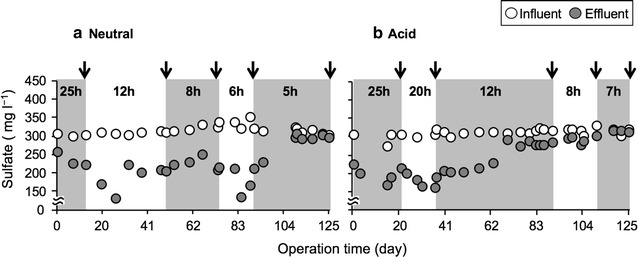
For acceleration of removing toxic metals from acid mine drainage (AMD), the effects of hydraulic retention time (HRT) and pH on the reactor performance and microbial community structure in the depth direction of a laboratory-scale packed-bed bioreactor containing rice bran as waste organic material were investigated. The HRT was shortened stepwise from 25 to 12 h, 8 h, and 6 to 5 h under the neutral condition using AMD neutralized with limestone (pH 6.3), and from 25 to 20 h, 12 h, and 8 to 7 h under the acid condition using AMD (pH 3.0). Under the neutral condition, the bioreactor stably operated up to 6 h HRT, which was shorter than under the acid condition (up to 20 h HRT). During stable sulfate reduction, both the organic matter-remaining condition and the low oxidation-reduction potential condition in lower parts of the reactor were observed. Principal coordinate analysis of Illumina sequencing data of 16S rRNA genes revealed a dynamic transition of the microbial communities at the boundary between stable and unstable operation in response to reductions in HRT. During stable operation under both the neutral and acid conditions, several fermentative operational taxonomic units (OTUs) from the phyla Firmicutes and Bacteroidetes dominated in lower parts of the bioreactor, suggesting that co-existence of these OTUs might lead to metabolic activation of sulfate-reducing bacteria. In contrast, during unstable operation at shorter HRTs, an OTU from the candidate phylum OP11 were found under both conditions. This study demonstrated that these microorganisms can be used to monitor the treatment of AMD, which suggests stable or deteriorated performance of the system.
为了加速从酸性矿山排水(AMD)中去除有毒金属,研究了水力停留时间(HRT)和pH对以米糠为废弃有机材料的实验室规模填充床生物反应器深度方向上的反应器性能和微生物群落结构的影响。在中性条件下,使用用石灰石中和的AMD(pH 6.3),HRT从25小时逐步缩短至12小时、8小时以及6至5小时;在酸性条件下,使用AMD(pH 3.0),HRT从25小时逐步缩短至20小时、12小时以及8至7小时。在中性条件下,生物反应器在HRT为6小时时仍能稳定运行,这比在酸性条件下(HRT可达20小时)运行时间短。在稳定的硫酸盐还原过程中,观察到反应器下部存在有机物残留条件和低氧化还原电位条件。对16S rRNA基因的Illumina测序数据进行主坐标分析,结果显示随着HRT的降低,微生物群落在稳定和不稳定运行的边界处发生了动态转变。在中性和酸性条件下的稳定运行期间,来自厚壁菌门和拟杆菌门的几个发酵操作分类单元(OTU)在生物反应器下部占主导地位,这表明这些OTU的共存可能导致硫酸盐还原菌的代谢激活。相比之下,在较短HRT下的不稳定运行期间,在两种条件下均发现了来自候选门OP11的一个OTU。本研究表明,这些微生物可用于监测AMD的处理情况,这意味着系统性能稳定或恶化。