Sato Toshiyuki, Takagawa Tetsuya, Kakuta Yoichi, Nishio Akihiro, Kawai Mikio, Kamikozuru Koji, Yokoyama Yoko, Kita Yuko, Miyazaki Takako, Iimuro Masaki, Hida Nobuyuki, Hori Kazutoshi, Ikeuchi Hiroki, Nakamura Shiro
Division of Internal Medicine, Department of Inflammatory Bowel Disease, Hyogo College of Medicine, Nishinomiya, Japan.
Department of Intestinal Inflammation Research, Hyogo College of Medicine, Nishinomiya, Japan.
Intest Res. 2017 Jul;15(3):328-337. doi: 10.5217/ir.2017.15.3.328. Epub 2017 Jun 12.
BACKGROUND/AIMS: Recent genome-wide analyses have provided strong evidence concerning adverse events caused by thiopurine drugs such as azathioprine (AZA) and 6-mercaptopurine. The strong associations identified between p.Arg139Cys and thiopurine-induced leukopenia and severe hair loss have been studied and confirmed over the last 2 years. However, other coding variants, including p.Val18_Val19insGlyVal, p.Val18Ile, and p.Ala134Thr, and a noncoding variation in (rs2834826) remain to be examined in detail in this respect. Therefore, we investigated the correlation between these adverse events and the 5 recently identified variants mentioned above among Japanese patients with inflammatory bowel diseases (IBD).
One hundred sixty thiopurine-treated patients with IBD were enrolled. Genotyping was performed using TaqMan SNP Genotyping Assays or Sanger sequencing.
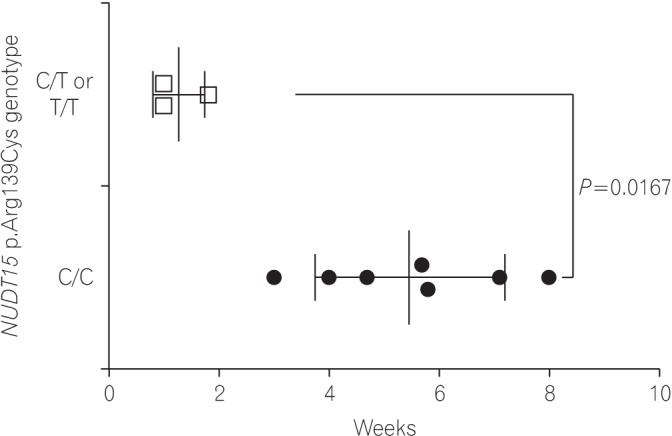
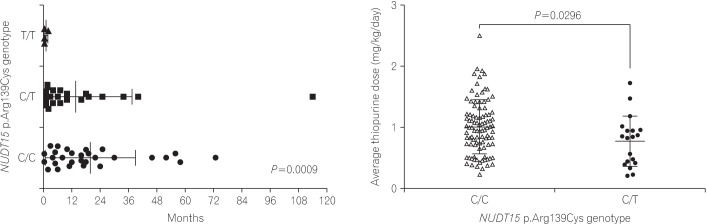
None of the 5 variants were associated with gastrointestinal intolerance to AZA. However, p.Arg139Cys was significantly associated with the interval between initiation and discontinuation of AZA among patients with gastrointestinal intolerance. This variant was strongly associated with early (<8 weeks) and late (≥8 weeks) leukopenia and severe hair loss. Moreover, it correlated with the interval between initiation of thiopurine therapy and leukopenia occurrence, and average thiopurine dose. p.Val18_Val19insGlyVal, p.Val18Ile, p.Ala134Thr, and rs2834826 exhibited no significant relationship with the adverse events examined.
Of the 5 variants investigated, p.Arg139Cys had the strongest impact on thiopurine-induced leukopenia and severe hair loss; therefore, its genotyping should be prioritized over that of other variants in efforts to predict these adverse events in Japanese patients with IBD.
背景/目的:近期全基因组分析为硫唑嘌呤(AZA)和6-巯基嘌呤等硫嘌呤类药物所致不良事件提供了有力证据。过去两年对p.Arg139Cys与硫嘌呤诱导的白细胞减少和严重脱发之间的强关联进行了研究并得到证实。然而,其他编码变异,包括p.Val18_Val19insGlyVal、p.Val18Ile和p.Ala134Thr,以及(rs2834826)处的非编码变异,在这方面仍有待详细研究。因此,我们调查了日本炎症性肠病(IBD)患者中这些不良事件与上述最近鉴定的5种变异之间的相关性。
纳入160例接受硫嘌呤治疗的IBD患者。使用TaqMan SNP基因分型检测法或桑格测序法进行基因分型。
5种变异均与对AZA的胃肠道不耐受无关。然而,在有胃肠道不耐受的患者中,p.Arg139Cys与AZA开始使用至停用的间隔时间显著相关。该变异与早期(<8周)和晚期(≥8周)白细胞减少及严重脱发密切相关。此外,它与硫嘌呤治疗开始至白细胞减少发生的间隔时间以及硫嘌呤平均剂量相关。p.Val18_Val19insGlyVal、p.Val18Ile、p.Ala134Thr和rs2834826与所检查的不良事件无显著关系。
在所研究的5种变异中,p.Arg139Cys对硫嘌呤诱导的白细胞减少和严重脱发影响最大;因此,在预测日本IBD患者的这些不良事件时,对其进行基因分型应优先于其他变异。