Kim Yoonji
Department of Orthodontics, Seoul St. Mary's Hospital, College of Medicine, The Catholic University of Korea, Seoul, Korea.
Korean J Orthod. 2017 Jul;47(4):215-221. doi: 10.4041/kjod.2017.47.4.215. Epub 2017 May 26.
This questionnaire study aimed to estimate the overall frequencies of positive perception towards orthodontic treatment among adults categorized according to age, sex, and area of living, and to identify barriers or negative perceptions preventing them from receiving orthodontic treatment.
The participants included 598 adults aged over 20 years (230 men and 368 women) who visited the Dental Hospital of Seoul St. Mary's Hospital. The participants' opinions regarding their consideration of receiving orthodontic treatment were recorded using a specially designed questionnaire.
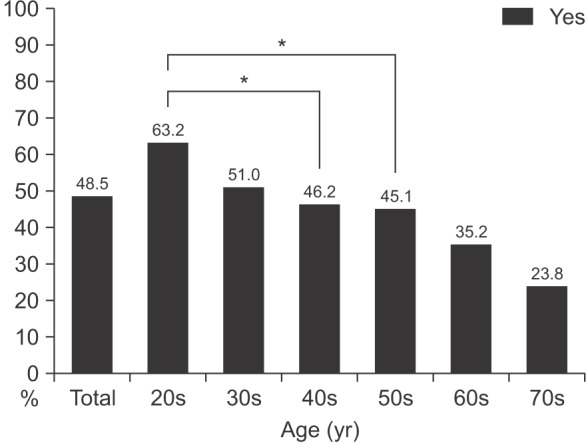
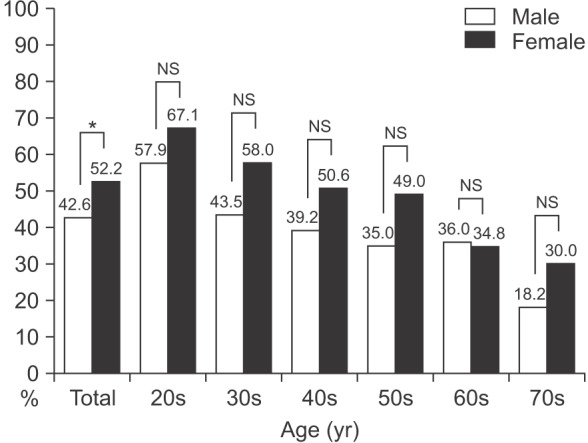
The overall rate of positive perception towards orthodontic treatment was 48.5%. Compared to adults in their 20s (63.2%), those in their 40s and 50s had a lower percentage of interest in orthodontic treatment (46.2% and 45.1%, respectively; < 0.05). Overall, women (52.2%) had a higher rate of interest than did men (42.6%; < 0.05). The area of living had no effect on the percentage of interest. The order of priority of chief complaints differed according to age: protrusion for those in the 20s and 30s, and spacing for those in the 40s to 60s. Overall, the main reason for not seeking treatment was the treatment fee. Respondents aged over 40 considered themselves "too old" for orthodontic treatment.
The middle-aged had a relatively high percentage of interest (above 45%) in orthodontic treatment. However, demographic characteristics were not significantly associated with the positive interest. These results highlight the need for educating the middle-aged about the limitations and possibilities of orthodontic treatment to increase its acceptance.
本问卷调查研究旨在评估按年龄、性别和居住地区分类的成年人对正畸治疗的积极认知总体频率,并确定阻碍他们接受正畸治疗的障碍或负面认知。
研究对象包括598名20岁以上的成年人(230名男性和368名女性),他们前往首尔圣玛丽医院牙科医院就诊。使用专门设计的问卷记录参与者对接受正畸治疗的考虑意见。
对正畸治疗的积极认知总体率为48.5%。与20多岁的成年人(63.2%)相比,40多岁和50多岁的成年人对正畸治疗的兴趣较低(分别为46.2%和45.1%;<0.05)。总体而言,女性(52.2%)的兴趣率高于男性(42.6%;<0.05)。居住地区对兴趣率没有影响。主要诉求的优先级顺序因年龄而异:20多岁和30多岁的人主要诉求是牙齿前突,40多岁到60多岁的人主要诉求是牙间隙。总体而言,不寻求治疗的主要原因是治疗费用。40岁以上的受访者认为自己“年龄太大”不适合正畸治疗。
中年人对正畸治疗的兴趣比例相对较高(超过45%)。然而,人口统计学特征与积极兴趣之间没有显著关联。这些结果凸显了有必要对中年人进行正畸治疗局限性和可能性的教育,以提高他们对正畸治疗的接受度。