Liu Zi-Meng, Zhang Xu-Yu, Chen Juan, Shen Jian-Tong, Jiang Zhi-Yi, Guan Xiang-Dong
Surgical Intensive Care Unit, The First Affiliated Hospital, Sun Yat-sen University, Guangzhou, Guangdong 510080, P.R. China.
Department of Anesthesiology, The First Affiliated Hospital, Sun Yat-sen University, Guangzhou, Guangdong 510080, P.R. China.
Exp Ther Med. 2017 Jul;14(1):260-266. doi: 10.3892/etm.2017.4502. Epub 2017 May 23.
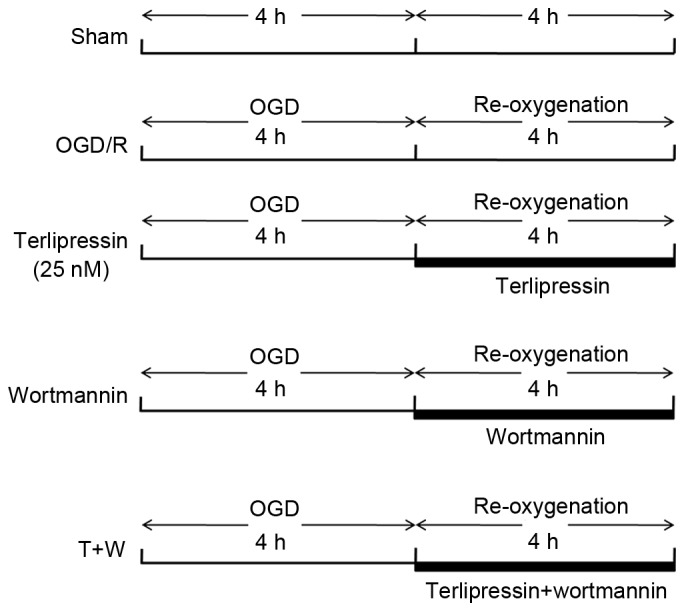
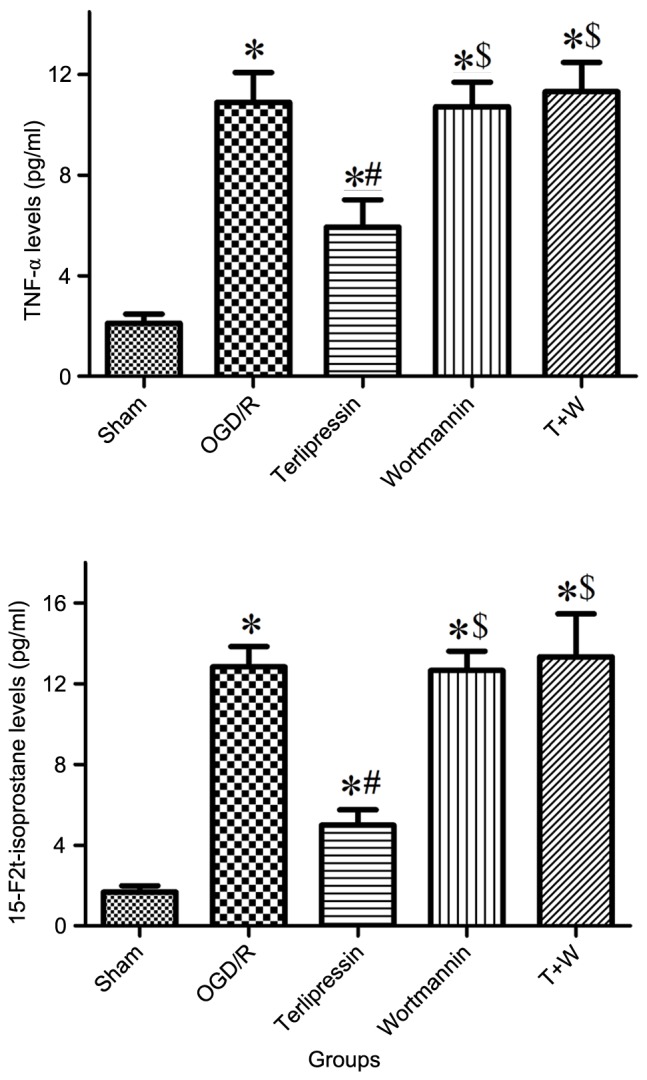
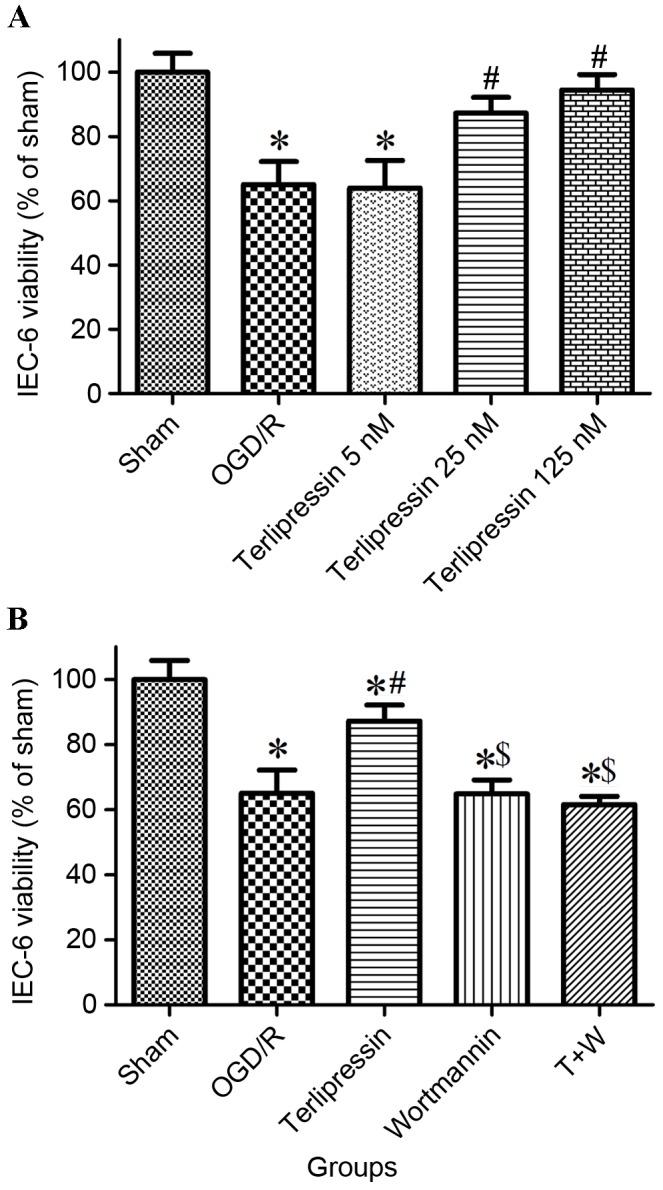
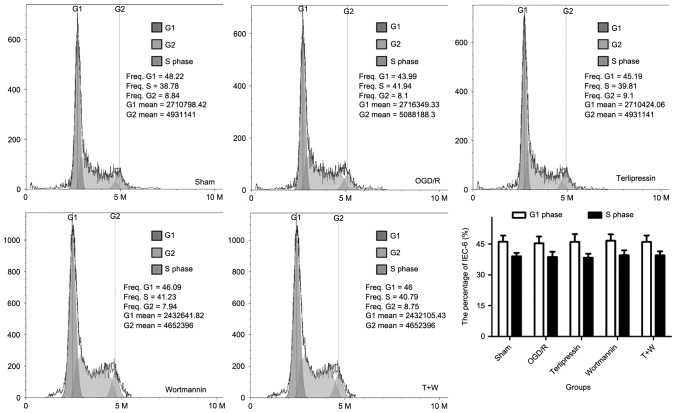
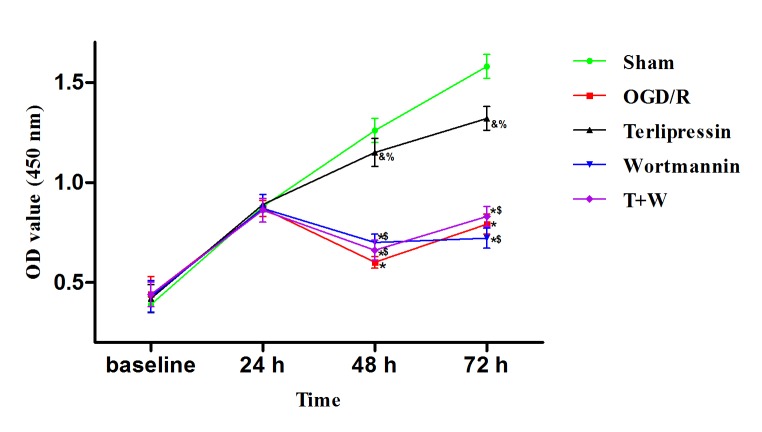
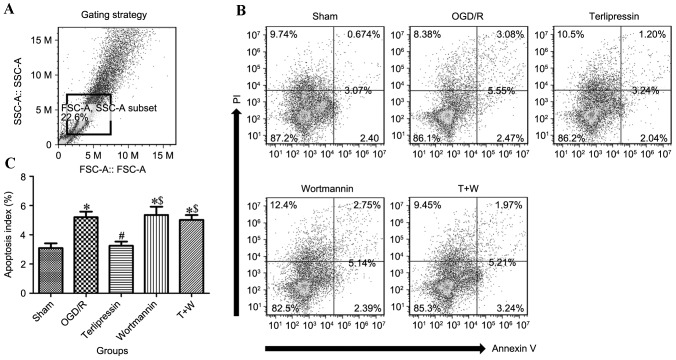
Intestinal ischemia/reperfusion (I/R) injury is associated with a high morbidity and mortality. Vasopressin is administered to critically ill patients with potential intestinal I/R. However, the impacts of vasopressin on intestinal epithelia under ischemic/anoxic conditions remain unclear. The aim of the present study was to evaluate the effects of terlipressin, a highly selective vasopressin V1 receptor agonist, on oxygen and glucose deprivation/re-oxygenation (OGD/R)-induced damage in intestinal epithelial cells (IEC-6). IEC-6 cells were subjected to OGD for 4 h, followed by 4 h re-oxygenation. Terlipressin was incubated with cells for 4 h following OGD. Following OGD/R, IEC-6 cell viability, proliferation and apoptosis, as well as cell cycle dynamics, were assessed and the levels of tumor necrosis factor (TNF)-α and 15-F2t-isoprostane in the culture medium were measured. In addition, wortmannin, a specific phosphatidylinositol 3-kinase (PI3K) inhibitor, was administrated to investigate the mechanism of terlipressin action. The results demonstrated that IEC-6 cell viability and proliferation decreased, and cell apoptosis increased, following OGD/R. However, IEC-6 cell cycle dynamics did not significantly change 4 h after OGD. Incubation with 25 nM terlipressin significantly improved cell viability, proliferation and apoptosis. Furthermore, terlipressin inhibited the secretion of TNF-α and 15-F2t-isoprostane from IEC-6 cells following OGD/R. The aforementioned effects of terlipressin were completely abolished following the application of 2 µM wortmannin. Therefore, the current study demonstrated that terlipressin administration following OGD attenuates OGD/R-induced cell damage via the PI3K signaling pathway. These results may help physicians to better understand and more effectively use terlipressin in a clinical setting.
肠缺血/再灌注(I/R)损伤与高发病率和死亡率相关。血管加压素用于有潜在肠I/R的危重病患者。然而,血管加压素在缺血/缺氧条件下对肠上皮的影响仍不清楚。本研究的目的是评估特利加压素(一种高度选择性的血管加压素V1受体激动剂)对氧和葡萄糖剥夺/复氧(OGD/R)诱导的肠上皮细胞(IEC-6)损伤的影响。将IEC-6细胞进行4小时的OGD处理,随后再进行4小时的复氧。在OGD后将特利加压素与细胞孵育4小时。在OGD/R后,评估IEC-6细胞的活力、增殖和凋亡以及细胞周期动态,并测量培养基中肿瘤坏死因子(TNF)-α和15-F2t-异前列腺素的水平。此外,给予渥曼青霉素(一种特异性磷脂酰肌醇3激酶(PI3K)抑制剂)以研究特利加压素的作用机制。结果表明,OGD/R后IEC-6细胞活力和增殖降低,细胞凋亡增加。然而,OGD后4小时IEC-6细胞周期动态没有明显变化。用25 nM特利加压素孵育可显著改善细胞活力、增殖和凋亡。此外,特利加压素抑制OGD/R后IEC-6细胞中TNF-α和15-F2t-异前列腺素的分泌。在应用2 μM渥曼青霉素后,特利加压素的上述作用完全被消除。因此,本研究表明,OGD后给予特利加压素可通过PI3K信号通路减轻OGD/R诱导的细胞损伤。这些结果可能有助于医生在临床环境中更好地理解并更有效地使用特利加压素。