Lundgren Sebastian, Karnevi Emelie, Elebro Jacob, Nodin Björn, Karlsson Mikael C I, Eberhard Jakob, Leandersson Karin, Jirström Karin
Department of Clinical Sciences Lund, Oncology and Pathology, Lund University, 221 85, Lund, Sweden.
Department of Microbiology, Tumor and Cellbiology, Karolinska Institute, 171 76, Stockholm, Sweden.
J Transl Med. 2017 Jul 3;15(1):152. doi: 10.1186/s12967-017-1256-y.
Dendritic cells (DC) and tumour-associated macrophages (TAM) are essential in linking the innate and adaptive immune response against tumour cells and tumour progression. These cells are also potential target for immunotherapy as well as providing a handle to investigate immune status in the tumour microenvironment. The aim of the present study was to examine their impact on prognosis and chemotherapy response in periampullary adenocarcinoma, including pancreatic cancer, with particular reference to morphological subtype.
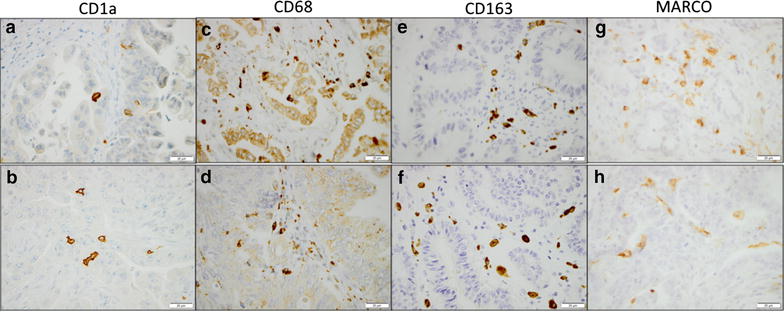
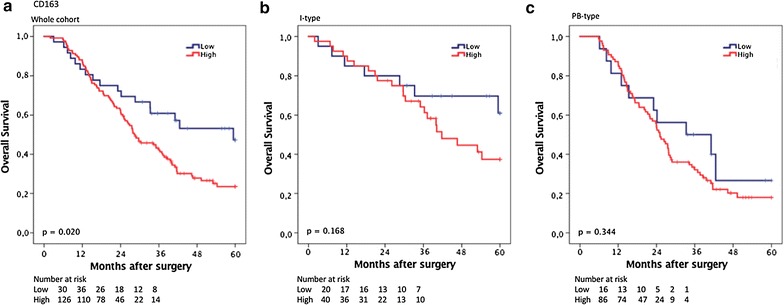
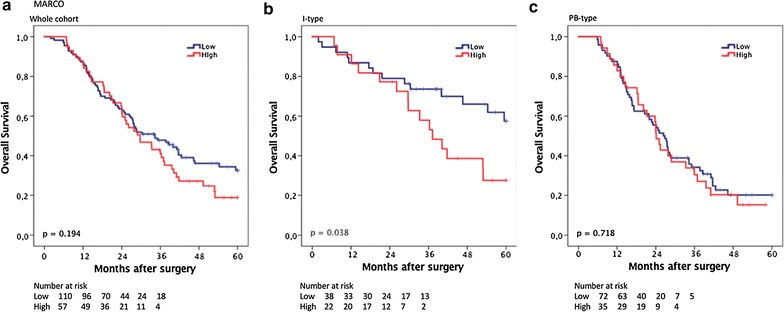
The density of tolerogenic immature CD1a dendritic cells (DC), and MARCO, CD68 and CD163 tissue-associated macrophages (TAM) was analysed by immunohistochemistry in tissue micro arrays with tumours from 175 consecutive cases of periampullary adenocarcinoma who had undergone pancreaticoduodenectomy, 110 with pancreatobiliary type (PB-type) and 65 with intestinal type (I-type) morphology. Kaplan-Meier and Cox regression analyses were applied to determine the impact of immune cell infiltration on 5-year overall survival (OS).
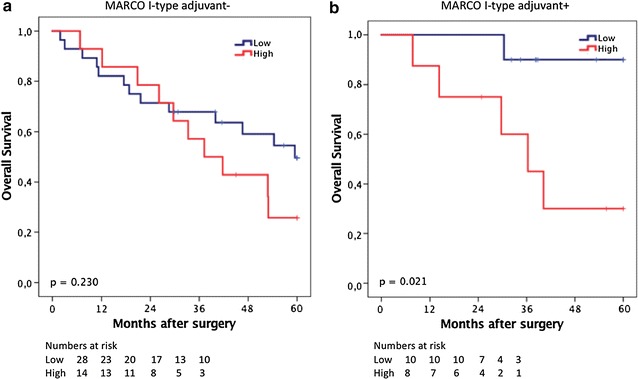
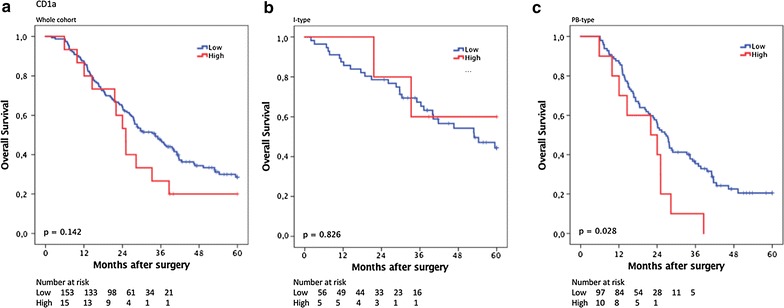
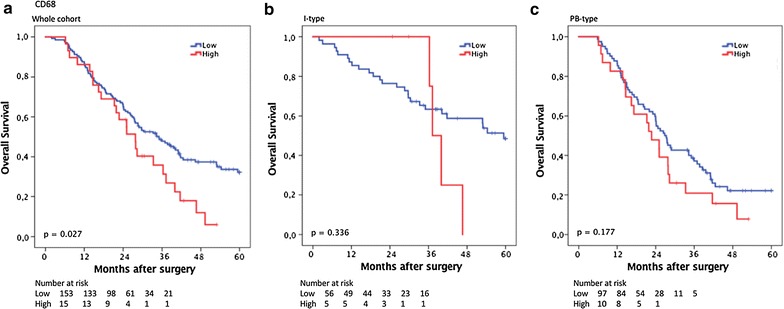
High density of CD1a DCs was an independent prognostic factor for a reduced OS in PB-type but not in I-type tumours (adjusted HR = 2.35; 95% CI 1.13-4.87). High density of CD68 and CD163 TAM was significantly associated with poor OS in the whole cohort, however only in unadjusted analysis (HR = 1.67; 95% CI 1.06-2.63, and HR = 1.84; 95% CI 1.09-3.09, respectively) and not in strata according to morphological subtype. High density of MARCO macrophages was significantly associated with poor prognosis in I-type but not in PB-type tumours (HR = 2.14 95% CI 1.03-4.44), and this association was only evident in patients treated with adjuvant chemotherapy. The prognostic value of the other investigated immune cells did not differ significantly in strata according to adjuvant chemotherapy.
The results from this study demonstrate that high infiltration of tolerogenic immature DCs independently predicts a shorter survival in patients with PB-type periampullary adenocarcinoma, and that high density of the MARCO subtype of TAMs predicts a shorter survival in patients with I-type tumours. These results emphasise the importance of taking morphological subtype into account in biomarker studies related to periampullary cancer, and indicate that therapies targeting dendritic cells may be of value in the treatment of PB-type tumours, which are associated with the worst prognosis.
树突状细胞(DC)和肿瘤相关巨噬细胞(TAM)在连接针对肿瘤细胞的先天性和适应性免疫反应以及肿瘤进展过程中起着至关重要的作用。这些细胞也是免疫治疗的潜在靶点,同时为研究肿瘤微环境中的免疫状态提供了途径。本研究的目的是探讨它们对壶腹周围腺癌(包括胰腺癌)预后和化疗反应的影响,特别参考形态学亚型。
通过免疫组织化学分析了175例连续接受胰十二指肠切除术的壶腹周围腺癌患者肿瘤组织微阵列中耐受性未成熟CD1a树突状细胞(DC)以及MARCO、CD68和CD163组织相关巨噬细胞(TAM)的密度,其中110例为胰胆管型(PB型),65例为肠型(I型)形态。应用Kaplan-Meier和Cox回归分析来确定免疫细胞浸润对5年总生存期(OS)的影响。
CD1a DC的高密度是PB型肿瘤而非I型肿瘤中总生存期缩短的独立预后因素(调整后HR = 2.35;95%CI 1.13 - 4.87)。CD68和CD163 TAM的高密度在整个队列中与较差的总生存期显著相关,但仅在未调整分析中如此(HR分别为1.67;95%CI 1.06 - 2.63和HR = 1.84;95%CI 1.09 - 3.09),而在根据形态学亚型分层分析中并非如此。MARCO巨噬细胞的高密度在I型肿瘤而非PB型肿瘤中与较差的预后显著相关(HR = 2.14,95%CI 1.03 - 4.44),并且这种关联仅在接受辅助化疗的患者中明显。根据辅助化疗分层分析,其他研究的免疫细胞的预后价值没有显著差异。
本研究结果表明,耐受性未成熟DC的高浸润独立预测PB型壶腹周围腺癌患者生存期较短,而TAM的MARCO亚型高密度预测I型肿瘤患者生存期较短。这些结果强调了在与壶腹周围癌相关的生物标志物研究中考虑形态学亚型的重要性,并表明靶向树突状细胞的疗法可能对预后最差的PB型肿瘤的治疗有价值。