Kongsted Alice, Hestbæk Lise, Kent Peter
Nordic Institute of Chiropractic and Clinical Biomechanics, Campusvej 55, DK-5230, Odense M, Denmark.
Department of Sports Science and Clinical Biomechanics, University of Southern Denmark, Campusvej 55, DK-5230, Odense M, Denmark.
BMC Musculoskelet Disord. 2017 Jul 3;18(1):285. doi: 10.1186/s12891-017-1644-8.
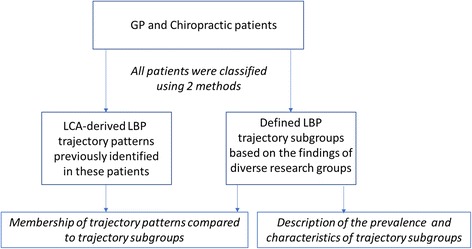
Similar types of trajectory patterns have been identified by Latent Class Analyses (LCA) across multiple low back pain (LBP) cohorts, but these patterns are impractical to apply to new cohorts or individual patients. It would be useful to be able to identify trajectory subgroups from descriptive definitions, as a way to apply the same definitions of mutually exclusive subgroups across populations. In this study, we investigated if the course trajectories of two LBP cohorts fitted with previously suggested trajectory subgroup definitions, how distinctly different these subgroups were, and if the subgroup definitions matched with LCA-derived patterns.
Weekly measures of LBP intensity and frequency during 1 year were available from two clinical cohorts. We applied definitions of 16 possible trajectory subgroups to these observations and calculated the prevalence of the subgroups. The probability of belonging to each of eight LCA-derived patterns was determined within each subgroup. LBP intensity and frequency were described within subgroups and the subgroups of 'fluctuating' and 'episodic' LBP were compared on clinical characteristics.
All of 1077 observed trajectories fitted with the defined subgroups. 'Severe episodic LBP' was the most frequent pattern in both cohorts and 'ongoing LBP' was almost non-existing. There was a clear relationship between the defined trajectory subgroups and LCA-derived trajectory patterns, as in most subgroups, all patients had high probabilities of belonging to only one or two of the LCA patterns. The characteristics of the six defined subgroups with minor LBP were very similar. 'Fluctuating LBP' subgroups were significantly more distressed, had more intense leg pain, higher levels of activity limitation, and more negative expectations about future LBP than 'episodic LBP' subgroups.
Previously suggested definitions of LBP trajectory subgroups could be readily applied to patients' observed data resulting in subgroups that matched well with LCA-derived trajectory patterns. We suggest that the number of trajectory subgroups can be reduced by merging some subgroups with minor LBP. Stable levels of LBP were almost not observed and we suggest that minor fluctuations in pain intensity might be conceptualised as 'ongoing LBP'. Lastly, we found clear support for distinguishing between fluctuating and episodic LBP.
通过潜在类别分析(LCA)在多个腰痛(LBP)队列中识别出了相似类型的轨迹模式,但这些模式应用于新队列或个体患者并不实际。能够从描述性定义中识别轨迹亚组,作为在人群中应用相互排斥亚组相同定义的一种方式,将是很有用的。在本研究中,我们调查了两个LBP队列的病程轨迹是否符合先前提出的轨迹亚组定义,这些亚组有多么明显的差异,以及亚组定义是否与LCA得出的模式相匹配。
从两个临床队列中获取了1年内每周的LBP强度和频率测量值。我们将16种可能的轨迹亚组定义应用于这些观察结果,并计算了亚组的患病率。在每个亚组中确定属于八种LCA得出的模式中每种模式的概率。在亚组内描述了LBP强度和频率,并比较了“波动型”和“发作型”LBP亚组的临床特征。
1077条观察到的轨迹均符合定义的亚组。“严重发作性LBP”是两个队列中最常见的模式,而“持续性LBP”几乎不存在。定义的轨迹亚组与LCA得出的轨迹模式之间存在明显关系,因为在大多数亚组中,所有患者属于仅一种或两种LCA模式的概率很高。六个定义的轻度LBP亚组的特征非常相似。与“发作型LBP”亚组相比,“波动型LBP”亚组明显更痛苦,腿痛更剧烈,活动受限程度更高,对未来LBP的负面预期更多。
先前提出的LBP轨迹亚组定义可以很容易地应用于患者的观察数据,从而产生与LCA得出的轨迹模式匹配良好的亚组。我们建议通过合并一些轻度LBP亚组来减少轨迹亚组的数量。几乎未观察到LBP的稳定水平,我们建议将疼痛强度的轻微波动概念化为“持续性LBP”。最后,我们发现了区分波动型和发作型LBP的明确依据。