Ghiaur Gabriel, Levis Mark
Adult Leukemia Program, Division of Hematological Malignancies, Sidney Kimmel Comprehensive Cancer Center, Johns Hopkins University, 1650 Orleans Street CRB I, Room 243, Baltimore, MD 21287, USA.
Adult Leukemia Program, Division of Hematological Malignancies, Sidney Kimmel Comprehensive Cancer Center, Johns Hopkins University, 1650 Orleans Street CRB I, Room 2M44, Baltimore, MD 21287, USA.
Hematol Oncol Clin North Am. 2017 Aug;31(4):681-692. doi: 10.1016/j.hoc.2017.04.005. Epub 2017 May 18.
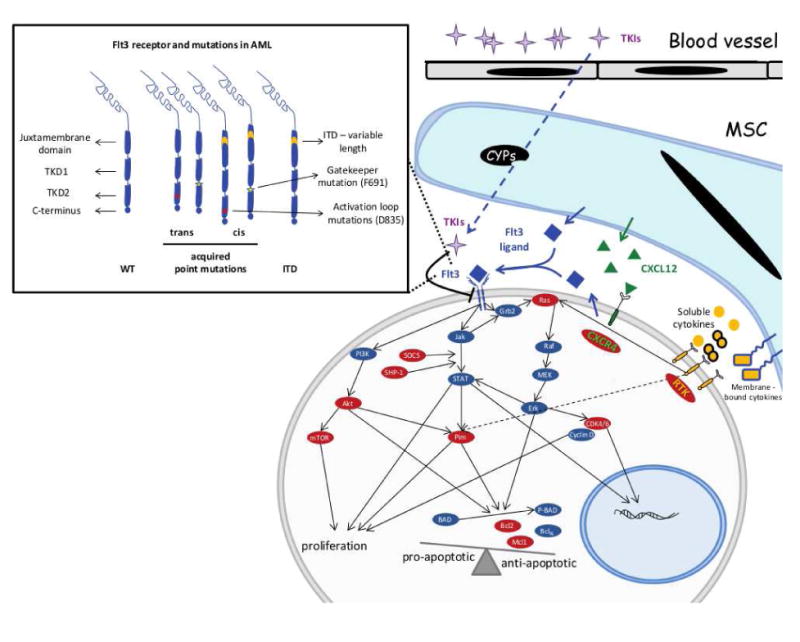
The presence of FLT3 mutations in acute myeloid leukemia (AML) carries a particularly poor prognosis, making the development of FLT3 inhibitors an imperative goal. The last decade has seen an abundance of clinical trials using these drugs alone or in combination with chemotherapy. This culminated with the recent approval by the US Food and Drug Administration of Midostaurin for the treatment of FLT3-mutated AML. Initial success has been followed by the emergence of clinical resistance. Although novel FLT3 inhibitors are being developed, studies into mechanisms of resistance raise hope of new strategies to prevent emergence of resistance and eliminate minimal residual disease.
急性髓系白血病(AML)中FLT3突变的存在预示着特别差的预后,这使得开发FLT3抑制剂成为一项紧迫的目标。在过去十年中,已经开展了大量单独使用这些药物或与化疗联合使用的临床试验。最近美国食品药品监督管理局批准米哚妥林用于治疗FLT3突变的AML,这是这些试验的 culminated 成果。初步成功之后出现了临床耐药性。尽管正在开发新型FLT3抑制剂,但对耐药机制的研究为预防耐药性出现和消除微小残留病的新策略带来了希望。 (注:“culminated”此处可能有误,根据语境推测可能是“culmination”,意为“高潮、顶点、最终结果” )