Jaiswal Mamta, Divers Jasmin, Dabelea Dana, Isom Scott, Bell Ronny A, Martin Catherine L, Pettitt David J, Saydah Sharon, Pihoker Catherine, Standiford Debra A, Dolan Lawrence M, Marcovina Santica, Linder Barbara, Liese Angela D, Pop-Busui Rodica, Feldman Eva L
Department of Neurology, University of Michigan, Ann Arbor, MI.
Department of Biostatistical Sciences, Wake Forest School of Medicine, Winston-Salem, NC.
Diabetes Care. 2017 Sep;40(9):1226-1232. doi: 10.2337/dc17-0179. Epub 2017 Jul 3.
We assessed the prevalence of and risk factors for diabetic peripheral neuropathy (DPN) in youth with type 1 diabetes (T1D) and type 2 diabetes (T2D) enrolled in the SEARCH for Diabetes in Youth (SEARCH) study.
The Michigan Neuropathy Screening Instrument (MNSI) was used to assess DPN in 1,734 youth with T1D (mean ± SD age 18 ± 4 years, T1D duration 7.2 ± 1.2 years, and HbA 9.1 ± 1.9%) and 258 youth with T2D (age 22 ± 3.5 years, T2D duration 7.9 ± 2 years, and HbA 9.4 ± 2.3%) who were enrolled in the SEARCH study and had ≥5 years of diabetes duration. DPN was defined as an MNSI exam score of >2. Glycemic control over time was estimated as area under the curve for HbA.
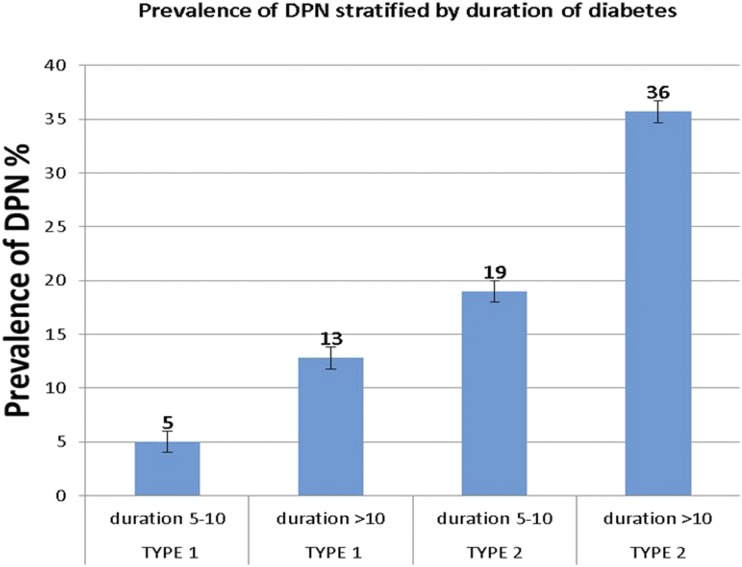
The prevalence of DPN was 7% in youth with T1D and 22% in youth with T2D. Risk factors for DPN in youth with T1D were older age, longer diabetes duration, smoking, increased diastolic blood pressure, obesity, increased LDL cholesterol and triglycerides, and lower HDL cholesterol (HDL-c). In youth with T2D, risk factors were older age, male sex, longer diabetes duration, smoking, and lower HDL-c. Glycemic control over time was worse among those with DPN compared with those without for youth with T1D (odds ratio 1.53 [95% CI 1.24; 1.88]) but not for youth with T2D (1.05 [0.7; 1.56]).
The high rates of DPN among youth with diabetes are a cause of concern and suggest a need for early screening and better risk factor management. Interventions in youth that address poor glycemic control and dyslipidemia may prevent or delay debilitating neuropathic complications.
我们评估了参与青少年糖尿病研究(SEARCH)的1型糖尿病(T1D)和2型糖尿病(T2D)青少年中糖尿病周围神经病变(DPN)的患病率及危险因素。
使用密歇根神经病变筛查工具(MNSI)对1734例T1D青少年(平均±标准差年龄18±4岁,T1D病程7.2±1.2年,糖化血红蛋白[HbA]9.1±1.9%)和258例T2D青少年(年龄22±3.5岁,T2D病程7.9±2年,HbA 9.4±2.3%)进行DPN评估,这些青少年均参与了SEARCH研究且糖尿病病程≥5年。DPN定义为MNSI检查评分>2。通过计算HbA曲线下面积来评估长期血糖控制情况。
T1D青少年中DPN的患病率为7%,T2D青少年中为22%。T1D青少年发生DPN的危险因素包括年龄较大、糖尿病病程较长、吸烟、舒张压升高、肥胖、低密度脂蛋白胆固醇和甘油三酯升高以及高密度脂蛋白胆固醇(HDL-c)降低。在T2D青少年中,危险因素为年龄较大、男性性别、糖尿病病程较长、吸烟以及HDL-c降低。与未发生DPN的T1D青少年相比,发生DPN的青少年长期血糖控制情况更差(优势比1.53[95%可信区间1.24;1.88]),但T2D青少年中并非如此(1.05[0.7;1.56])。
糖尿病青少年中DPN高发生率令人担忧,提示需要进行早期筛查和更好的危险因素管理。针对血糖控制不佳和血脂异常的青少年进行干预可能预防或延缓使人衰弱的神经病变并发症。