Saini Mukesh, Wang Ze Win, Chiang Chung-Jen, Chao Yun-Peng
Department of Chemical Engineering, Feng Chia University, 100 Wenhwa Road, Taichung, 40724 Taiwan.
Department of Medical Laboratory Science and Biotechnology, China Medical University, No. 91, Hsueh-Shih Road, Taichung, 40402 Taiwan.
Biotechnol Biofuels. 2017 Jul 4;10:173. doi: 10.1186/s13068-017-0857-2. eCollection 2017.
Crude glycerol in the waste stream of the biodiesel production process is an abundant and renewable resource. However, the glycerol-based industry is usually afflicted by the cost for refinement of crude glycerol. This issue can be addressed by developing a microbial process to convert crude glycerol to value-added chemicals. In this study, was implemented for the production of n-butanol based on the reduced nature of glycerol.
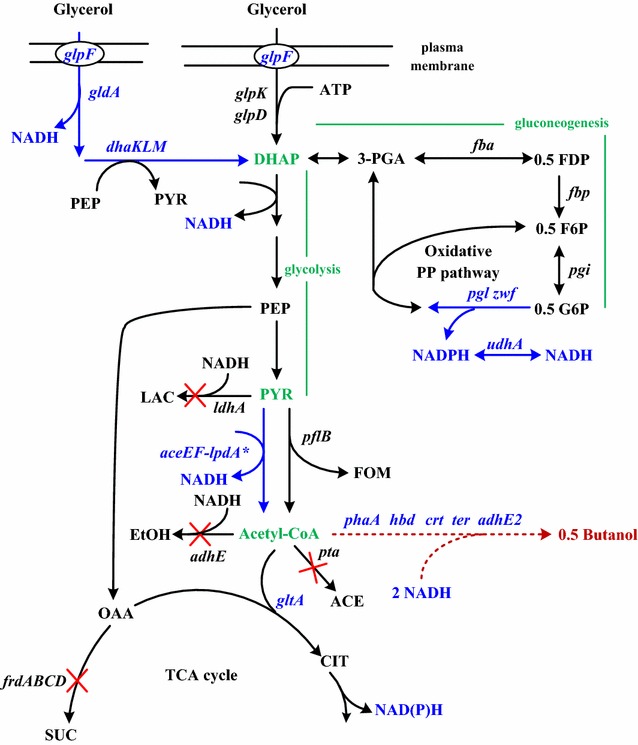
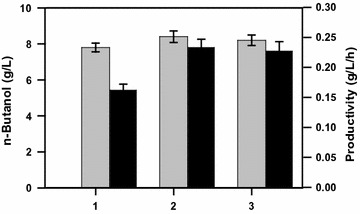
The central metabolism of was rewired to improve the efficiency of glycerol metabolism and provide the reductive need for n-butanol in . This was carried out in several steps by (1) forcing the glycolytic flux through the oxidation pathway of pyruvate, (2) directing the gluconeogenic flux into the oxidative pentose phosphate pathway, (3) enhancing the anaerobic catabolism for glycerol, and (4) moderately suppressing the tricarboxylic acid cycle. Under the microaerobic condition, the engineered strain enabled the production of 6.9 g/L n-butanol from 20 g/L crude glycerol. The conversion yield and the productivity reach 87% of the theoretical yield and 0.18 g/L/h, respectively.
The approach by rational rewiring of metabolic pathways enables to synthesize n-butanol from glycerol in an efficient way. Our proposed strategies illustrate the feasibility of manipulating key metabolic nodes at the junction of the central catabolism. As a result, it renders the intracellular redox state adjustable for various purposes. Overall, the developed technology platform may be useful for the economic viability of the glycerol-related industry.
生物柴油生产过程废物流中的粗甘油是一种丰富的可再生资源。然而,甘油基产业通常受到粗甘油精制成本的困扰。这个问题可以通过开发一种微生物工艺将粗甘油转化为增值化学品来解决。在本研究中,基于甘油的还原性实现了正丁醇的生产。
对[具体微生物名称未给出]的中心代谢进行重新布线,以提高甘油代谢效率,并为[具体微生物名称未给出]中正丁醇的合成提供还原需求。这通过几个步骤来实现:(1)迫使糖酵解通量通过丙酮酸的氧化途径;(2)将糖异生通量导向氧化戊糖磷酸途径;(3)增强甘油的厌氧分解代谢;(4)适度抑制三羧酸循环。在微需氧条件下,工程菌株能够从20 g/L粗甘油中生产6.9 g/L正丁醇。转化率和生产率分别达到理论产率的87%和0.18 g/(L·h)。
通过合理重新布线代谢途径的方法使[具体微生物名称未给出]能够有效地从甘油合成正丁醇。我们提出的策略说明了在中心分解代谢交界处操纵关键代谢节点的可行性。结果,它使细胞内氧化还原状态可根据各种目的进行调节。总体而言,所开发的技术平台可能对甘油相关产业的经济可行性有用。