
功能失调的骨形态发生蛋白受体2(BMPR2)信号传导导致肺动脉高压中内皮细胞对谷氨酰胺的异常需求。
Dysfunctional BMPR2 signaling drives an abnormal endothelial requirement for glutamine in pulmonary arterial hypertension.
作者信息
Egnatchik Robert A, Brittain Evan L, Shah Amy T, Fares Wassim H, Ford H James, Monahan Ken, Kang Christie J, Kocurek Emily G, Zhu Shijun, Luong Thong, Nguyen Thuy T, Hysinger Erik, Austin Eric D, Skala Melissa C, Young Jamey D, Roberts L Jackson, Hemnes Anna R, West James, Fessel Joshua P
机构信息
Children's Medical Center Research Institute, University of Texas Southwestern, Dallas, TX, USA.
Department of Chemical and Biomolecular Engineering, Vanderbilt University, Nashville, TN, USA.
出版信息
Pulm Circ. 2017 Feb 1;7(1):186-199. doi: 10.1086/690236. eCollection 2017 Mar.
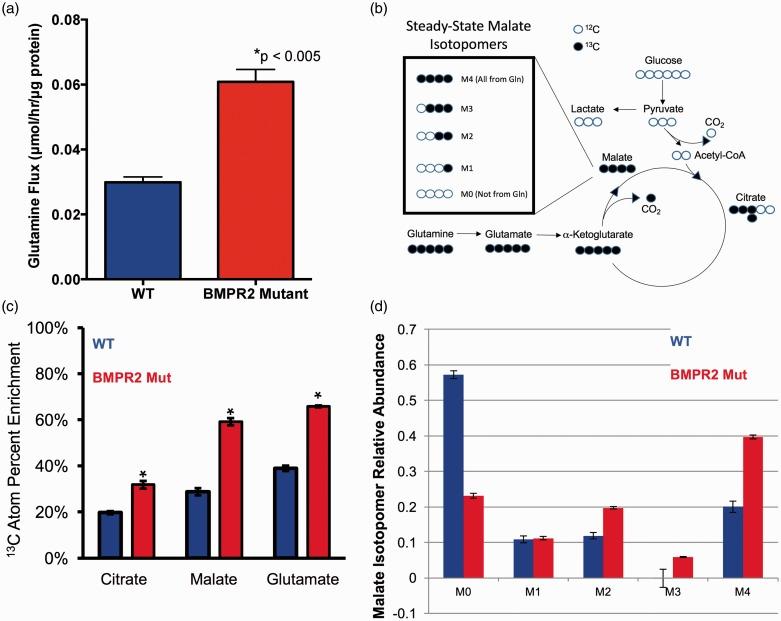
Pulmonary arterial hypertension (PAH) is increasingly recognized as a systemic disease driven by alteration in the normal functioning of multiple metabolic pathways affecting all of the major carbon substrates, including amino acids. We found that human pulmonary hypertension patients (WHO Group I, PAH) exhibit systemic and pulmonary-specific alterations in glutamine metabolism, with the diseased pulmonary vasculature taking up significantly more glutamine than that of controls. Using cell culture models and transgenic mice expressing PAH-causing BMPR2 mutations, we found that the pulmonary endothelium in PAH shunts significantly more glutamine carbon into the tricarboxylic acid (TCA) cycle than wild-type endothelium. Increased glutamine metabolism through the TCA cycle is required by the endothelium in PAH to survive, to sustain normal energetics, and to manifest the hyperproliferative phenotype characteristic of disease. The strict requirement for glutamine is driven by loss of sirtuin-3 (SIRT3) activity through covalent modification by reactive products of lipid peroxidation. Using 2-hydroxybenzylamine, a scavenger of reactive lipid peroxidation products, we were able to preserve SIRT3 function, to normalize glutamine metabolism, and to prevent the development of PAH in BMPR2 mutant mice. In PAH, targeting glutamine metabolism and the mechanisms that underlie glutamine-driven metabolic reprogramming represent a viable novel avenue for the development of potentially disease-modifying therapeutics that could be rapidly translated to human studies.
肺动脉高压(PAH)越来越被认为是一种系统性疾病,由多种代谢途径的正常功能改变所驱动,这些途径影响所有主要的碳底物,包括氨基酸。我们发现,人类肺动脉高压患者(世界卫生组织第一组,PAH)在谷氨酰胺代谢方面表现出全身和肺部特异性改变,患病的肺血管系统摄取的谷氨酰胺比对照组明显更多。使用细胞培养模型和表达导致PAH的BMPR2突变的转基因小鼠,我们发现PAH中的肺内皮细胞比野生型内皮细胞将显著更多的谷氨酰胺碳分流到三羧酸(TCA)循环中。PAH中的内皮细胞需要通过TCA循环增加谷氨酰胺代谢来存活、维持正常能量代谢,并表现出疾病特征性的过度增殖表型。对谷氨酰胺的严格需求是由脂质过氧化反应产物的共价修饰导致的沉默调节蛋白3(SIRT3)活性丧失所驱动的。使用2-羟基苄胺,一种活性脂质过氧化产物清除剂,我们能够保留SIRT3功能,使谷氨酰胺代谢正常化,并预防BMPR2突变小鼠PAH的发展。在PAH中,针对谷氨酰胺代谢以及谷氨酰胺驱动的代谢重编程的潜在机制,代表了开发可能改变疾病进程的治疗方法的一个可行的新途径,这些治疗方法可以迅速转化为人体研究。




 Zotero 插件