Hemnes Anna, Fortune Niki, Simon Katie, Trenary Irina A, Shay Sheila, Austin Eric, Young Jamey D, Britain Evan, West James, Talati Megha
Division of Allergy, Pulmonary, and Critical Care Medicine, Department of Medicine, Vanderbilt University Medical Center, Nashville, TN, United States.
Department of Chemical and Biomolecular Engineering, Vanderbilt University, Nashville, TN, United States.
Front Med (Lausanne). 2024 Sep 12;11:1387195. doi: 10.3389/fmed.2024.1387195. eCollection 2024.
In PAH metabolic abnormalities in multiple pathways are well-recognized features of right ventricular dysfunction, however, prior work has focused mainly on the use of a single "omic" modality to describe a single deranged pathway. We integrated metabolomic and epigenomic data using transcriptomics in failing and non-failing RVs from a rodent model to provide novel mechanistic insight and translated these findings to accessible human specimens by correlation with plasma from PAH patients.
Study was conducted in a doxycycline-inducible BMPR2 mutant mouse model of RV failure. Plasma was collected from controls and PAH patients. Transcriptomic and metabolomic analyses were done on mouse RV tissue and human plasma. For mouse RV, we layered metabolomic and transcriptomic data for multiple metabolic pathways and compared our findings with metabolomic and transcriptomic data obtained for human plasma. We confirmed our key findings in cultured cardiomyocyte cells with BMPR2 mutation.
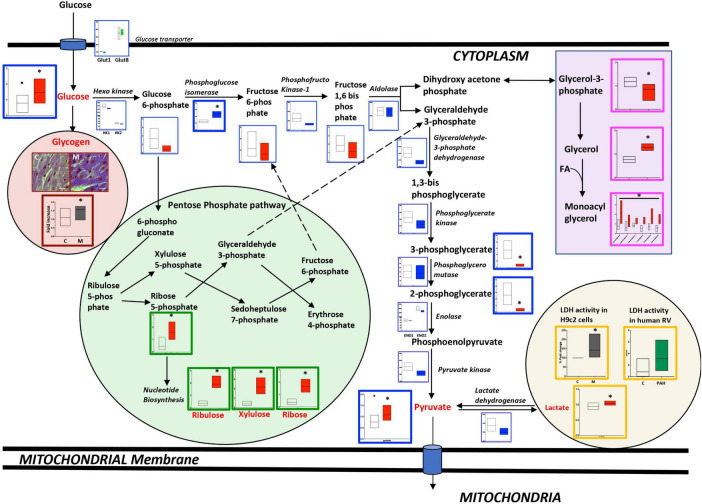
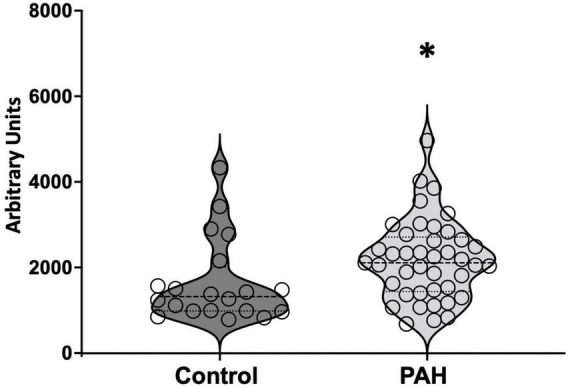
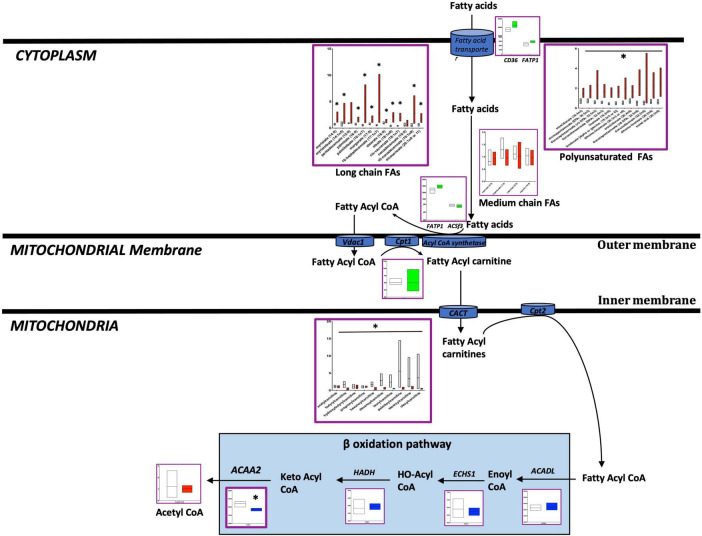
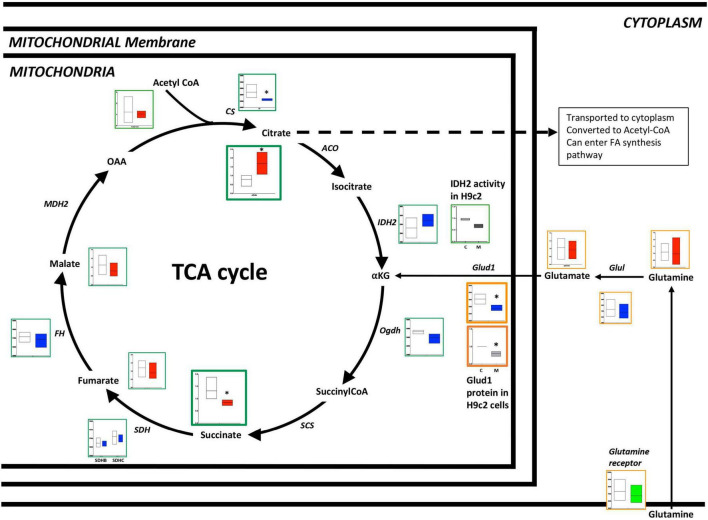
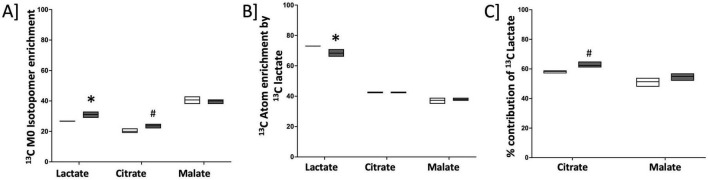
In failing mouse RVs, (1) in the glycolysis pathway, glucose is converted to lactate via aerobic glycolysis, but may also be utilized for glycogen, fatty acid, and nucleic acid synthesis, (2) in the fatty acid pathway, FAs are accumulated in the cytoplasm because the transfer of FAs to mitochondria is reduced, however, the ß-oxidation pathway is likely to be functional. (3) the TCA cycle is altered at multiple checkpoints and accumulates citrate, and the glutaminolysis pathway is not activated. In PAH patients, plasma metabolic and transcriptomic data indicated that unlike in the failing BMPR2 mutant RV, expression of genes and metabolites measured for the glycolysis pathway, FA pathway, TCA cycle, and glutaminolysis pathway were increased. Lactate was the only metabolite that was increased both in RV and circulation. We confirmed using a stable isotope of lactate that cultured cardiomyocytes with mutant BMPR2 show a modest increase in endogenous lactate, suggesting a possibility of an increase in lactate production by cardiomyocytes in failing BMPR2 mutant RV.
In the failing RV with mutant BMPR2, lactate is produced by RV cardiomyocytes and may be secreted out, thereby increasing lactate in circulation. Lactate can potentially serve as a marker of RV dysfunction in PAH, which warrants investigation.
在肺动脉高压(PAH)中,多种途径的代谢异常是右心室功能障碍的公认特征,然而,先前的研究主要集中在使用单一的“组学”方法来描述单一的紊乱途径。我们在啮齿动物模型的衰竭和非衰竭右心室中,利用转录组学整合代谢组学和表观基因组学数据,以提供新的机制见解,并通过与PAH患者的血浆进行相关性分析,将这些发现转化到可获取的人类样本中。
在多西环素诱导的右心室衰竭BMPR2突变小鼠模型中进行研究。从对照组和PAH患者中采集血浆。对小鼠右心室组织和人类血浆进行转录组学和代谢组学分析。对于小鼠右心室,我们对多个代谢途径的代谢组学和转录组学数据进行分层,并将我们的发现与人类血浆获得的代谢组学和转录组学数据进行比较。我们在具有BMPR2突变的培养心肌细胞中证实了我们的关键发现。
在衰竭的小鼠右心室中,(1)在糖酵解途径中,葡萄糖通过有氧糖酵解转化为乳酸,但也可能用于糖原、脂肪酸和核酸合成;(2)在脂肪酸途径中,脂肪酸在细胞质中积累,因为脂肪酸向线粒体的转运减少,然而,β-氧化途径可能仍有功能;(3)三羧酸循环在多个检查点发生改变并积累柠檬酸,谷氨酰胺分解途径未被激活。在PAH患者中,血浆代谢组学和转录组学数据表明,与衰竭的BMPR2突变右心室不同,糖酵解途径、脂肪酸途径、三羧酸循环和谷氨酰胺分解途径中测量的基因和代谢物表达增加。乳酸是右心室和循环中唯一增加的代谢物。我们使用乳酸的稳定同位素证实,具有突变BMPR2的培养心肌细胞内源性乳酸有适度增加,这表明衰竭的BMPR2突变右心室中心肌细胞产生乳酸增加的可能性。
在具有突变BMPR2的衰竭右心室中,乳酸由右心室心肌细胞产生并可能分泌出来,从而增加循环中的乳酸。乳酸有可能作为PAH中右心室功能障碍的标志物,值得进一步研究。