Pentzold Stefan, Jensen Mikael Kryger, Matthes Annemarie, Olsen Carl Erik, Petersen Bent Larsen, Clausen Henrik, Møller Birger Lindberg, Bak Søren, Zagrobelny Mika
Department of Plant and Environmental Sciences and Copenhagen Plant Science Centre, University of Copenhagen, Thorvaldsensvej 40, 1871 Frederiksberg C, Denmark.
Department of Bioorganic Chemistry, Max Planck Institute for Chemical Ecology, Hans-Knöll-Straße 8, 07745 Jena, Germany.
R Soc Open Sci. 2017 Jun 28;4(6):170262. doi: 10.1098/rsos.170262. eCollection 2017 Jun.
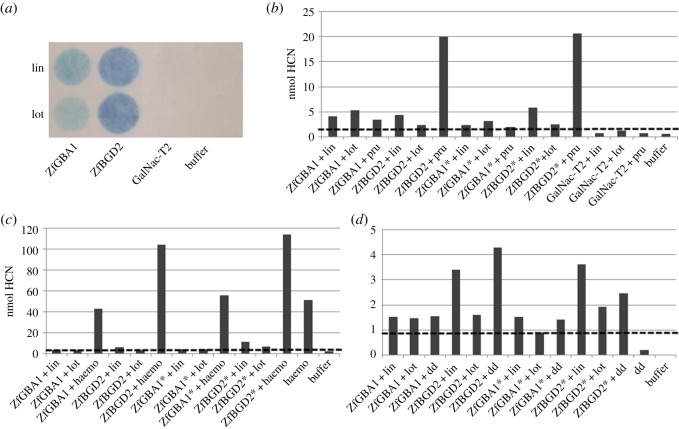
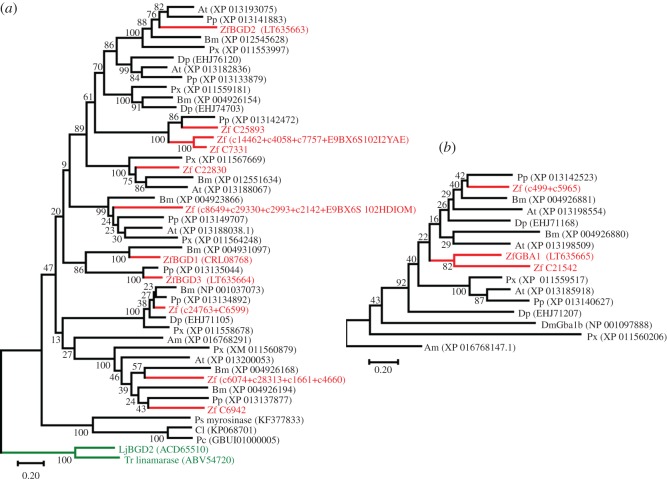
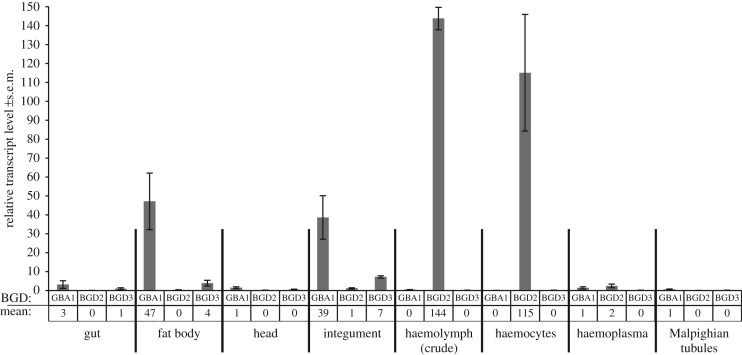
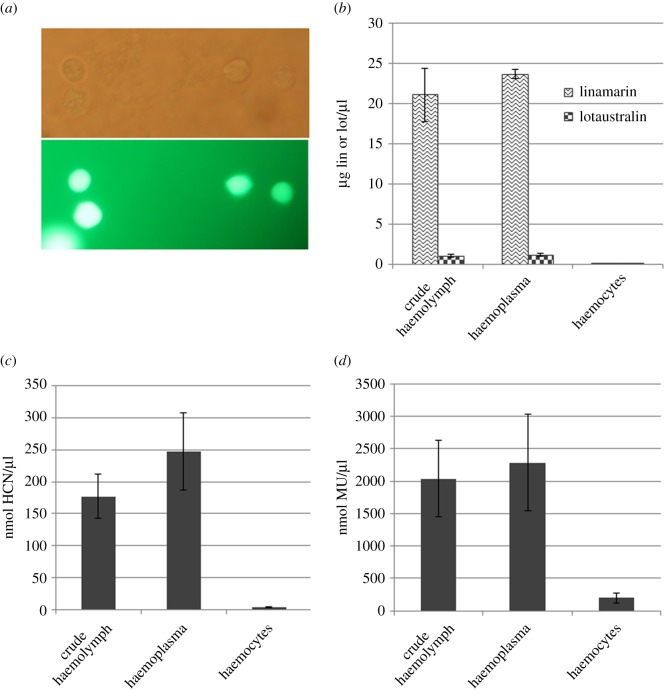
Low molecular weight compounds are typically used by insects and plants for defence against predators. They are often stored as inactive β-glucosides and kept separate from activating β-glucosidases. When the two components are mixed, the β-glucosides are hydrolysed releasing toxic aglucones. Cyanogenic plants contain cyanogenic glucosides and release hydrogen cyanide due to such a well-characterized two-component system. Some arthropods are also cyanogenic, but comparatively little is known about their system. Here, we identify a specific β-glucosidase ( involved in cyanogenesis from larvae of (Lepidoptera, Zygaenidae), and analyse the spatial organization of cyanide release in this specialized insect. High levels of mRNA and protein were found in haemocytes by transcriptomic and proteomic profiling. Heterologous expression in insect cells showed that ZfBGD2 hydrolyses linamarin and lotaustralin, the two cyanogenic glucosides present in . Linamarin and lotaustralin as well as cyanide release were found exclusively in the haemoplasma. Phylogenetic analyses revealed that clusters with other insect β-glucosidases, and correspondingly, the ability to hydrolyse cyanogenic glucosides catalysed by a specific β-glucosidase evolved convergently in insects and plants. The spatial separation of the β-glucosidase ZfBGD2 and its cyanogenic substrates within the haemolymph provides the basis for cyanide release in . This spatial separation is similar to the compartmentalization of the two components found in cyanogenic plant species, and illustrates one similarity in cyanide-based defence in these two kingdoms of life.
低分子量化合物通常被昆虫和植物用于抵御捕食者。它们常以无活性的β-葡萄糖苷形式储存,并与激活β-葡萄糖苷酶分开保存。当这两种成分混合时,β-葡萄糖苷会被水解,释放出有毒的苷元。含氰植物含有含氰葡萄糖苷,并由于这种特征明确的双组分系统而释放氰化氢。一些节肢动物也含氰,但对其系统了解相对较少。在这里,我们鉴定了一种特定的β-葡萄糖苷酶(参与来自 (鳞翅目,斑蛾科)幼虫的氰化作用),并分析了这种特殊昆虫中氰化物释放的空间组织。通过转录组学和蛋白质组学分析在血细胞中发现了高水平的 mRNA 和蛋白质。在昆虫细胞中的异源表达表明,ZfBGD2 水解亚麻苦苷和百脉根苷,这是 中存在的两种含氰葡萄糖苷。亚麻苦苷和百脉根苷以及氰化物释放仅在血浆中被发现。系统发育分析表明, 与其他昆虫β-葡萄糖苷酶聚类,相应地,由特定β-葡萄糖苷酶催化水解含氰葡萄糖苷的能力在昆虫和植物中趋同进化。β-葡萄糖苷酶 ZfBGD2 与其含氰底物在血淋巴中的空间分离为 中的氰化物释放提供了基础。这种空间分离类似于在含氰植物物种中发现的两种成分的区室化,并说明了这两个生命王国中基于氰化物防御的一个相似之处。