Teunissen Michelle, Riemers Frank M, van Leenen Dik, Groot Koerkamp Marian J A, Meij Björn P, Alblas Jacqueline, Penning Louis C, Miranda-Bedate Alberto, Tryfonidou Marianna A
Faculty of Veterinary Medicine, Department of Clinical Sciences of Companion Animals, Utrecht University, Yalelaan 108, Utrecht 3584 CM, The Netherlands.
Molecular Cancer Research, University Medical Centre Utrecht, Utrecht, The Netherlands.
J Orthop Res. 2018 Jan;36(1):138-148. doi: 10.1002/jor.23647. Epub 2017 Aug 14.
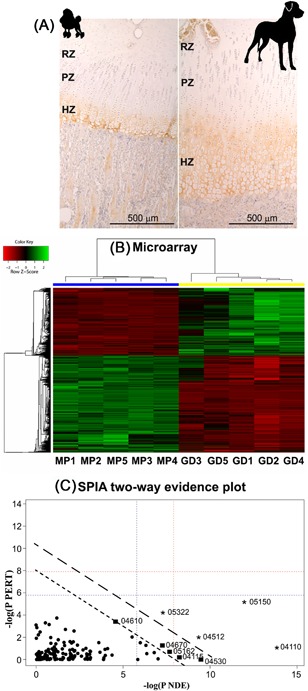
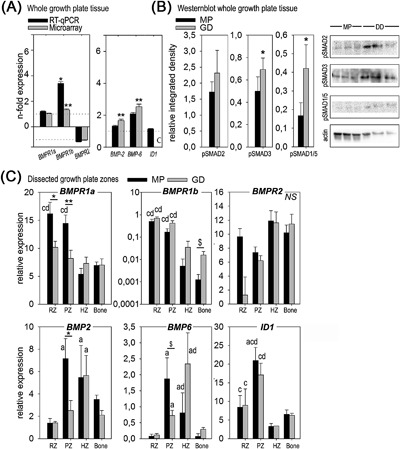
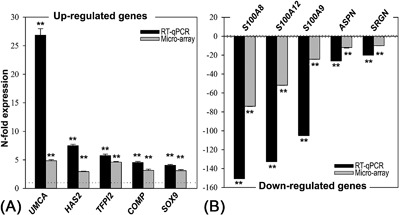
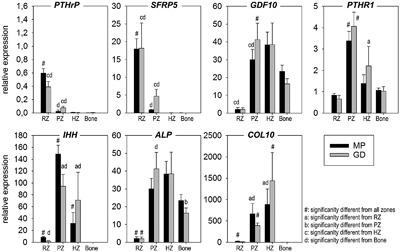
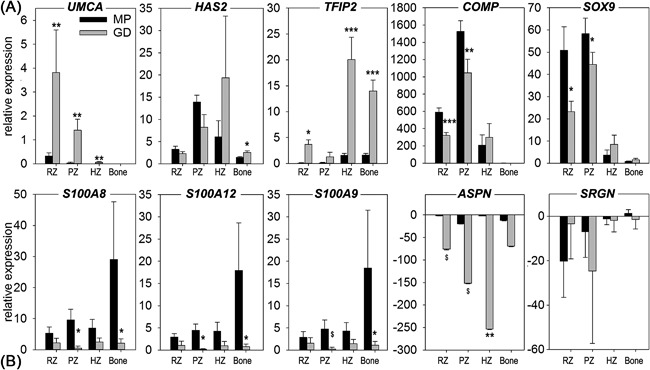
The difference in the adult height of mammals, and hence in endochondral bone formation, is not yet fully understood and may serve to identify targets for bone and cartilage regeneration. In line with this hypothesis, the intra-species disparity between the adult height of Great Danes and Miniature Poodles was investigated at a transcriptional level. Microarray analysis of the growth plate of five Great Danes and five Miniature Poodles revealed 2,981 unique genes that were differentially expressed, including many genes with an unknown role in skeletal development. A signaling pathway impact analysis indicated activation of the cell cycle, extracellular matrix receptor interaction and the tight junction pathway, and inhibition of pathways associated with inflammation and the complement cascade. In additional validation steps, the gene expression profile of the separate growth plate zones for both dog breeds were determined. Given that the BMP signaling is known for its crucial role in skeletal development and fracture healing, and BMP-2 is used in orthopaedic and spine procedures for bone augmentation, further investigations concentrated on the BMP pathway.The canonical BMP-2 and BMP-6 signaling pathway was activated in the Great Danes compared to Miniature Poodles. In conclusion, investigating the differential expression of genes involved in endochondral bone formation in small and large breed dogs, could be a game changing strategy to provide new insights in growth plate development and identify new targets for bone and cartilage regeneration. © 2017 The Authors. Journal of Orthopaedic Research® published by Wiley Periodicals, Inc. on behalf of the Orthopaedic Research Society. J Orthop Res 36:138-148, 2018.
哺乳动物成年后的身高差异,以及由此导致的软骨内成骨差异,目前尚未完全明确,这可能有助于确定骨与软骨再生的靶点。基于这一假设,研究人员在转录水平上对大丹犬和迷你贵宾犬成年后的种内身高差异进行了研究。对五只大丹犬和五只迷你贵宾犬的生长板进行微阵列分析,发现了2981个差异表达的独特基因,其中包括许多在骨骼发育中作用未知的基因。信号通路影响分析表明,细胞周期、细胞外基质受体相互作用和紧密连接通路被激活,而与炎症和补体级联相关的通路受到抑制。在进一步的验证步骤中,确定了两个犬种生长板不同区域的基因表达谱。鉴于骨形态发生蛋白(BMP)信号在骨骼发育和骨折愈合中具有关键作用,且BMP-2在骨科和脊柱手术中用于骨增量,因此进一步的研究集中在BMP通路上。与迷你贵宾犬相比,大丹犬中经典的BMP-2和BMP-6信号通路被激活。总之,研究小型犬和大型犬软骨内成骨相关基因的差异表达,可能是一种改变游戏规则的策略,可为生长板发育提供新见解,并确定骨与软骨再生的新靶点。© 2017作者。《骨科研究杂志》由威利期刊公司代表骨科研究协会出版。《骨科研究杂志》36:138 - 148,2018年。