St John Ashley M, Kao Katie, Liederman Jacqueline, Grieve Philip G, Tarullo Amanda R
Department of Psychological and Brain Sciences, Boston University, Boston, MA.
Departments of Pediatrics and Biomedical Engineering, Columbia University Medical Center, New York, NY.
Dev Psychobiol. 2017 Sep;59(6):787-801. doi: 10.1002/dev.21540. Epub 2017 Jul 7.
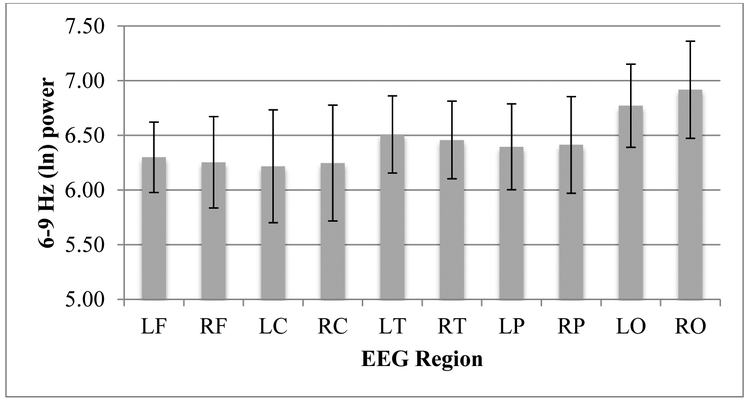
Physiological stress systems and the brain rapidly develop through infancy. While the roles of caregiving and environmental factors have been studied, implications of maternal physiological stress are unclear. We assessed maternal and infant diurnal cortisol when infants were 6 and 12 months. We measured 12-month infant electroencephalography (EEG) 6-9 Hz power during a social interaction. Steeper 6-month maternal slope predicted steeper 12-month infant slope controlling for 6-month infant slope and breastfeeding. Steeper 6-month maternal slope predicted lower 6-9 Hz power. Six-month maternal area under the cuve (AUCg) was unrelated to 12-month infant AUCg and 6-9 Hz power. Psychosocial, caregiving, and breastfeeding variables did not explain results. At 6 months, maternal and infant slopes correlated, as did maternal and infant AUCg. Twelve-month maternal and infant cortisol were unrelated. Results indicate maternal slope is an informative predictor of infant physiology and suggest the importance of maternal physiological stress in this developmental period.
生理应激系统和大脑在婴儿期迅速发育。虽然照料和环境因素的作用已得到研究,但母亲生理应激的影响尚不清楚。我们在婴儿6个月和12个月时评估了母婴的昼夜皮质醇水平。我们在社交互动期间测量了12个月大婴儿的脑电图(EEG)6 - 9赫兹功率。在控制6个月大婴儿斜率和母乳喂养的情况下,6个月大母亲的斜率越陡,预测12个月大婴儿的斜率越陡。6个月大母亲的斜率越陡,预测6 - 9赫兹功率越低。6个月大母亲的曲线下面积(AUCg)与12个月大婴儿的AUCg以及6 - 9赫兹功率无关。心理社会、照料和母乳喂养变量无法解释这些结果。在6个月时,母婴斜率相关,母婴AUCg也相关。12个月时母婴皮质醇不相关。结果表明母亲斜率是婴儿生理状况的一个有意义的预测指标,并表明母亲生理应激在这个发育阶段的重要性。