Zhu Ya-Jing, You Hua, Tan Jin-Xiang, Li Fan, Qiu Zhu, Li Hong-Zhong, Huang Hong-Yan, Zheng Ke, Ren Guo-Sheng
Molecular Oncology and Epigenetics Laboratory, The First Affiliated Hospital of Chongqing Medical University, Yuzhong, Chongqing 400016, P.R. China.
Department of Lymphoma, Head and Neck Oncology, Affiliated Hospital of Academy of Military Medical Sciences, Fengtai, Beijing 100071, P.R. China.
Oncol Lett. 2017 Jul;14(1):63-72. doi: 10.3892/ol.2017.6134. Epub 2017 May 8.
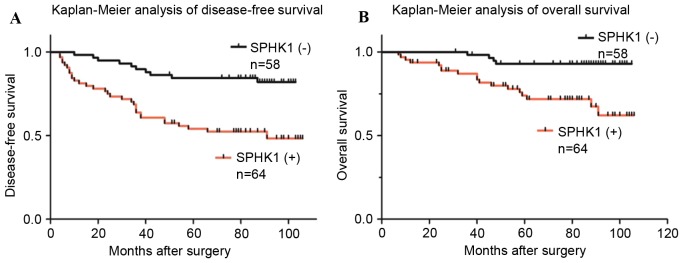
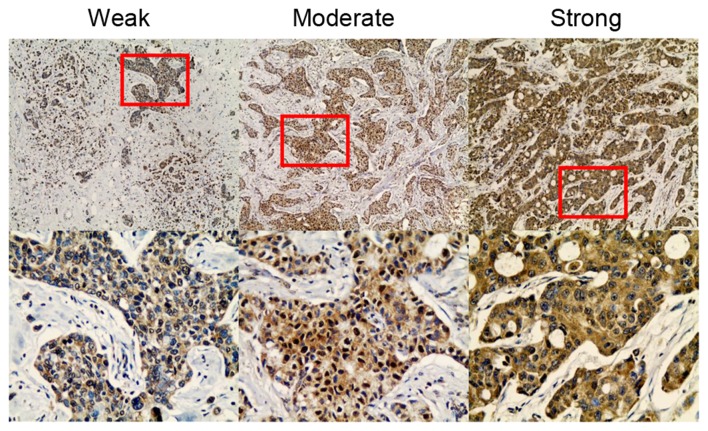
Sphingosine kinase 1 (SPHK1) is a bioactive lipid mediator that has been identified as a biomarker in various cancers and is considered to play an important role in tumor progression. In the present study, the expression level of SPHK1 was examined in breast cancer clinical specimens, and its association with patient survival was investigated to clarify the clinical significance of SPHK1 in breast cancer. SPHK1 mRNA expression was increased in breast cancer tissues compared with that in matched adjacent breast tissues in 19 of 32 paired tissue specimens (59.4%). Immunohistochemical analysis of 122 breast cancer cases revealed that the expression levels of SPHK1 were upregulated in 64 tumor tissues (52.5%), and increased expression levels of the protein were significantly associated with the presence of lymph node metastasis (P=0.0016), number of positive lymph nodes (P=0.0268) and presence of distant metastasis (P=0.0097). Increased SPHK1 protein expression was also associated with human epidermal growth factor receptor 2 status (P=0.0100), initial symptoms (P=0.0025) and tumor location (P=0.0457). Patients with increased SPHK1 protein expression had shorter overall survival and disease-free survival times compared with patients with lower SPHK1. Univariate and multivariate analyses indicated that high SPHK1 expression may be a poor prognostic factor. These results indicated that SPHK1 may perform an important role in breast cancer and may be a predictive factor in patients with breast cancer.
鞘氨醇激酶1(SPHK1)是一种生物活性脂质介质,已被确定为多种癌症的生物标志物,并被认为在肿瘤进展中起重要作用。在本研究中,检测了乳腺癌临床标本中SPHK1的表达水平,并研究了其与患者生存的关系,以阐明SPHK1在乳腺癌中的临床意义。在32对配对组织标本中的19对(59.4%)中,乳腺癌组织中SPHK1 mRNA表达高于配对的相邻乳腺组织。对122例乳腺癌病例的免疫组织化学分析显示,64例肿瘤组织(52.5%)中SPHK1表达上调,蛋白表达水平升高与淋巴结转移(P=0.0016)、阳性淋巴结数量(P=0.0268)和远处转移(P=0.0097)显著相关。SPHK1蛋白表达增加还与人类表皮生长因子受体2状态(P=0.0100)、初始症状(P=0.0025)和肿瘤位置(P=0.0457)相关。与SPHK1水平较低的患者相比,SPHK1蛋白表达增加的患者总生存期和无病生存期较短。单因素和多因素分析表明,高SPHK1表达可能是一个不良预后因素。这些结果表明,SPHK1可能在乳腺癌中发挥重要作用,并且可能是乳腺癌患者的一个预测因素。