Department of Rehabilitation Sciences, College of Health Sciences, 900 South Limestone, Lexington, KY 40536 USA.
The Center for Muscle Biology, University of Kentucky, 900 South Limestone, Lexington, KY 40536 USA.
Skelet Muscle. 2017 Jul 10;7(1):14. doi: 10.1186/s13395-017-0132-z.
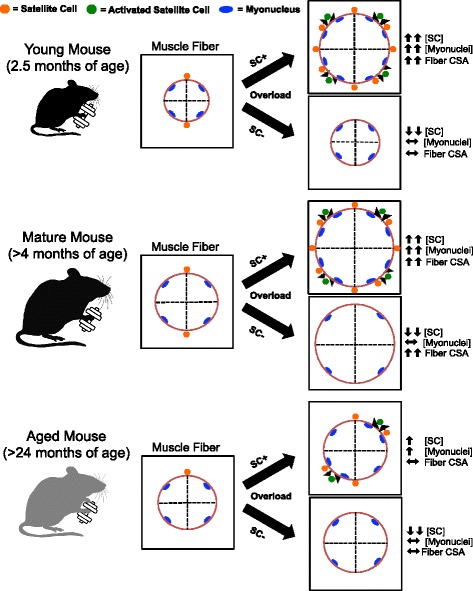
Pax7+ satellite cells are required for skeletal muscle fiber growth during post-natal development in mice. Satellite cell-mediated myonuclear accretion also appears to persist into early adulthood. Given the important role of satellite cells during muscle development, we hypothesized that the necessity of satellite cells for adaptation to an imposed hypertrophic stimulus depends on maturational age.
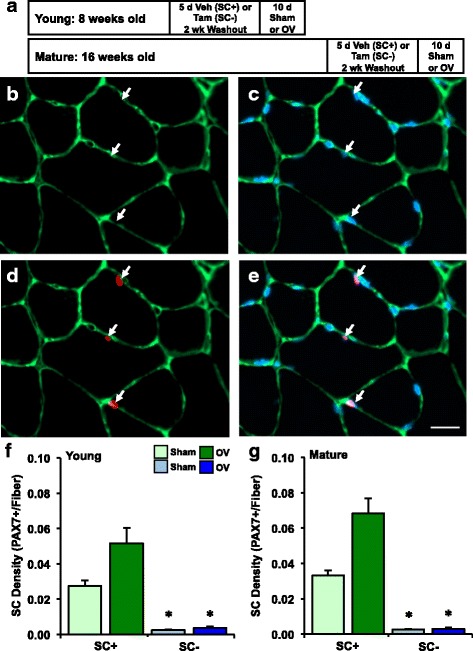
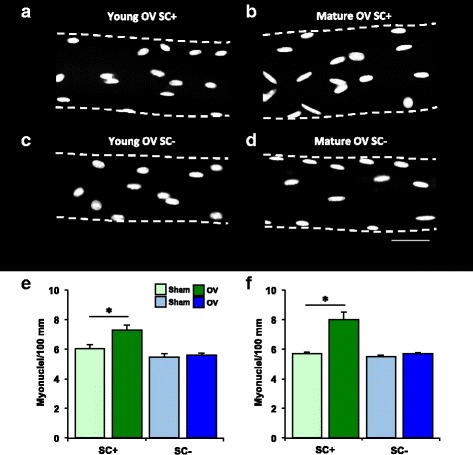
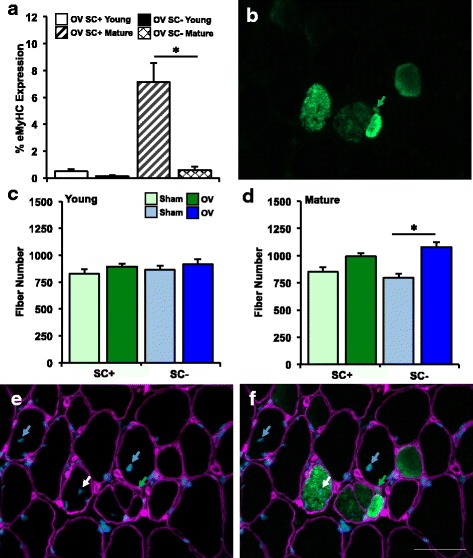
Pax7-R26R mice were treated for 5 days with vehicle (satellite cell-replete, SC+) or tamoxifen (satellite cell-depleted, SC-) at 2 months (young) and 4 months (mature) of age. Following a 2-week washout, mice were subjected to sham surgery or 10 day synergist ablation overload of the plantaris (n = 6-9 per group). The surgical approach minimized regeneration, de novo fiber formation, and fiber splitting while promoting muscle fiber growth. Satellite cell density (Pax7+ cells/fiber), embryonic myosin heavy chain expression (eMyHC), and muscle fiber cross sectional area (CSA) were evaluated via immunohistochemistry. Myonuclei (myonuclei/100 mm) were counted on isolated single muscle fibers.
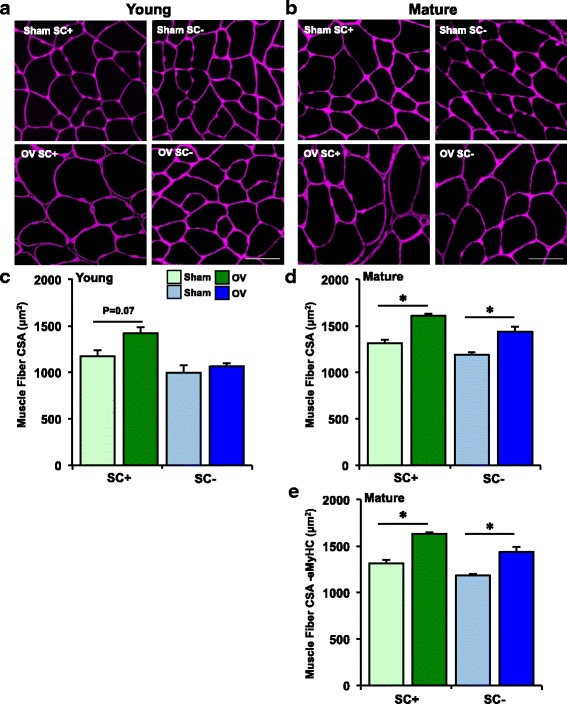
Tamoxifen treatment depleted satellite cells by ≥90% and prevented myonuclear accretion with overload in young and mature mice (p < 0.05). Satellite cells did not recover in SC- mice after overload. Average muscle fiber CSA increased ~20% in young SC+ (p = 0.07), mature SC+ (p < 0.05), and mature SC- mice (p < 0.05). In contrast, muscle fiber hypertrophy was prevented in young SC- mice. Muscle fiber number increased only in mature mice after overload (p < 0.05), and eMyHC expression was variable, specifically in mature SC+ mice.
Reliance on satellite cells for overload-induced hypertrophy is dependent on maturational age, and global responses to overload differ in young versus mature mice.
在小鼠出生后的发育过程中,Pax7+卫星细胞是骨骼肌纤维生长所必需的。卫星细胞介导的肌核积累似乎也持续到成年早期。鉴于卫星细胞在肌肉发育中的重要作用,我们假设卫星细胞对于适应强制肥大刺激的必要性取决于成熟年龄。
Pax7-R26R 小鼠在 2 个月(年轻)和 4 个月(成熟)时分别用载体(卫星细胞丰富,SC+)或他莫昔芬(卫星细胞耗尽,SC-)处理 5 天。经过 2 周的洗脱期后,小鼠接受假手术或 10 天协同肌消融超负荷的比目鱼肌(每组 6-9 只)。该手术方法最大限度地减少了再生、新纤维形成和纤维分裂,同时促进了肌肉纤维生长。通过免疫组织化学评估卫星细胞密度(Pax7+细胞/纤维)、胚胎肌球蛋白重链表达(eMyHC)和肌肉纤维横截面积(CSA)。在分离的单个肌纤维上计数肌核(肌核/100mm)。
他莫昔芬处理通过≥90%耗尽卫星细胞,并防止年轻和成熟小鼠超负荷时的肌核积累(p<0.05)。负荷后 SC- 小鼠的卫星细胞没有恢复。年轻的 SC+(p=0.07)、成熟的 SC+(p<0.05)和成熟的 SC- 小鼠(p<0.05)的平均肌肉纤维 CSA 增加了约 20%。相比之下,年轻的 SC- 小鼠的肌肉纤维肥大被阻止了。只有在成熟的小鼠中,负荷后肌肉纤维数量才增加(p<0.05),并且 eMyHC 的表达是可变的,特别是在成熟的 SC+ 小鼠中。
依赖卫星细胞来实现超负荷诱导的肥大依赖于成熟年龄,并且年轻和成熟的小鼠对超负荷的反应不同。