Shepherd Thomas A, Edelstyn Nicola M J, Longshaw Laura, Sim Julius, Watts Keira, Mayes Andrew R, Murray Michael, Ellis Simon J
Research Institute for Primary Care and Health Sciences, Keele University, ST5 5BG Keele, Staffordshire UK.
School of Psychology, Keele University, Keele, Staffordshire UK.
Pilot Feasibility Stud. 2017 Jul 6;4:11. doi: 10.1186/s40814-017-0154-7. eCollection 2018.
The aim was to assess the feasibility of a single-centre, single-blind, randomized, crossover design to explore the effects of two slow-release dopamine agonists, ropinirole and pramipexole, on cued recall in Parkinson's disease. As the design required a switch from the prescribed agonist (pramipexole-to-ropinirole, or ropinirole-to-pramipexole), the primary objectives were to (a) examine the efficacy of processes and procedures used to manage symptoms during the washout period and (b) to use cued recall estimates to inform a power calculation for a definitive trial. Secondary objectives were to assess consent and missing data rates, acceptability of clinical support for the OFF sessions, experience of the OFF sessions and of agonist switching, barriers-to-participation for patients and informal caregivers.
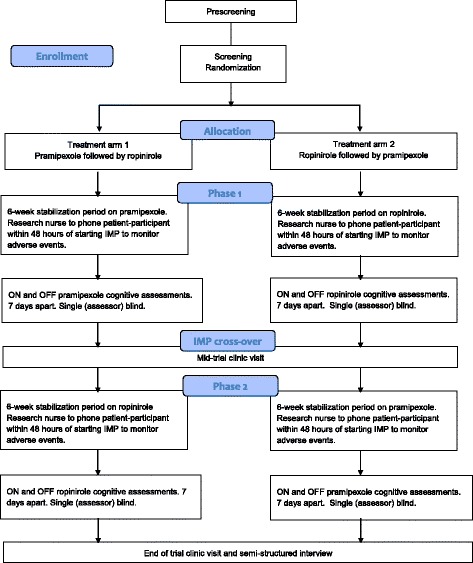
Patients were randomized in a 1:1 ratio to two treatment arms and stabilized on each agonist for 6 weeks. The arms differed only in the sequence in which the agonists were administered. Cued recall was assessed ON medication and, following a washout period resulting in 93.75% agonist elimination, OFF medication.
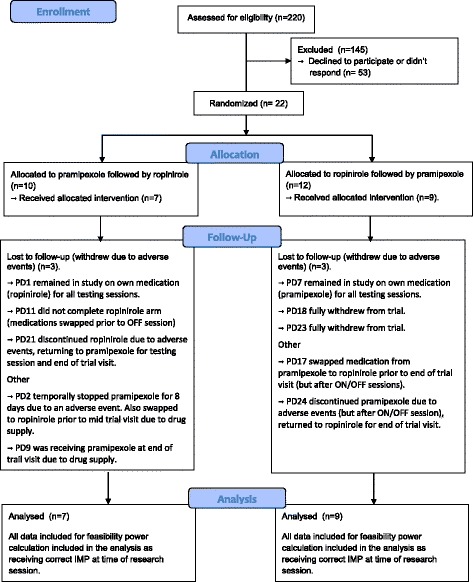
A total of 220 patients were screened: 145 were excluded and 75 invitations to participate were sent to eligible patients. Fifty-three patients declined, 22 consented and 16 completed the study. There were no serious adverse events, and rates of non-serious adverse events were equivalent between the agonists. Using the largest standard deviation (SD) of the ON-OFF difference cued recall score (inflated by ~25% to give a conservative estimate of the SD in a definitive trial) and assuming an effect of at least 10% of the observed range of OFF medication cued recall scores for either agonist to be clinically important, a main trial requires a sample size of just under 150 patients. The consent and missing data rates were 29 and 27% respectively. The washout period and the preparation for the OFF sessions were acceptable, and the sessions were manageable. The experience of switching was also manageable. Barriers to participation included concerns about disease stability, side effects, research process, carer workload and accessibility of the information sheet.
This study presented challenges to recruitment both in design and execution, and while it was a major aim of the study to assess this, evaluation of these challenges provided the opportunity to explore how they could be overcome for future studies.
EudraCT 2012-000801-64.
本研究旨在评估单中心、单盲、随机交叉设计的可行性,以探究两种缓释多巴胺激动剂罗匹尼罗和普拉克索对帕金森病线索回忆的影响。由于该设计要求从规定的激动剂(普拉克索换为罗匹尼罗,或罗匹尼罗换为普拉克索)进行转换,主要目标是:(a)检查洗脱期用于管理症状的流程和程序的有效性;(b)使用线索回忆估计值为确定性试验进行样本量计算提供依据。次要目标是评估同意率和缺失数据率、停药期临床支持的可接受性、停药期以及激动剂转换的体验、患者和非正式照料者参与研究的障碍。
患者按1:1比例随机分为两个治疗组,每组在每种激动剂上稳定治疗6周。两组仅在激动剂给药顺序上不同。在服药时评估线索回忆,并在经过洗脱期使激动剂消除率达到93.75%后,在停药时评估线索回忆。
共筛选了220例患者:145例被排除,向符合条件的患者发出了75份参与邀请。53例患者拒绝,22例同意,16例完成了研究。未发生严重不良事件,两种激动剂的非严重不良事件发生率相当。使用服药 - 停药差异线索回忆评分的最大标准差(标准差)(增加约25%以给出确定性试验中标准差的保守估计),并假设任一激动剂停药时线索回忆评分观察范围至少10%的效应具有临床意义,主要试验所需样本量略低于150例患者。同意率和缺失数据率分别为29%和27%。洗脱期和停药期准备是可接受的,且停药期是可管理的。转换体验也是可管理的。参与障碍包括对疾病稳定性、副作用、研究过程、照料者工作量和信息表可获取性的担忧。
本研究在设计和实施方面都面临招募挑战,虽然评估这些挑战是本研究的一个主要目标,但对这些挑战的评估提供了一个机会,以探索未来研究如何克服这些挑战。
EudraCT 2012 - 000801 - 64。