Armour Mike, Dahlen Hannah G, Zhu Xiaoshu, Farquhar Cindy, Smith Caroline A
The National Institute of Complementary Medicine, Western Sydney University, Sydney, Australia.
School of Nursing and Midwifery, Western Sydney University, Sydney, Australia.
PLoS One. 2017 Jul 12;12(7):e0180177. doi: 10.1371/journal.pone.0180177. eCollection 2017.
We examined the effect of changing treatment timing and the use of manual, electro acupuncture on the symptoms of primary dysmenorrhea.
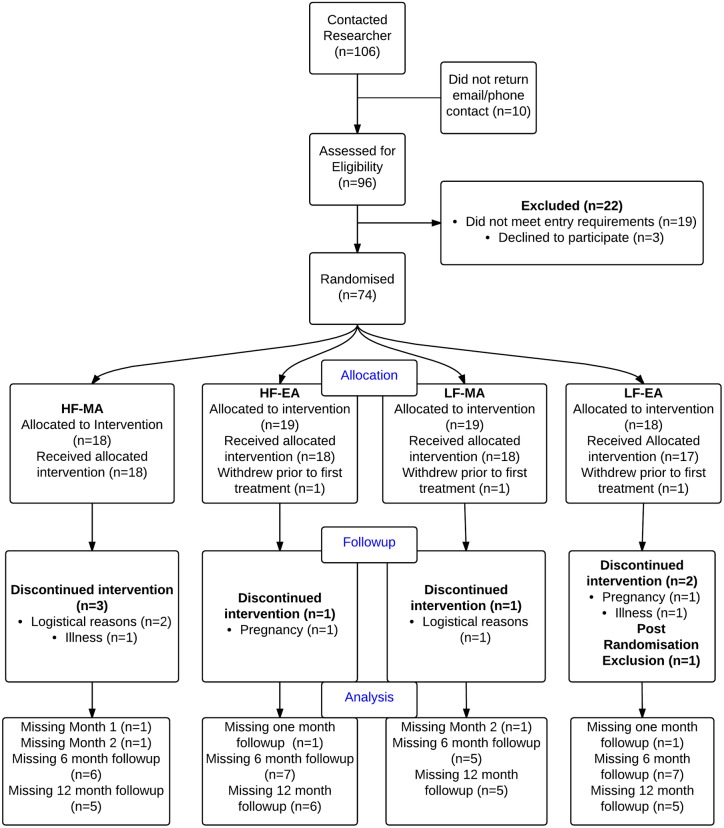
A randomised controlled trial was performed with four arms, low frequency manual acupuncture (LF-MA), high frequency manual acupuncture (HF-MA), low frequency electro acupuncture (LF-EA) and high frequency electro acupuncture (HF-EA). A manualised trial protocol was used to allow differentiation and individualized treatment over three months. A total of 74 women were randomly assigned to one of the four groups (LF-MA n = 19, HF-MA n = 18, LF-EA n = 18, HF-EA n = 19). Twelve treatments were performed over three menstrual cycles, either once per week (LF groups) or three times in the week prior to menses (HF groups). All groups received a treatment in the first 48 hours of menses. The primary outcome was the reduction in peak menstrual pain at 12 months from trial entry.
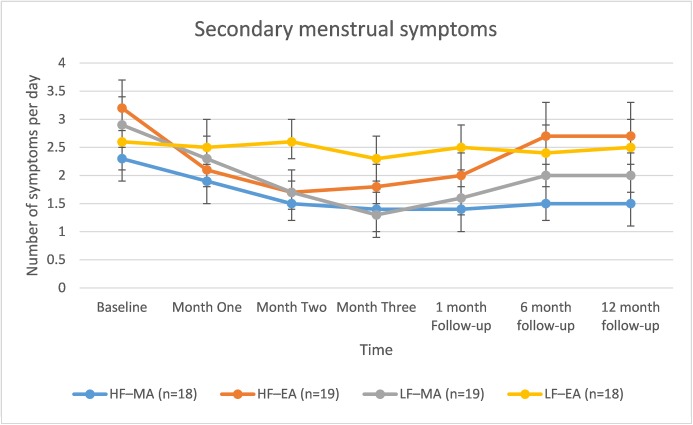
During the treatment period and nine month follow-up all groups showed statistically significant (p < .001) reductions in peak and average menstrual pain compared to baseline but there were no differences between groups (p > 0.05). Health related quality of life increased significantly in six domains in groups having high frequency of treatment compared to two domains in low frequency groups. Manual acupuncture groups required less analgesic medication than electro-acupuncture groups (p = 0.02). HF-MA was most effective in reducing secondary menstrual symptoms compared to both-EA groups (p<0.05).
Acupuncture treatment reduced menstrual pain intensity and duration after three months of treatment and this was sustained for up to one year after trial entry. The effect of changing mode of stimulation or frequency of treatment on menstrual pain was not significant. This may be due to a lack of power. The role of acupuncture stimulation on menstrual pain needs to be investigated in appropriately powered randomised controlled trials.
我们研究了改变治疗时机以及使用手动针刺、电针治疗对原发性痛经症状的影响。
进行了一项随机对照试验,分为四组,即低频手动针刺(LF-MA)、高频手动针刺(HF-MA)、低频电针(LF-EA)和高频电针(HF-EA)。采用标准化试验方案,在三个月内进行差异化和个体化治疗。共有74名女性被随机分配到四组中的一组(LF-MA组n = 19,HF-MA组n = 18,LF-EA组n = 18,HF-EA组n = 19)。在三个月经周期内进行12次治疗,低频组每周一次,高频组在月经前一周进行三次。所有组在月经的前48小时接受一次治疗。主要结局是自试验开始12个月时月经疼痛峰值的降低。
在治疗期间和9个月的随访中,与基线相比,所有组的月经疼痛峰值和平均疼痛均有统计学显著降低(p <.001),但组间无差异(p > 0.05)。与低频组的两个领域相比,高频治疗组的六个领域的健康相关生活质量显著提高。手动针刺组比电针组需要更少的止痛药物(p = 0.02)。与两个电针组相比,HF-MA在减轻继发性月经症状方面最有效(p<0.05)。
针刺治疗三个月后可减轻月经疼痛强度和持续时间,且在试验开始后长达一年仍持续有效。改变刺激方式或治疗频率对月经疼痛的影响不显著。这可能是由于样本量不足。针刺刺激对月经疼痛的作用需要在样本量合适的随机对照试验中进行研究。