
15-氧代二十碳四烯酸介导单核细胞与内皮细胞的黏附。
15-oxoeicosatetraenoic acid mediates monocyte adhesion to endothelial cell.
作者信息
Ma Guohua, Pan Bing, Ren Sufen, Guo Caixia, Guo Yansong, Wei Lixin, Zheng Lemin, Chen Buxing
机构信息
Department of Cardiology, Beijing Tian Tan Hospital, Capital Medical University, Beijing, 100050, China.
Tai Zhou Municipal Hospital, Taizhou, 318000, China.
出版信息
Lipids Health Dis. 2017 Jul 12;16(1):137. doi: 10.1186/s12944-017-0518-2.
BACKGROUND
A great number of studies reported that 12/15-lipoxygenase (12/15-LO) played an important role in atherosclerosis. And its arachidonic acid(AA) metabolite, 15(S)-hydroperoxy-5,8,11,13-(Z,Z,Z,E)-eicosatetraenoic acid (15(S)-HETE), is demonstrated to mediate endothelial dysfunction. 15-oxo-5,8,11,13-(Z,Z,Z,E)-eicosatetraenoic acid (15-oxo-ETE) was formed from 15-hydroxyprostaglandin dehydrogenase (PGDH)-mediated oxidation of 15(S)-HETE. However, relatively little is known about the biological effects of 15-oxo-ETE in cardiovascular disease. Here, we explore the likely role of 15-lipoxygenase (LO)-1-mediated AA metabolism,15-oxo-ETE, in the early pathogenesis of atherosclerosis.
METHODS
The 15-oxo-ETE level in serum was detected by means of liquid chromatography and online tandem mass spectrometry (LC-MS/MS). And the underlying mechanisms were illuminated by molecular techniques, including immunoblotting, MTT assay, immunocytochemistry and Immunohistochemistry.
RESULTS
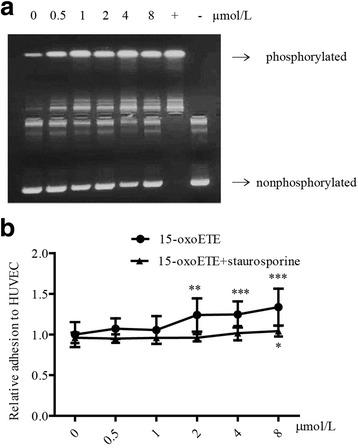
Increased 15-oxo-ETE level is found in in patients with acute myocardial infarction (AMI). After 15-oxo-ETE treatment, Human umbilical vein endothelial cells (HUVECs) showed more attractive to monocytes, whereas monocyte adhesion is suppressed when treated with PKC inhibitor. In ex vivo study, exposure of arteries from C57 mice and ApoE-/-mice to 15-oxo-ETE led to significantly increased E-selectin expression and monocyte adhesion.
CONCLUSIONS
This is the first report that 15-oxo-ETE promotes early pathological process of atherosclerosis by accelerating E-selectin expression and monocyte adhesion. 15-oxo-ETE -induced monocyte adhesion is partly attributable to activation of PKC.
背景
大量研究报道12/15 - 脂氧合酶(12/15 - LO)在动脉粥样硬化中起重要作用。其花生四烯酸(AA)代谢产物15(S) - 氢过氧 - 5,8,11,13 - (Z,Z,Z,E) - 二十碳四烯酸(15(S) - HETE)被证明可介导内皮功能障碍。15 - 氧代 - 5,8,11,13 - (Z,Z,Z,E) - 二十碳四烯酸(15 - 氧代 - ETE)由15 - 羟基前列腺素脱氢酶(PGDH)介导的15(S) - HETE氧化形成。然而,关于15 - 氧代 - ETE在心血管疾病中的生物学效应知之甚少。在此,我们探讨15 - 脂氧合酶(LO) - 1介导的AA代谢产物15 - 氧代 - ETE在动脉粥样硬化早期发病机制中的可能作用。
方法
采用液相色谱和在线串联质谱(LC - MS/MS)检测血清中15 - 氧代 - ETE水平。并通过分子技术阐明潜在机制,包括免疫印迹、MTT法、免疫细胞化学和免疫组织化学。
结果
急性心肌梗死(AMI)患者血清中15 - 氧代 - ETE水平升高。15 - 氧代 - ETE处理后,人脐静脉内皮细胞(HUVECs)对单核细胞的吸引力增加,而用蛋白激酶C(PKC)抑制剂处理时单核细胞黏附受到抑制。在体外研究中,将C57小鼠和载脂蛋白E基因敲除(ApoE - / -)小鼠的动脉暴露于- 15 - 氧代 - ETE会导致E选择素表达和单核细胞黏附显著增加。
结论
这是首次报道15 - 氧代 - ETE通过加速E选择素表达和单核细胞黏附促进动脉粥样硬化的早期病理过程。15 - 氧代 - ETE诱导的单核细胞黏附部分归因于PKC的激活。


 Zotero 插件