Cuevas-Ramos Daniel, Lim Dawn Shao Ting, Fleseriu Maria
Department of Endocrinology and Metabolism, Neuroendocrinology Clinic, Instituto Nacional de Ciencias Médicas y Nutrición Salvador Zubirán, Vasco de Quiroga 15, Sección XVI, Tlalpan, Mexico City, 14030 Mexico.
Departments of Medicine (Endocrinology) and Neurological Surgery, and Northwest Pituitary Center, Oregon Health & Science University, 3303 SW Bond Ave, Mail Code CH8N, Portland, OR 97239 USA.
Clin Diabetes Endocrinol. 2016 Sep 13;2:16. doi: 10.1186/s40842-016-0033-9. eCollection 2016.
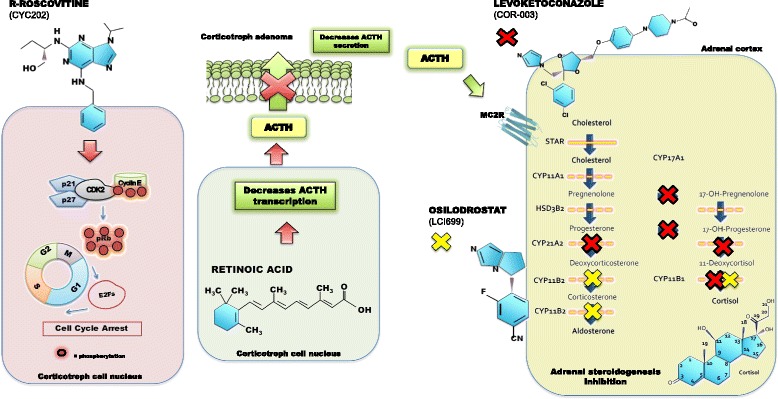
Cushing's disease (CD) is the most common cause of endogenous Cushing's syndrome (CS). The goal of treatment is to rapidly control cortisol excess and achieve long-term remission, to reverse the clinical features and reduce long-term complications associated with increased mortality. While pituitary surgery remains first line therapy, pituitary radiotherapy and bilateral adrenalectomy have traditionally been seen as second-line therapies for persistent hypercortisolism. Medical therapy is now recognized to play a key role in the control of cortisol excess. In this review, all currently available medical therapies are summarized, and novel medical therapies in phase 3 clinical trials, such as osilodrostat and levoketoconazole are discussed, with an emphasis on indications, efficacy and safety. Emerging data suggests increased efficacy and better tolerability with these novel therapies and combination treatment strategies, and potentially increases the therapeutic options for treatment of CD. New insights into the pathophysiology of CD are highlighted, along with potential therapeutic applications. Future treatments on the horizon such as R-roscovitine, retinoic acid, epidermal growth factor receptor inhibitors and somatostatin-dopamine chimeric compounds are also described, with a focus on potential clinical utility.
库欣病(CD)是内源性库欣综合征(CS)最常见的病因。治疗目标是迅速控制皮质醇过量并实现长期缓解,逆转临床特征并减少与死亡率增加相关的长期并发症。虽然垂体手术仍然是一线治疗方法,但垂体放疗和双侧肾上腺切除术传统上被视为持续性皮质醇增多症的二线治疗方法。现在人们认识到药物治疗在控制皮质醇过量方面起着关键作用。在这篇综述中,总结了所有目前可用的药物治疗方法,并讨论了3期临床试验中的新型药物治疗方法,如奥西卓他和左酮康唑,重点介绍了适应证、疗效和安全性。新出现的数据表明,这些新型治疗方法和联合治疗策略具有更高的疗效和更好的耐受性,并可能增加治疗CD的选择。文中突出了对CD病理生理学的新见解以及潜在的治疗应用。还描述了即将出现的未来治疗方法,如R-罗哌汀、视黄酸、表皮生长因子受体抑制剂和生长抑素-多巴胺嵌合化合物,重点关注其潜在的临床应用。