Namouchi Amine, Cimino Mena, Favre-Rochex Sandrine, Charles Patricia, Gicquel Brigitte
Centre for Ecological and Evolutionary Synthesis, Department of Biosciences, University of Oslo, P.O. Box 1066, Blindern NO-0316, Oslo, Norway.
Unit of Mycobacterial genetics, Institut Pasteur, 25-28, rue du Docteur Roux, 75724, Paris, Cedex 15, France.
BMC Genomics. 2017 Jul 13;18(1):530. doi: 10.1186/s12864-017-3924-y.
Tuberculosis (TB) is caused by Mycobacterium tuberculosis and represents one of the major challenges facing drug discovery initiatives worldwide. The considerable rise in bacterial drug resistance in recent years has led to the need of new drugs and drug regimens. Model systems are regularly used to speed-up the drug discovery process and circumvent biosafety issues associated with manipulating M. tuberculosis. These include the use of strains such as Mycobacterium smegmatis and Mycobacterium marinum that can be handled in biosafety level 2 facilities, making high-throughput screening feasible. However, each of these model species have their own limitations.
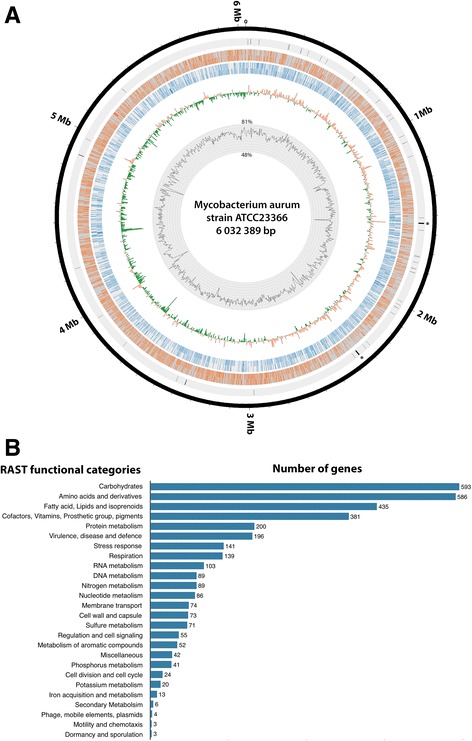
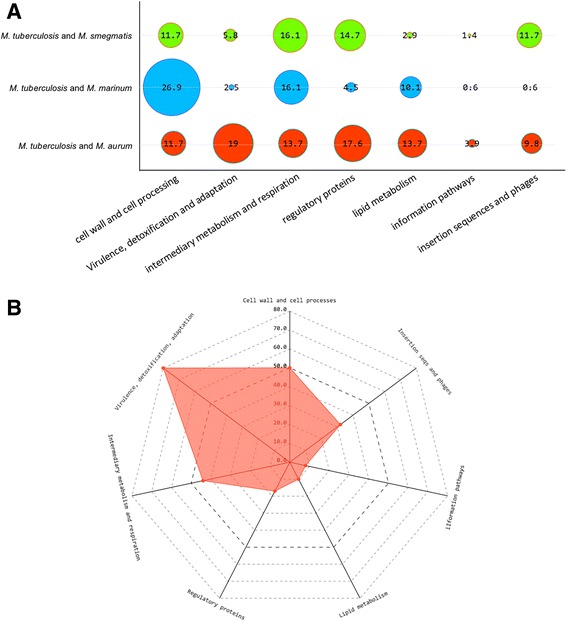
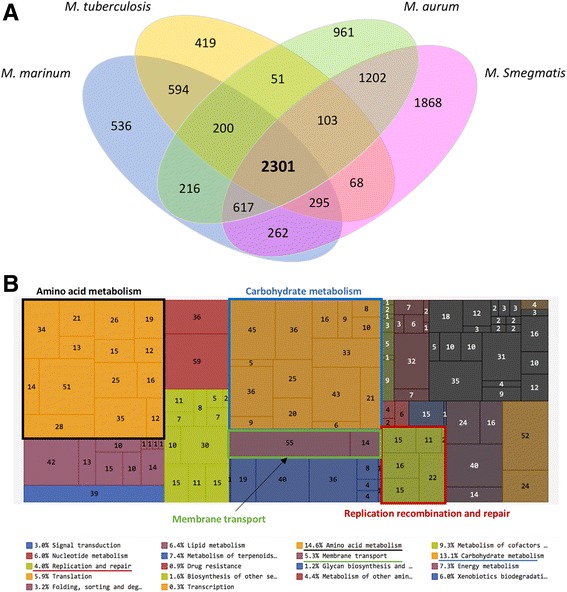
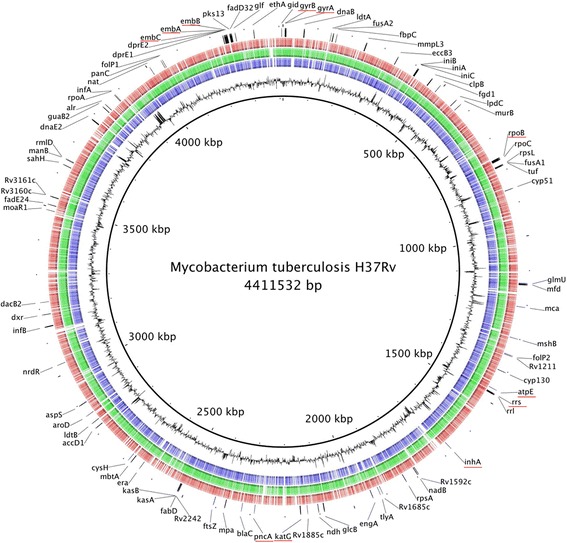
We report and describe the first complete genome sequence of Mycobacterium aurum ATCC23366, an environmental mycobacterium that can also grow in the gut of humans and animals as part of the microbiota. This species shows a comparable resistance profile to that of M. tuberculosis for several anti-TB drugs. The aims of this study were to (i) determine the drug resistance profile of a recently proposed model species, Mycobacterium aurum, strain ATCC23366, for anti-TB drug discovery as well as Mycobacterium smegmatis and Mycobacterium marinum (ii) sequence and annotate the complete genome sequence of this species obtained using Pacific Bioscience technology (iii) perform comparative genomics analyses of the various surrogate strains with M. tuberculosis (iv) discuss how the choice of the surrogate model used for drug screening can affect the drug discovery process.
We describe the complete genome sequence of M. aurum, a surrogate model for anti-tuberculosis drug discovery. Most of the genes already reported to be associated with drug resistance are shared between all the surrogate strains and M. tuberculosis. We consider that M. aurum might be used in high-throughput screening for tuberculosis drug discovery. We also highly recommend the use of different model species during the drug discovery screening process.
结核病(TB)由结核分枝杆菌引起,是全球药物研发计划面临的主要挑战之一。近年来细菌耐药性的显著上升导致了对新药和新治疗方案的需求。模型系统常用于加速药物研发过程,并规避与处理结核分枝杆菌相关的生物安全问题。这些系统包括使用耻垢分枝杆菌和海分枝杆菌等菌株,它们可在生物安全2级设施中处理,从而使高通量筛选成为可能。然而,这些模型物种都有各自的局限性。
我们报告并描述了金色分枝杆菌ATCC23366的首个完整基因组序列,这是一种环境分枝杆菌,作为微生物群的一部分也可在人和动物的肠道中生长。该物种对几种抗结核药物的耐药谱与结核分枝杆菌相当。本研究的目的是:(i)确定最近提出的用于抗结核药物研发的模型物种金色分枝杆菌ATCC23366以及耻垢分枝杆菌和海分枝杆菌的耐药谱;(ii)对使用太平洋生物科学技术获得的该物种的完整基因组序列进行测序和注释;(iii)对各种替代菌株与结核分枝杆菌进行比较基因组学分析;(iv)讨论用于药物筛选的替代模型的选择如何影响药物研发过程。
我们描述了用于抗结核药物研发的替代模型金色分枝杆菌的完整基因组序列。所有替代菌株和结核分枝杆菌之间共享了大多数已报道与耐药性相关的基因。我们认为金色分枝杆菌可用于结核病药物研发的高通量筛选。我们还强烈建议在药物研发筛选过程中使用不同的模型物种。