Ahmad Zainab, Sadiq Sara, Asghar Mariam, Khan Alizay Rashid, Arif Omer, Shah Syed Hamza, Nadeem Shahrukh, Waseem Yamna, Aibani Rafi, Syed Ammar Salman, Mustafa Rabia M, Abdulrahman Zainab, Fatima Kaneez
Dow University of Health Sciences (DUHS), Karachi, Pakistan.
MBBS, Dow University of Health Sciences (DUHS), Karachi, Pakistan.
Cureus. 2017 Jun 12;9(6):e1338. doi: 10.7759/cureus.1338.
Despite the high prevalence of human immunodeficiency virus (HIV) in Pakistan, no prior work has been done to specifically highlight the importance of education as a social vaccine against HIV. Therefore, our study focuses on differences in knowledge and practices regarding HIV and acquired immunodeficiency syndrome (AIDS) among educated and uneducated adults.
A cross-sectional study was carried out in which data was collected from all over Karachi. An individual was designated as educated if he had received education above primary school level. Individuals who had studied till primary school or less were considered uneducated. The questionnaire was split into four sections that assessed respondents' demographics, knowledge, attitudes, and practices regarding HIV/AIDS. Chi square test was used as the primary statistical test.
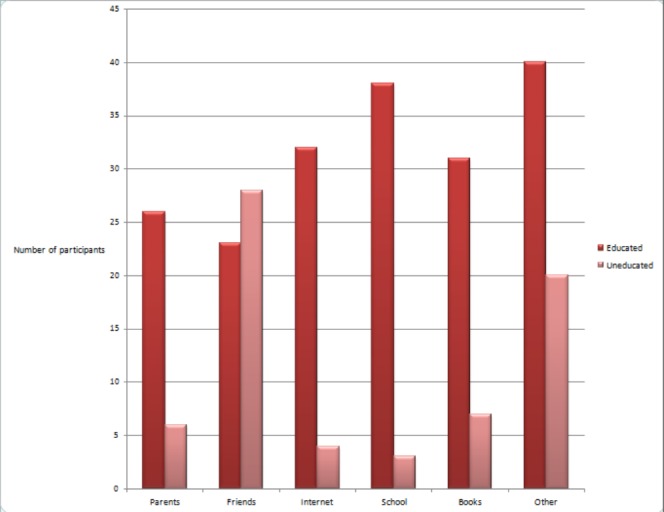
Out of the 446 adult participants, 235 (52.7%) were educated and 211 (47.3%) were uneducated. Educated participants were significantly more likely to have heard about HIV (183 vs. 39, p < 0.001) and had better knowledge about the symptoms of HIV/AIDS (p < 0.001). Among the participants who knew about AIDS, a greater percentage of uneducated (n = 28, 53%) than educated individuals (n = 68, 37%) believed that people suffering from AIDS should be isolated (p = o.o16) and that HIV can spread through water (40% vs 20% respectively, p < 0.001). Both educated (n = 49, 27%) and uneducated (n = 46, 89%) adults believed that awareness would help prevent the spread of HIV (p = 0.978) and were willing to educate their children about it (p = 0.696).
Our study revealed a gap in the knowledge about HIV/AIDS between educated and uneducated adults. There is an urgent need for awareness programs that especially reach out to the uneducated masses that are otherwise uninformed about HIV and are under high risk of acquiring HIV.
尽管巴基斯坦人类免疫缺陷病毒(HIV)感染率很高,但此前尚无专门研究强调教育作为预防HIV的社会疫苗的重要性。因此,我们的研究聚焦于受过教育和未受过教育的成年人在HIV和获得性免疫缺陷综合征(AIDS)知识及行为方面的差异。
开展了一项横断面研究,从卡拉奇各地收集数据。如果一个人接受过小学以上教育,则被认定为受过教育。只读到小学或更低学历的人被视为未受过教育。问卷分为四个部分,评估受访者的人口统计学特征、关于HIV/AIDS的知识、态度和行为。卡方检验用作主要统计检验。
在446名成年参与者中,235人(52.7%)受过教育,211人(47.3%)未受过教育。受过教育的参与者听说过HIV的可能性显著更高(183人对39人,p<0.001),并且对HIV/AIDS症状的了解更好(p<0.001)。在了解艾滋病的参与者中,未受过教育的人(n = 28,53%)比受过教育的人(n = 68,37%)中更大比例的人认为艾滋病患者应该被隔离(p = 0.016),并且认为HIV可以通过水传播(分别为40%对20%,p<0.001)。受过教育的成年人(n = 49,27%)和未受过教育的成年人(n = 46,89%)都认为提高认识有助于预防HIV传播(p = 0.978),并且愿意向他们的孩子传授相关知识(p = 0.696)。
我们的研究揭示了受过教育和未受过教育的成年人在HIV/AIDS知识方面存在差距。迫切需要开展宣传项目,尤其要针对那些对HIV一无所知且感染HIV风险很高的未受过教育的人群。