Burlion Aude, Brunel Simon, Petit Nicolas Y, Olive Daniel, Marodon Gilles
Sorbonne Universités, UPMC Université Paris 06, CIMI-PARIS (Centre d'Immunologie et des Maladies Infectieuses), INSERM U 1135, CNRS ERL 8255, Paris, France.
Centre de recherche en Cancérologie de Marseille, INSERM U1068, CNRS U7258, Aix Marseille Université, Institut Paoli - Calmettes, Marseille, France.
Front Immunol. 2017 Jun 30;8:756. doi: 10.3389/fimmu.2017.00756. eCollection 2017.
Graft-vs-host disease (GVHD) is a major complication of allogenic bone marrow transplantation (BMT). Targeting costimulatory molecules with antagonist antibodies could dampen the excessive immune response that occurs, while preserving the beneficial graft vs leukemia (GVL) of the allogeneic response. Previous studies using a mouse model of GVHD have shown that targeting the T-cell Inducible COStimulator (ICOS, CD278) molecule is beneficial, but it is unclear whether the same applies to human cells.
Here, we assessed whether a monoclonal antibody (mAb) to human ICOS was able to antagonize the costimulatory signal delivered to human T cells. To test this hypothesis, we used a xenogeneic model of GVHD where human peripheral blood mononuclear cells were adoptively transferred in immunocompromised NOD.SCID.gc-null mice (NSG).
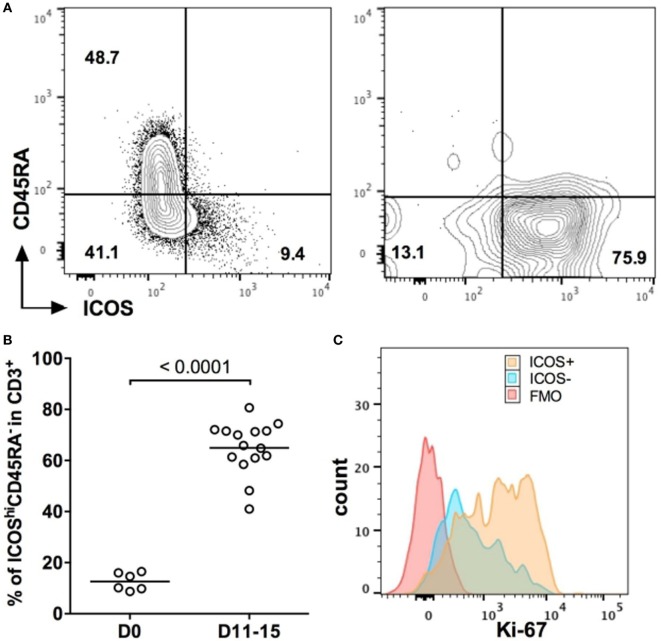
In this model, control mice invariably lost weight and died by day 50. In contrast, 65% of the mice receiving a single injection of the anti-hICOS mAb survived beyond 100 days. Moreover, a significant improvement in survival was obtained in a curative xeno-GVHD setting. Mechanistically, administration of the anti-hICOS mAb was associated with a strong reduction in perivascular infiltrates in liver and lungs and reduction in frequencies and numbers of human T cells in the spleen. In addition, the mAb prevented T-cell expansion in the blood during xeno-GVHD. Importantly, GVHD-protected mice retained the ability to control the P815 mastocytoma cell line, mimicking GVL in humans.
A mAb-targeting human ICOS alleviated GVHD without impairing GVL in a xenograft murine model. Thus, ICOS represents a promising target in the management of BMT, preventing GVHD while preserving GVL.
移植物抗宿主病(GVHD)是异基因骨髓移植(BMT)的主要并发症。用拮抗剂抗体靶向共刺激分子可抑制发生的过度免疫反应,同时保留异基因反应有益的移植物抗白血病(GVL)作用。先前使用GVHD小鼠模型的研究表明,靶向T细胞诱导共刺激分子(ICOS,CD278)是有益的,但尚不清楚这是否同样适用于人类细胞。
在此,我们评估了抗人ICOS单克隆抗体(mAb)是否能够拮抗传递至人T细胞的共刺激信号。为了验证这一假设,我们使用了GVHD异种模型,将人外周血单个核细胞过继转移至免疫缺陷的NOD.SCID.gc基因敲除小鼠(NSG)体内。
在该模型中,对照小鼠无一例外体重减轻,并在第50天死亡。相比之下,单次注射抗hICOS mAb的小鼠中有65%存活超过100天。此外,在治愈性异种GVHD情况下,存活率有显著提高。从机制上讲,给予抗hICOS mAb与肝脏和肺部血管周围浸润的显著减少以及脾脏中人T细胞频率和数量的减少有关。此外,该mAb可防止异种GVHD期间血液中T细胞的扩增。重要的是,受GVHD保护的小鼠保留了控制P815肥大细胞瘤细胞系的能力,类似于人类的GVL。
在异种移植小鼠模型中,靶向人ICOS的mAb可减轻GVHD而不损害GVL。因此,ICOS是BMT治疗中有前景的靶点,可预防GVHD同时保留GVL。