Zeng Huijun, Xu Ningbo, Liu Yanting, Liu Boyang, Yang Zhao, Fu Zhao, Lian Changlin, Guo Hongbo
The National Key Clinical Specialty, The Engineering Technology Research Center of Education Ministry of China, Guangdong Provincial Key Laboratory on Brain Function Repair and Regeneration, Department of Neurosurgery, Zhujiang Hospital, Southern Medical University, Guangzhou, Guangdong 510282, P.R. China.
The First College of Clinical Medical Science, China Three Gorges University, Yichang, Hubei 443002, P.R. China.
Int J Oncol. 2017 Aug;51(2):445-455. doi: 10.3892/ijo.2017.4033. Epub 2017 Jun 7.
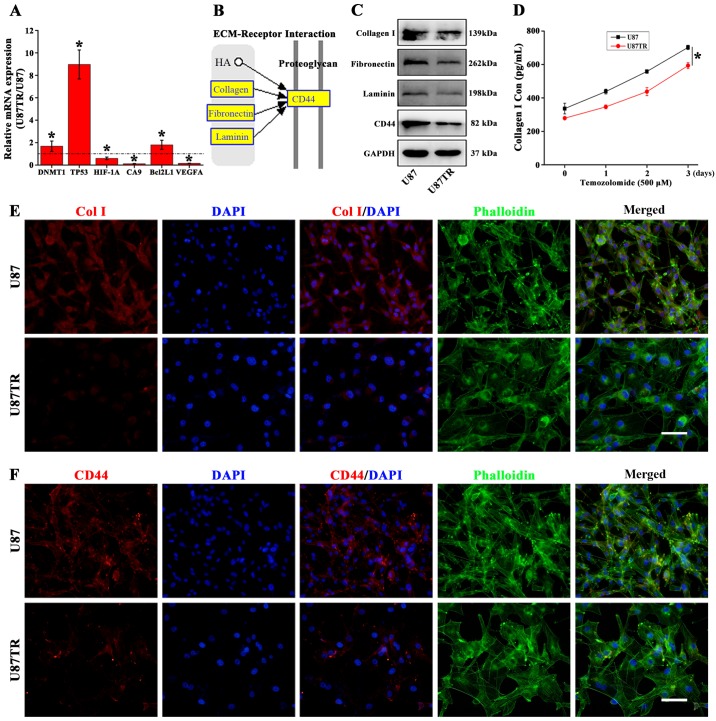
Temozolomide (TMZ) is an alkylating chemotherapeutic agent widely used in anti-glioma treatment. However, acquired TMZ resistance represents a major clinical challenge that leads to tumor relapse or progress. This study investigated the genomic profiles including long non-coding RNA (lncRNA) and mRNA expression associated with acquired TMZ resistance in glioblastoma (GBM) cells in vitro. The TMZ-resistant (TR) of GBM sub-cell lines were established through repetitive exposure to increasing TMZ concentrations in vitro. The differentially expressed lncRNAs and mRNAs between the parental U87 and U87TR cells were detected by human lncRNA microarray method. In this study, we identified 2,692 distinct lncRNAs demonstrating >2-fold differential expression with 1,383 lncRNAs upregulated and 1,309 lncRNAs downregulated. Moreover, 4,886 differential mRNAs displayed 2,933 mRNAs upregulated and 1,953 mRNAs downregulated. Further lncRNA classification and subgroup analysis revealed the potential functions of the lncRNA-mRNA relationship associated with the acquired TMZ resistance. Gene ontology and pathway analysis on mRNAs showed significant biological regulatory genes and pathways involved in acquired TMZ resistance. Moreover, we found the ECM‑receptor interaction pathway was significantly downregulated and ECM related collagen Ι, fibronectin, laminin and CD44 were closely associated with the TR phenotype in vitro. Our findings indicate that the dysregulated lncRNAs and mRNAs identified in this work may provide novel targets for overcoming acquired TMZ resistance in GBM chemotherapy.
替莫唑胺(TMZ)是一种广泛用于抗胶质瘤治疗的烷化剂化疗药物。然而,获得性TMZ耐药是导致肿瘤复发或进展的主要临床挑战。本研究在体外调查了与胶质母细胞瘤(GBM)细胞获得性TMZ耐药相关的基因组图谱,包括长链非编码RNA(lncRNA)和mRNA表达。通过在体外反复暴露于递增的TMZ浓度,建立了GBM亚细胞系的TMZ耐药(TR)细胞。采用人lncRNA芯片法检测亲本U87和U87TR细胞之间差异表达的lncRNA和mRNA。在本研究中,我们鉴定出2692种不同的lncRNA,其差异表达倍数>2倍,其中1383种lncRNA上调,1309种lncRNA下调。此外,4886种差异mRNA中,2933种mRNA上调,1953种mRNA下调。进一步的lncRNA分类和亚组分析揭示了与获得性TMZ耐药相关的lncRNA-mRNA关系的潜在功能。对mRNA的基因本体论和通路分析显示,有重要的生物调节基因和通路参与获得性TMZ耐药。此外,我们发现体外ECM-受体相互作用通路显著下调,且ECM相关的胶原蛋白Ι、纤连蛋白、层粘连蛋白和CD44与TR表型密切相关。我们的研究结果表明,本研究中鉴定出的lncRNA和mRNA失调可能为克服GBM化疗中的获得性TMZ耐药提供新的靶点。