
采用双螺杆挤出进行热机械纤维预处理对可再生无胶香菜纤维板生产及性能的影响
Impact of Thermomechanical Fiber Pre-Treatment Using Twin-Screw Extrusion on the Production and Properties of Renewable Binderless Coriander Fiberboards.
作者信息
Uitterhaegen Evelien, Labonne Laurent, Merah Othmane, Talou Thierry, Ballas Stéphane, Véronèse Thierry, Evon Philippe
机构信息
Laboratoire de Chimie Agro-industrielle (LCA), Université de Toulouse, Institut National de la Recherche Agronomique (INRA), Institut National Polytechnique de Toulouse (INPT), 31030 Toulouse CEDEX 4, France.
Ovalie Innovation, 2 Rue Marguerite Duras, 32000 Auch, France.
出版信息
Int J Mol Sci. 2017 Jul 17;18(7):1539. doi: 10.3390/ijms18071539.
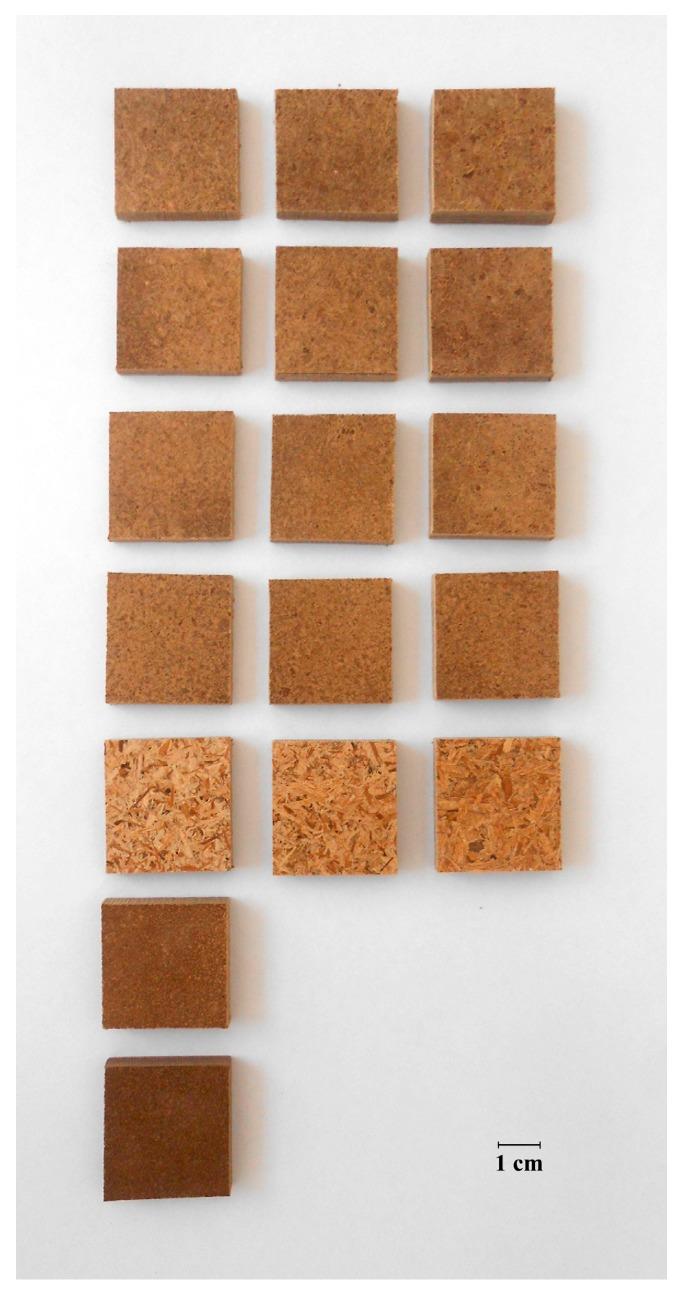
The aim of this study consisted of manufacturing renewable binderless fiberboards from coriander straw and a deoiled coriander press cake, thus at the same time ensuring the valorization of crop residues and process by-products. The press cake acted as a natural binder inside the boards owing to the thermoplastic behavior of its protein fraction during thermopressing. The influence of different fiber-refining methods was evaluated and it was shown that a twin-screw extrusion treatment effectively improved fiber morphology and resulted in fiberboards with enhanced performance as compared to a conventional grinding process. The best fiberboard was produced with extrusion-refined straw using a 0.4 liquid/solid (L/S) ratio and with 40% press cake addition. The water sensitivity of the boards was effectively reduced by 63% through the addition of an extrusion raw material premixing operation and thermal treatment of the panels at 200 °C, resulting in materials with good performance showing a flexural strength of 29 MPa and a thickness swelling of 24%. Produced without the use of any chemical adhesives, these fiberboards could thus present viable, sustainable alternatives for current commercial wood-based materials such as oriented strand board, particleboard and medium-density fiberboard, with high cost-effectiveness.
本研究的目的是用香菜秸秆和脱油香菜压榨饼制造可再生无胶纤维板,从而同时确保农作物残余物和加工副产品的增值利用。由于其蛋白质部分在热压过程中的热塑性行为,压榨饼在纤维板内部充当天然粘合剂。评估了不同纤维精制方法的影响,结果表明,与传统研磨工艺相比,双螺杆挤压处理有效地改善了纤维形态,并使纤维板性能得到增强。使用0.4的液固比(L/S)和添加40%的压榨饼,用挤压精制的秸秆生产出了最佳纤维板。通过添加挤压原料预混合操作以及在200°C对板材进行热处理,板材的水敏感性有效降低了63%,得到了性能良好的材料,其弯曲强度为29MPa,厚度膨胀率为24%。这些纤维板在不使用任何化学粘合剂的情况下生产,因此对于当前的商用木质材料,如定向刨花板、刨花板和中密度纤维板而言,可能是可行的、可持续的替代品,且具有高成本效益。




 Zotero 插件