Filatov Alexander S, Spisak Sarah N, Zabula Alexander V, McNeely James, Rogachev Andrey Yu, Petrukhina Marina A
Department of Chemistry , University at Albany , State University of New York , Albany , NY 12222 , USA . Email:
Department of Chemistry , University of Wisconsin , Madison , WI 53706 , USA.
Chem Sci. 2015 Mar 1;6(3):1959-1966. doi: 10.1039/c4sc03485f. Epub 2014 Dec 16.
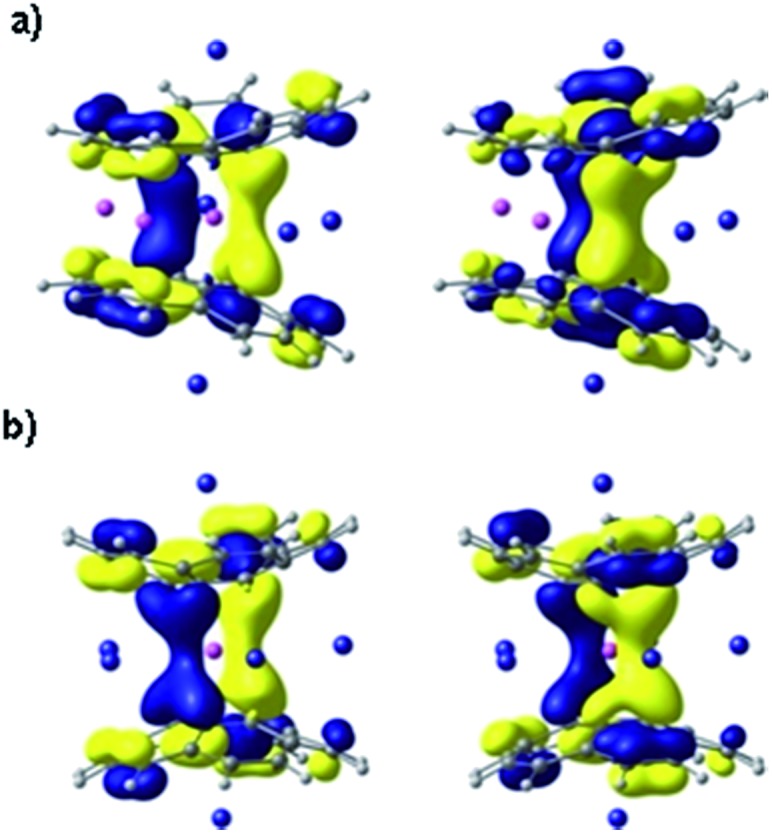
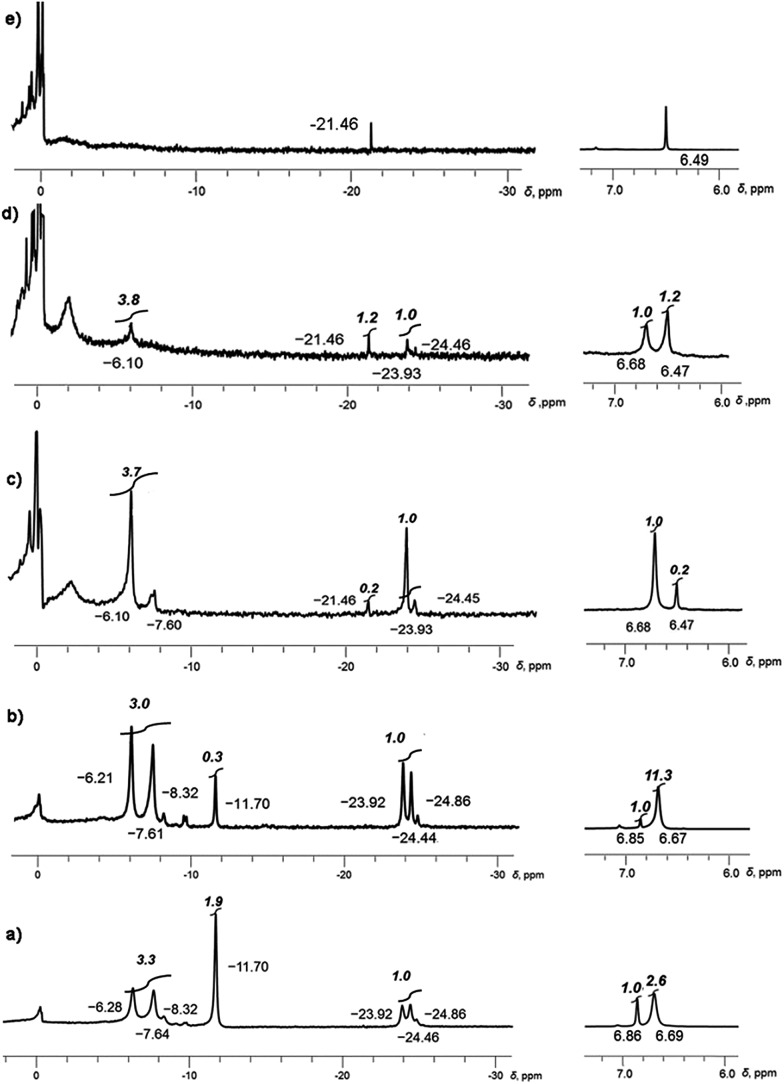
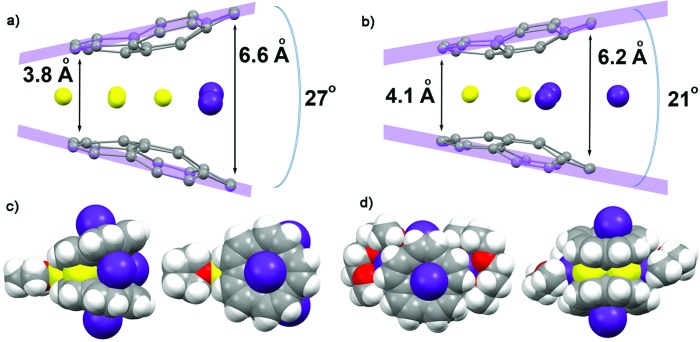
Self-assembly processes of the highly reduced bowl-shaped corannulene generated by the chemical reduction with a binary combination of alkali metals, namely Li-Rb, have been investigated by variable-temperature H and Li NMR spectroscopy. The formation of several unique mixed metal sandwich products based on tetrareduced corannulene, CH (), has been revealed followed by investigation of their dynamic transformations in solutions. Analysis of NMR data allowed to propose the mechanism of stepwise alkali metal substitution as well as to identify experimental conditions for the isolation of intermediate and final supramolecular products. As a result, two new triple-decker aggregates with a mixed Li-Rb core, [{Rb(THF)}]//[LiRb(CH){Li(THF)}] () and [{Rb(diglyme)}]//[LiRb(CH)(diglyme)]·0.5THF (·0.5THF), have been crystallized and structurally characterized. The LiRb-product has an open coordination site at the sandwich periphery and thus is considered transient on the way to the LiRb-sandwich having the maximized intercalated alkali metal content. Next, the formation of the LiRb self-assembly with has been identified by Li NMR as the final step in a series of dynamic transformations in this system. This product was also isolated and crystallographically characterized to confirm the LiRb core. Notably, all sandwiches have their central cavities, located in between the hub-sites of two CH decks, occupied by an internal Li ion which exhibits the record high negative shift (ranging from -21 to -25 ppm) in Li NMR spectra. The isolation of three novel aggregates having different Li-Rb core compositions allowed us to look into the origin of the unusual Li NMR shifts at the molecular level. The discussion of formation mechanisms, dynamic transformations as well as unique electronic structures of these remarkable mixed alkali metal organometallic self-assemblies is provided and supported by DFT calculations.
通过变温氢核磁共振和锂核磁共振光谱研究了由碱金属二元组合(即锂 - 铷)化学还原生成的高度还原的碗状蔻的自组装过程。基于四还原蔻(CH)揭示了几种独特的混合金属夹心产物的形成,随后研究了它们在溶液中的动态转变。核磁共振数据分析有助于提出逐步碱金属取代的机制,并确定分离中间和最终超分子产物的实验条件。结果,两种具有混合锂 - 铷核的新型三层聚集体[{Rb(THF)}]//[LiRb(CH){Li(THF)}]()和[{Rb(二甘醇二甲醚)}]//[LiRb(CH)(二甘醇二甲醚)]·0.5THF(·0.5THF)已结晶并进行了结构表征。锂铷产物在夹心外围有一个开放的配位位点,因此在形成插层碱金属含量最大化的锂铷夹心的过程中被认为是过渡态的。接下来,通过锂核磁共振确定了锂铷与的自组装的形成是该系统一系列动态转变的最后一步。该产物也被分离并通过晶体学表征以确认锂铷核。值得注意的是,所有夹心结构在两个CH层的轮毂位点之间都有其中心腔,被一个内部锂离子占据,该锂离子在锂核磁共振光谱中表现出创纪录的高负位移(范围从 -21到 -25 ppm)。三种具有不同锂 - 铷核组成的新型聚集体的分离使我们能够在分子水平上探究异常锂核磁共振位移的起源。通过密度泛函理论计算提供并支持了对这些显著的混合碱金属有机金属自组装体的形成机制、动态转变以及独特电子结构的讨论。