Deutsches Zentrum für Neurodegenerative Erkrankungen (DZNE), Sigmund-Freud-Str, 27 53127, Bonn, Germany.
Sci Rep. 2017 Jul 18;7(1):5665. doi: 10.1038/s41598-017-06015-3.
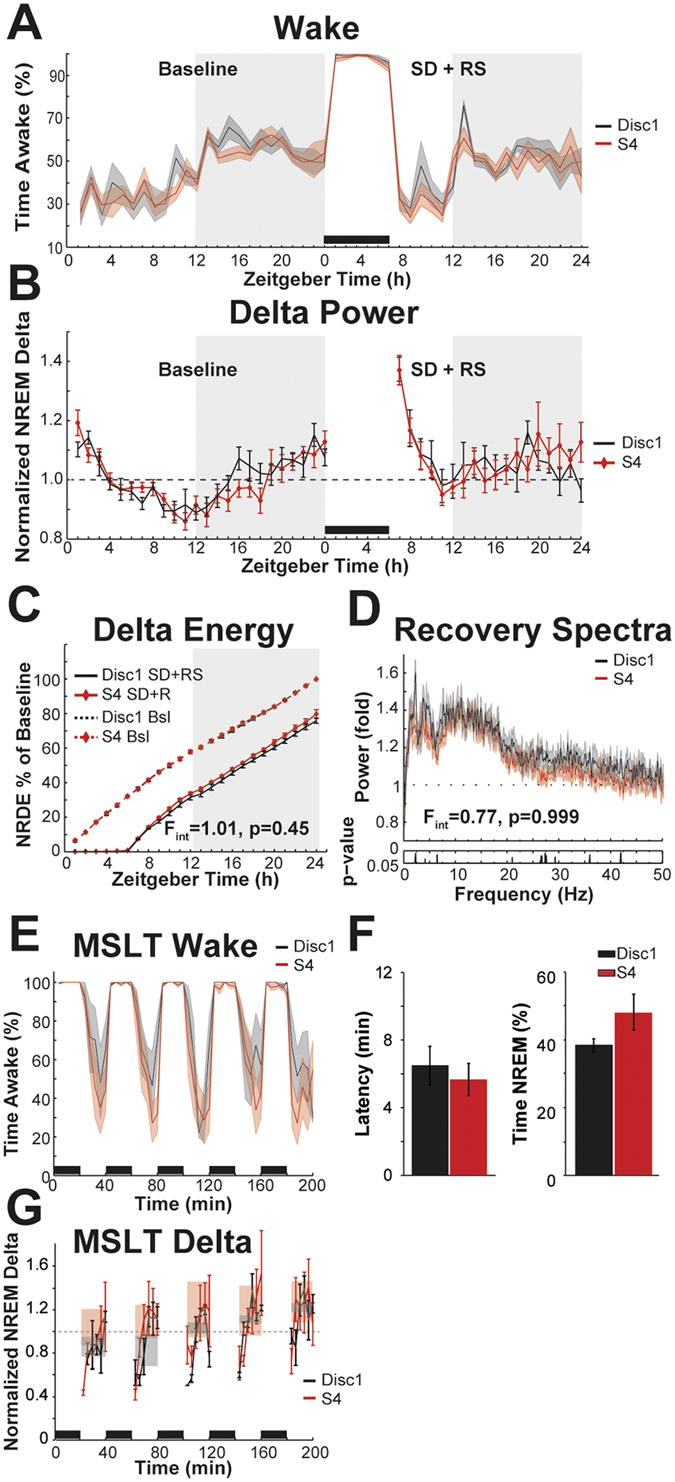
The gene Disrupted in Schizophrenia-1 (DISC1) is linked to a range of psychiatric disorders. Two recent transgenic studies suggest DISC1 is also involved in homeostatic sleep regulation. Several strains of inbred mice commonly used for genome manipulation experiments, including several Swiss and likely all 129 substrains, carry a natural deletion mutation of Disc1. This constitutes a potential confound for studying sleep in genetically modified mice. Since disturbed sleep can also influence psychiatric and neurodegenerative disease models, this putative confound might affect a wide range of studies in several fields. Therefore, we asked to what extent the natural Disc1 deletion affects sleep. To this end, we first compared sleep and electroencephalogram (EEG) phenotypes of 129S4 mice carrying the Disc1 deletion and C57BL/6N mice carrying the full-length version. We then bred Disc1 from C57BL/6N into the 129S4 background, resulting in S4-Disc1 mice. The differences between 129S4 and C57BL/6N were not detected in the 129S4 to S4-Disc1 comparison. We conclude that the mutation has no effect on the measured sleep and EEG characteristics. Thus, it is unlikely the widespread Disc1 deletion has led to spurious results in previous sleep studies or that it alters sleep in mouse models of psychiatric or neurodegenerative diseases.
精神分裂症相关蛋白 1(DISC1)基因与多种精神疾病有关。最近的两项转基因研究表明,DISC1 也参与了稳态睡眠调节。包括几种瑞士品系和可能所有的 129 亚系在内的几种常用于基因组操作实验的近交系小鼠,携带 DISC1 的自然缺失突变。这可能会对研究基因修饰小鼠的睡眠造成潜在的混淆。由于睡眠障碍也会影响精神和神经退行性疾病模型,这种潜在的混淆可能会影响多个领域的广泛研究。因此,我们询问了自然 DISC1 缺失对睡眠的影响程度。为此,我们首先比较了携带 Disc1 缺失的 129S4 小鼠和携带全长版本的 C57BL/6N 小鼠的睡眠和脑电图(EEG)表型。然后,我们将 Disc1 从 C57BL/6N 繁殖到 129S4 背景中,得到 S4-Disc1 小鼠。在 129S4 到 S4-Disc1 的比较中,没有检测到 129S4 和 C57BL/6N 之间的差异。我们得出结论,该突变对测量的睡眠和 EEG 特征没有影响。因此,以前的睡眠研究中广泛的 DISC1 缺失不太可能导致虚假结果,也不太可能改变精神或神经退行性疾病小鼠模型中的睡眠。