Yu Mi-Yeon, Lee Sung Woo, Baek Seon Ha, Na Ki Young, Chae Dong-Wan, Chin Ho Jun, Kim Sejoong
Department of Internal Medicine, Seoul National University Hospital, Seoul, Korea.
Department of Internal Medicine, Eulji General Hospital, Seoul, Korea.
PLoS One. 2017 Jul 19;12(7):e0180750. doi: 10.1371/journal.pone.0180750. eCollection 2017.
Development of acute kidney injury (AKI) is common and is associated with poor outcomes. We aimed to determine whether hypoalbuminemia (HA) at admission could be a risk factor for the development of AKI and mortality in hospitalized patients.
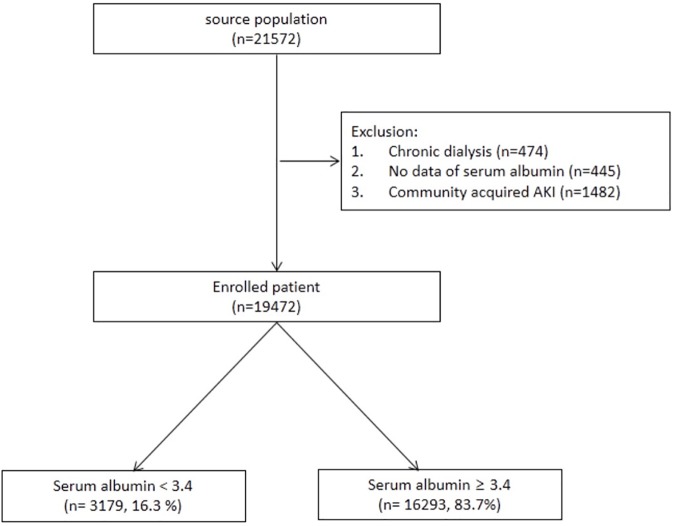
We enrolled patients who were admitted to Seoul National University Bundang Hospital from January 2013 to December 2013. HA at admission was defined as a serum albumin level < 3.4 mg/dL measured within two days after admission. AKI was defined as an increase in the serum creatinine level by ≥0.3 mg/dL or ≥1.5 times of the baseline value during the hospital stay.
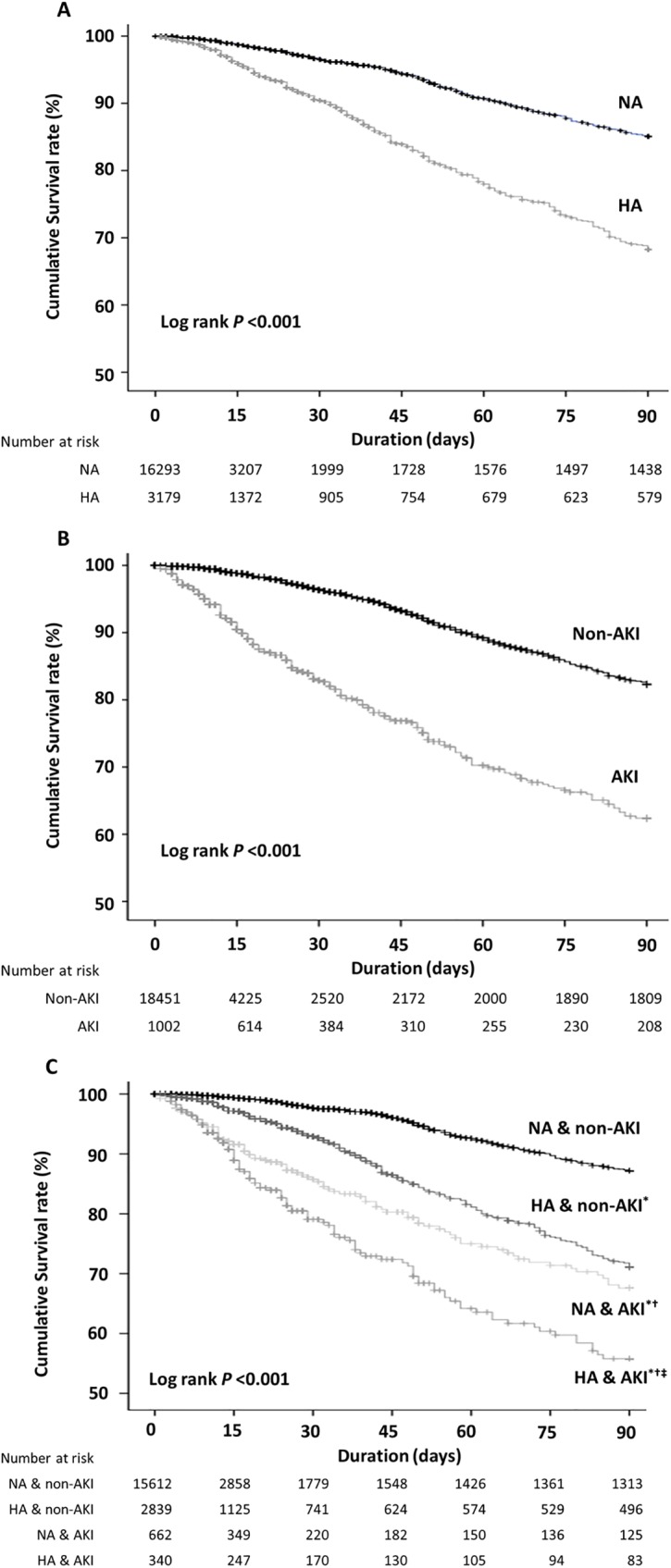
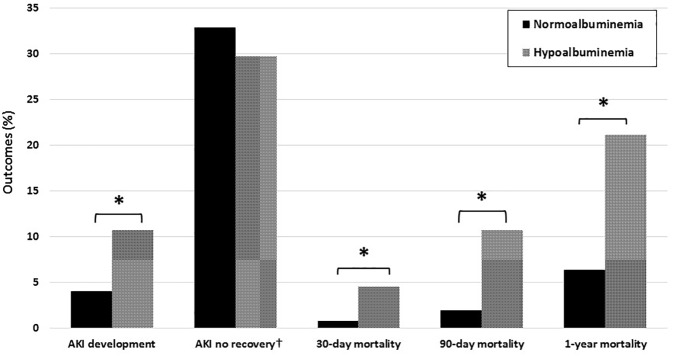
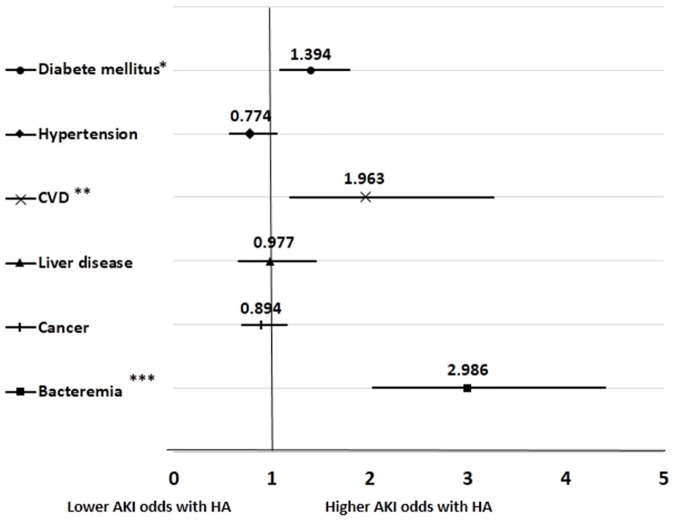
A total of 19,472 patients were enrolled and divided into HA and normoalbuminemia (NA) groups at admission. The incidence of AKI was 10.7% (340/3179) in the HA group and 4.1% (662/16293) in the NA group (adjusted odds ratio [OR], 1.243; 95% confidence interval [CI], 1.069-1.445; P = 0.005). The hazard ratios for the 30-day, 90-day, and 1-year mortality were 1.873 (95% CI, 1.383-2.537; P < 0.001), 1.710 (95% CI, 1.410-2.072; P < 0.001), and 1.372 (95% CI, 1.214-1.551; P < 0.001), compared to the NA group. In patients with AKI, albumin replacement improved renal recovery (OR, 2.605; 95% CI, 1.450-4.681; P = 0.001). The mortality rate was not different according to albumin replacement.
HA is associated with the development of AKI and high mortality in hospitalized patients. Replacement of albumin after the development of AKI may contribute to renal recovery. Further clinical trials are warranted.
急性肾损伤(AKI)的发生很常见,且与不良预后相关。我们旨在确定入院时低白蛋白血症(HA)是否可能是住院患者发生AKI及死亡的危险因素。
我们纳入了2013年1月至2013年12月入住首尔国立大学盆唐医院的患者。入院时的HA定义为入院后两天内测得的血清白蛋白水平<3.4mg/dL。AKI定义为住院期间血清肌酐水平升高≥0.3mg/dL或≥基线值的1.5倍。
共纳入19472例患者,入院时分为HA组和正常白蛋白血症(NA)组。HA组AKI的发生率为10.7%(340/3179),NA组为4.1%(662/16293)(校正比值比[OR],1.243;95%置信区间[CI],1.069 - 1.445;P = 0.005)。与NA组相比,30天、90天和1年死亡率的风险比分别为1.873(95%CI,1.383 - 2.537;P < 0.001)、1.710(95%CI,1.410 - 2.072;P < 0.001)和1.372(95%CI,1.214 - 1.551;P < 0.001)。在发生AKI的患者中,白蛋白替代治疗可改善肾脏恢复情况(OR,2.605;95%CI,1.450 - 4.681;P = 0.001)。白蛋白替代治疗后的死亡率无差异。
HA与住院患者发生AKI及高死亡率相关。AKI发生后补充白蛋白可能有助于肾脏恢复。有必要进行进一步的临床试验。