
迈向商品市场中的微藻甘油三酯。
Towards microalgal triglycerides in the commodity markets.
作者信息
Benvenuti Giulia, Ruiz Jesús, Lamers Packo P, Bosma Rouke, Wijffels René H, Barbosa Maria J
机构信息
Bioprocess Engineering, AlgaePARC, Wageningen University, P.O. Box 16, 6700 AA Wageningen, The Netherlands.
Algades-Alga, Development, Engineering and Services, S.L., c. Margaritas, Costa Oeste, El Puerto de Santa María, 11500 Cádiz, Spain.
出版信息
Biotechnol Biofuels. 2017 Jul 17;10:188. doi: 10.1186/s13068-017-0873-2. eCollection 2017.
BACKGROUND
Microalgal triglycerides (TAGs) hold great promise as sustainable feedstock for commodity industries. However, to determine research priorities and support business decisions, solid techno-economic studies are essential. Here, we present a techno-economic analysis of two-step TAG production (growth reactors are operated in continuous mode such that multiple batch-operated stress reactors are inoculated and harvested sequentially) for a 100-ha plant in southern Spain using vertically stacked tubular photobioreactors. The base case is established with outdoor pilot-scale data and based on current process technology.
RESULTS
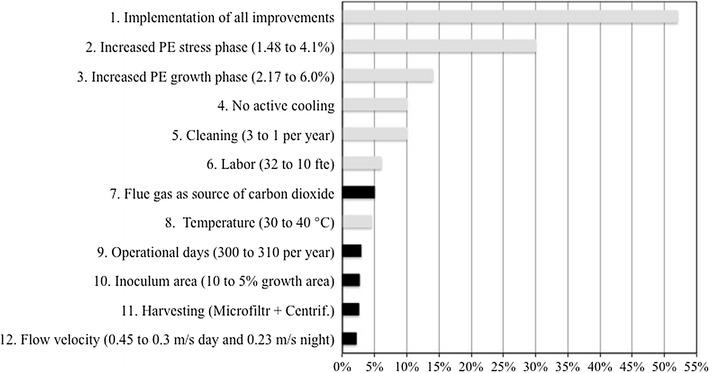
For the base case, production costs of 6.7 € per kg of biomass containing 24% TAG (w/w) were found. Several scenarios with reduced production costs were then presented based on the latest biological and technological advances. For instance, much effort should focus on increasing the photosynthetic efficiency during the stress and growth phases, as this is the most influential parameter on production costs (30 and 14% cost reduction from base case). Next, biological and technological solutions should be implemented for a reduction in cooling requirements (10 and 4.5% cost reduction from base case when active cooling is avoided and cooling setpoint is increased, respectively). When implementing all the suggested improvements, production costs can be decreased to 3.3 € per kg of biomass containing 60% TAG (w/w) within the next 8 years.
CONCLUSIONS
With our techno-economic analysis, we indicated a roadmap for a substantial cost reduction. However, microalgal TAGs are not yet cost efficient when compared to their present market value. Cost-competiveness strictly relies on the valorization of the whole biomass components and on cheaper PBR designs (e.g. plastic film flat panels). In particular, further research should focus on the development and commercialization of PBRs where active cooling is avoided and stable operating temperatures are maintained by the water basin in which the reactor is placed.
背景
微藻甘油三酯(TAGs)作为商品行业可持续的原料具有巨大潜力。然而,为了确定研究重点并支持商业决策,扎实的技术经济研究至关重要。在此,我们针对西班牙南部一个100公顷的工厂,使用垂直堆叠的管式光生物反应器,对两步法TAG生产(生长反应器以连续模式运行,使得多个分批操作的应激反应器依次接种和收获)进行了技术经济分析。基础案例基于室外中试规模数据并依据当前工艺技术建立。
结果
对于基础案例,发现每千克含24% TAG(重量/重量)的生物质生产成本为6.7欧元。然后基于最新的生物学和技术进展提出了几种降低生产成本的方案。例如,应大力专注于在应激和生长阶段提高光合效率,因为这是对生产成本影响最大的参数(比基础案例降低30%和14%的成本)。接下来,应实施生物学和技术解决方案以降低冷却需求(分别避免主动冷却和提高冷却设定点时,比基础案例降低10%和4.5%的成本)。实施所有建议的改进措施后,在未来8年内,每千克含60% TAG(重量/重量)的生物质生产成本可降至3.3欧元。
结论
通过我们的技术经济分析,我们指明了大幅降低成本的路线图。然而,与当前市场价值相比,微藻TAGs尚不具备成本效益。成本竞争力严格依赖于整个生物质组分的增值以及更便宜的光生物反应器设计(如塑料薄膜平板)。特别是,进一步的研究应聚焦于开发和商业化那些避免主动冷却且通过放置反应器的水池维持稳定运行温度的光生物反应器。



 Zotero 插件