Lorenz Carla S, Wicht Anna-Jorina, Guluzada Leyla, Crone Barbara, Karst Uwe, Lee Hwa Jun, Triebskorn Rita, Haderlein Stefan B, Huhn Carolin, Köhler Heinz-R
Institute of Evolution and Ecology, Animal Physiological Ecology, Eberhard-Karls-Universität Tübingen, Tübingen, Germany.
Institute of Physical and Theoretical Chemistry, Eberhard-Karls-Universität Tübingen, Tübingen, Germany.
PeerJ. 2017 Jul 18;5:e3525. doi: 10.7717/peerj.3525. eCollection 2017.
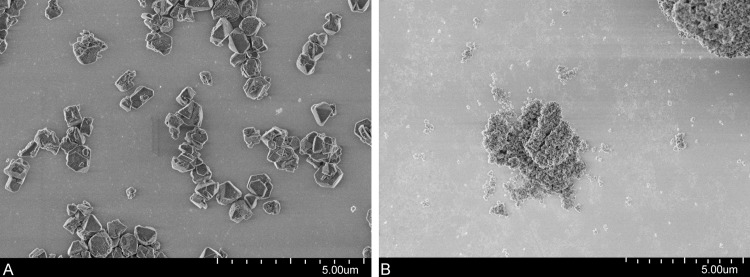
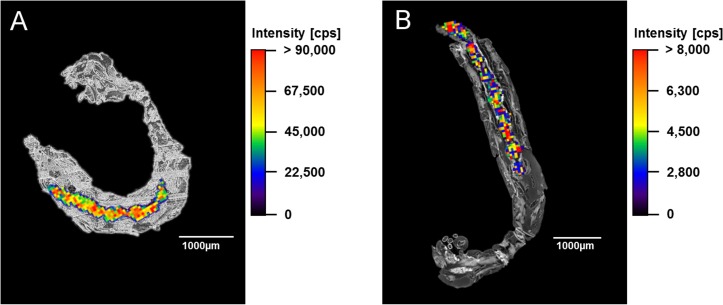
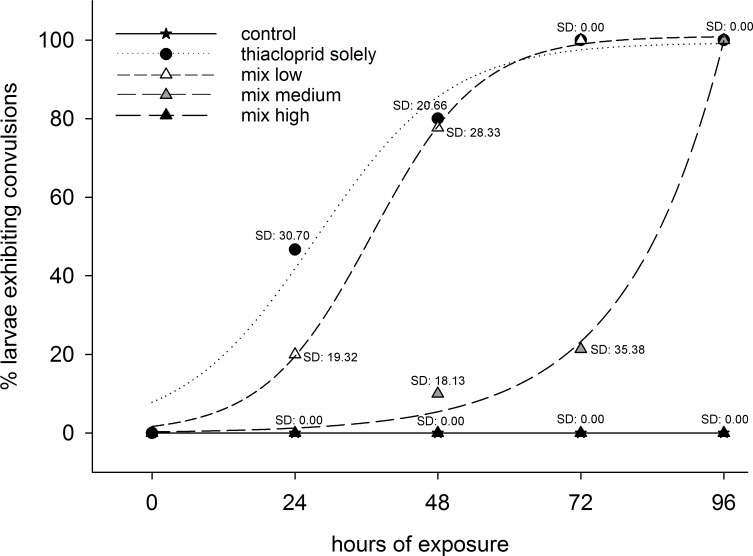
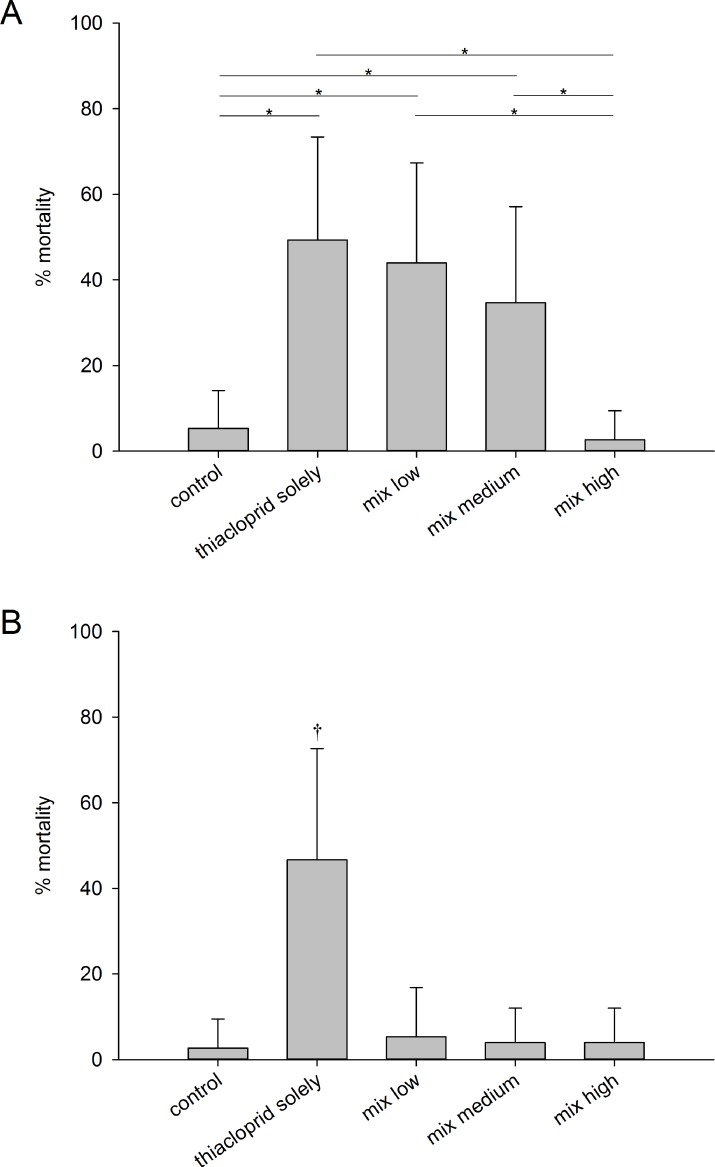
This study investigated whether zeolites of different size (Y30 (nano-sized) and H-Beta(OH)-III (forming large aggregates/agglomerates composed of 50 nm small primary particles)) exerted acute toxicity on larvae of the non-biting midge, , and whether such zeolites are able to modulate the toxicity of a common insecticide, thiacloprid, by means of adsorption of a dissolved toxicant. We conducted acute toxicity tests with fourth instar larvae of . In these tests, larvae were exposed to zeolites or thiacloprid solely, or to mixtures of both compounds. The mixtures comprised 1.0 µg/L thiacloprid in addition to low (5.2 mg/L), medium (18.2 mg/L), and high (391.7 mg/L) zeolite concentrations, resulting in different adsorption rates of thiacloprid. As biological endpoints, changes in mortality rates and in behavior were monitored every 24 h over a total investigation period of 96 h. Furthermore, we conducted chemical analyses of thiacloprid in the medium and the larvae and located the zeolite particles within the larvae by LA-ICP-MS imaging techniques. Our results demonstrate that both types of zeolites did not exert acute toxicity when applied as single-substances, but led to reduced acute toxicity of thiacloprid when applied together with thiacloprid. These results are in line with the sorption properties of zeolites indicating reduced bioavailability of thiacloprid, although our data indicate that thiacloprid can desorb from zeolites to some extent. While freely dissolved (i.e., non-sorbed) fraction of thiacloprid was a good parameter to roughly estimate toxic effects, it did not correlate with measured internal thiacloprid concentrations. Moreover, it was shown that both zeolite types were ingested by the larvae, but no indication for cellular uptake of them was found.
本研究调查了不同尺寸的沸石(Y30(纳米级)和H-Beta(OH)-III(形成由50纳米小初级颗粒组成的大聚集体/团聚体))是否对摇蚊幼虫产生急性毒性,以及此类沸石是否能够通过吸附溶解的有毒物质来调节常见杀虫剂噻虫啉的毒性。我们对摇蚊四龄幼虫进行了急性毒性试验。在这些试验中,幼虫分别暴露于沸石或噻虫啉,或两种化合物的混合物中。混合物除了含有低(5.2毫克/升)、中(18.2毫克/升)和高(391.7毫克/升)浓度的沸石外,还含有1.0微克/升的噻虫啉,导致噻虫啉的不同吸附率。作为生物学终点,在总共96小时的调查期内,每24小时监测死亡率和行为的变化。此外,我们对培养基和幼虫中的噻虫啉进行了化学分析,并通过激光烧蚀电感耦合等离子体质谱成像技术在幼虫体内定位了沸石颗粒。我们的结果表明,两种类型的沸石作为单一物质使用时均未产生急性毒性,但与噻虫啉一起使用时会导致噻虫啉的急性毒性降低。这些结果与沸石的吸附特性一致,表明噻虫啉的生物利用度降低,尽管我们的数据表明噻虫啉可以在一定程度上从沸石上解吸。虽然噻虫啉的自由溶解(即未吸附)部分是大致估计毒性作用的良好参数,但它与测得的体内噻虫啉浓度不相关。此外,结果表明两种类型的沸石均被幼虫摄入,但未发现细胞摄取它们的迹象。