Division of Cardiology, Department of Internal medicine, Seoul National University Boramae Medical Center, Seoul, Republic of Korea.
Division of Cardiology, Department of Internal medicine, Seoul National University Hospital, Seoul, Republic of Korea.
Sci Rep. 2017 Jul 24;7(1):6324. doi: 10.1038/s41598-017-06579-0.
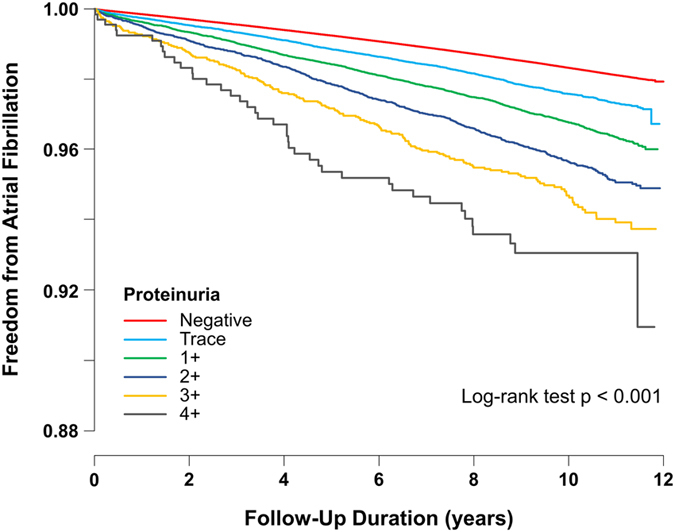
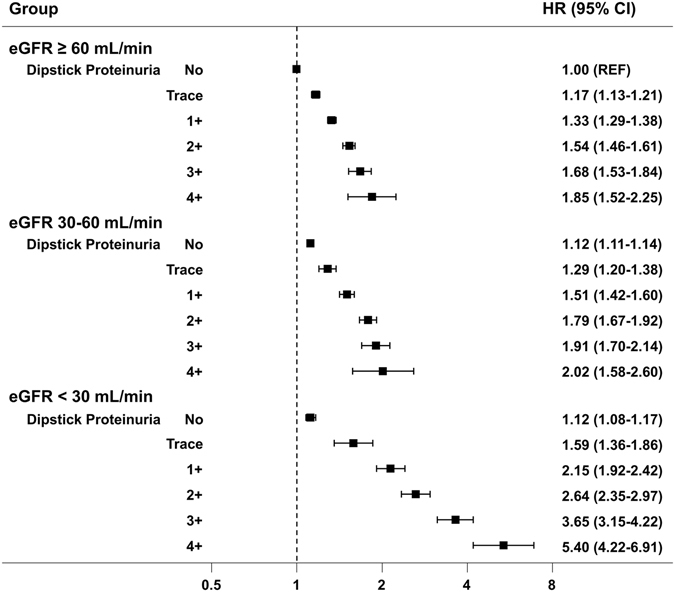
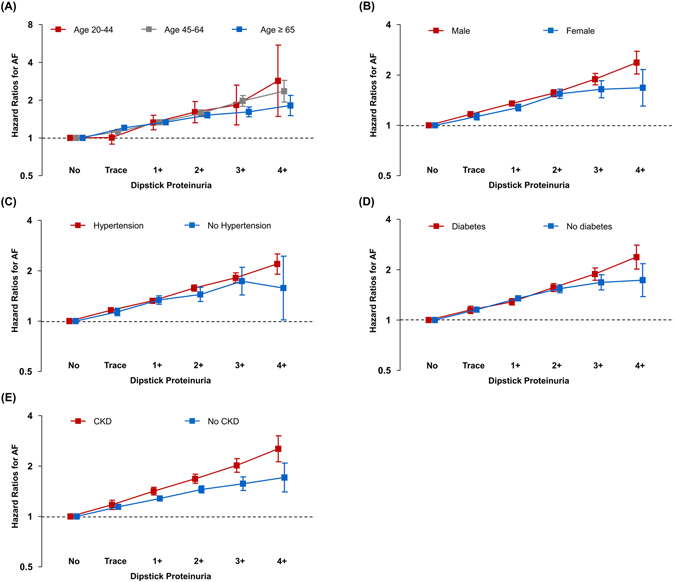
Proteinuria is one of the well-known risk factors for cardiovascular disease. However the impact of proteinuria on the incidence of atrial fibrillation (AF) is unclear. In this study, we investigated the association between proteinuria detected using urine dipstick test and the risk of AF. A total of 18,201,275 individuals were analyzed, who had no prior AF and had received biennial health checkups provided by the National Health Insurance Service between 2005 and 2008 in Korea. Incidences of AF were ascertained through the end of 2015. During a mean follow-up of 9.6 years, a total of 324,764 (1.8%) developed AF (1.86 per 1,000 person-years). In Cox regression models, proteinuria was associated with an increased risk of AF: adjusted HR and 95% CI of AF occurrence were 1.13 (1.10-1.16), 1.34 (1.31-1.38), 1.53 (1.48-1.58), 1.82 (1.71-1.94), and 1.86 (1.61-2.16) in individuals with trace, 1+, 2+, 3+, and 4+ proteinuria, respectively, compared with those without proteinuria. The result was consistent even after additional adjustment for estimated glomerular filtration rate. In addition, the risk of AF further increased or decreased according to the follow-up dipstick test results. Thus, proteinuria measured with a dipstick test might be considered a potent risk factor for AF development.
蛋白尿是心血管疾病的已知危险因素之一。然而,蛋白尿对心房颤动(AF)发生率的影响尚不清楚。在这项研究中,我们研究了尿试纸检测到的蛋白尿与 AF 风险之间的关系。总共分析了 18201275 名个体,他们没有 AF 病史,并且在 2005 年至 2008 年期间接受了国家健康保险服务提供的两年一次的健康检查。通过 2015 年底确定 AF 的发生率。在平均 9.6 年的随访期间,共有 324764 人(1.8%)发生了 AF(1.86/1000 人年)。在 Cox 回归模型中,蛋白尿与 AF 风险增加相关:调整后的 AF 发生 HR 和 95%CI 分别为 1.13(1.10-1.16)、1.34(1.31-1.38)、1.53(1.48-1.58)、1.82(1.71-1.94)和 1.86(1.61-2.16),在 trace、1+、2+、3+和 4+蛋白尿的个体中,与无蛋白尿的个体相比。即使在进一步调整估计肾小球滤过率后,结果仍然一致。此外,根据随访尿试纸检测结果,AF 的风险进一步增加或降低。因此,尿试纸测量的蛋白尿可能被认为是 AF 发展的一个潜在危险因素。