Ferrigno Andrea, Berardo Clarissa, Di Pasqua Laura G, Siciliano Veronica, Richelmi Plinio, Vairetti Mariapia
Andrea Ferrigno, Clarissa Berardo, Laura G Di Pasqua, Veronica Siciliano, Plinio Richelmi, Mariapia Vairetti, Department of Internal Medicine and Therapeutics (Cellular and Molecular Pharmacology and Toxicology), University of Pavia, 27100 Pavia, Italy.
World J Gastroenterol. 2017 Jul 7;23(25):4500-4507. doi: 10.3748/wjg.v23.i25.4500.
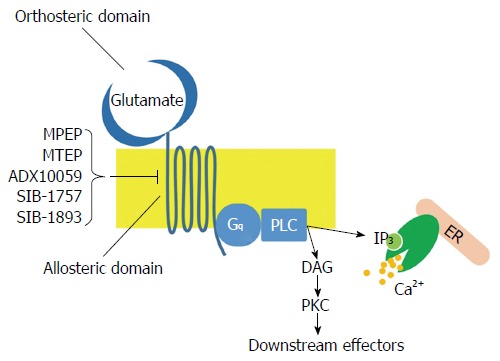
Metabotropic glutamate receptor subtype 5 (mGluR5) is a Group I mGlu subfamily of receptors coupled to the inositol trisphosphate/diacylglycerol pathway. Like other mGluR subtypes, mGluR5s contain a phylogenetically conserved, extracellular orthosteric binding site and a more variable allosteric binding site, located on the heptahelical transmembrane domain. The mGluR5 receptor has proved to be a key pharmacological target in conditions affecting the central nervous system (CNS) but its presence outside the CNS underscores its potential role in pathologies affecting peripheral organs such as the gastrointestinal (GI) tract and accessory digestive organs such as the tongue, liver and pancreas. Following identification of mGluR5s in the mouth, various studies have subsequently demonstrated its involvement in mechanical allodynia, inflammation, pain and oral cancer. mGluR5 expression has also been identified in gastroesophageal vagal pathways. Indeed, experimental and human studies have demonstrated that mGluR5 blockade reduces transient lower sphincter relaxation and reflux episodes. In the intestine, mGluR5s have been shown to be involved in the control of intestinal inflammation, visceral pain and the epithelial barrier function. In the liver, mGluR5s have a permissive role in the onset of ischemic injury in rat and mice hepatocytes. Conversely, livers from mice treated with selective negative allosteric modulators and mGluR5 knockout mice are protected against ischemic injury. Similar results have been observed in experimental models of free-radical injury and mouse models of acetaminophen intoxication. Finally, mGluR5s in the pancreas are associated with insulin secretion control. The picture is, however, far from complete as the review attempts to establish in particular as regards identifying specific targets and innovative therapeutic approaches for the treatment of GI disorders.
代谢型谷氨酸受体5(mGluR5)是I组代谢型谷氨酸受体亚家族,与肌醇三磷酸/二酰基甘油途径偶联。与其他代谢型谷氨酸受体亚型一样,mGluR5s含有一个系统发育保守的细胞外正构结合位点和一个位于七螺旋跨膜结构域上的更具变异性的别构结合位点。事实证明,mGluR5受体是影响中枢神经系统(CNS)疾病的关键药理学靶点,但其在中枢神经系统外的存在突出了其在影响外周器官(如胃肠道(GI))和附属消化器官(如舌头、肝脏和胰腺)的疾病中的潜在作用。在口腔中鉴定出mGluR5s后,随后的各种研究表明其参与了机械性异常性疼痛、炎症、疼痛和口腔癌。mGluR5的表达也已在胃食管迷走神经通路中得到鉴定。事实上,实验和人体研究表明,阻断mGluR5可减少一过性下食管括约肌松弛和反流发作。在肠道中,mGluR5s已被证明参与肠道炎症、内脏疼痛和上皮屏障功能的控制。在肝脏中,mGluR5s在大鼠和小鼠肝细胞缺血性损伤的发生中起允许作用。相反,用选择性负性别构调节剂处理的小鼠肝脏和mGluR5基因敲除小鼠的肝脏对缺血性损伤具有保护作用。在自由基损伤实验模型和对乙酰氨基酚中毒小鼠模型中也观察到了类似结果。最后,胰腺中的mGluR5s与胰岛素分泌控制有关。然而,这幅图景远未完整,正如本综述尤其试图在确定治疗胃肠道疾病的特定靶点和创新治疗方法方面所表明的那样。