Al-Hammadi Noora, Caparrotti Palmira, Divakar Saju, Riyas Mohamed, Chandramouli Suparna Halsnad, Hammoud Rabih, Hayes Jillian, Mc Garry Maeve, Paloor Satheesh Prasad, Petric Primoz
Department of Radiation Oncology, National Center for Cancer Care and Research, Hamad Medical Corporation, Doha, Qatar.
Radiol Oncol. 2017 Mar 17;51(2):160-168. doi: 10.1515/raon-2017-0014. eCollection 2017 Jun.
Omitting the placement of clips inside tumour bed during breast cancer surgery poses a challenge for delineation of lumpectomy cavity clinical target volume (CTV). We aimed to quantify inter-observer variation and accuracy for CT- and MRI-based segmentation of CTV in patients without clips.
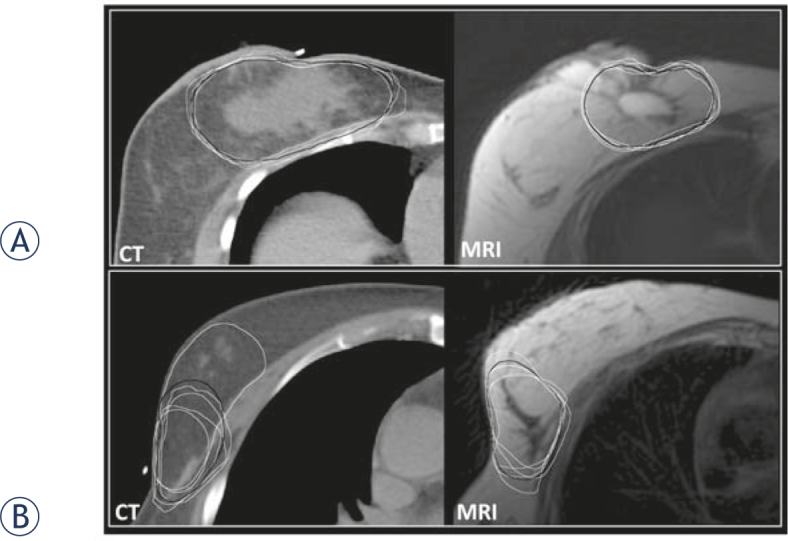
CT- and MRI-simulator images of 12 breast cancer patients, treated by breast conserving surgery and radiotherapy, were included in this study. Five radiation oncologists recorded the cavity visualization score (CVS) and delineated CTV on both modalities. Expert-consensus (EC) contours were delineated by a senior radiation oncologist, respecting opinions of all observers. Inter-observer volumetric variation and generalized conformity index (CI) were calculated. Deviations from EC contour were quantified by the accuracy index (AI) and inter-delineation distances (IDD).
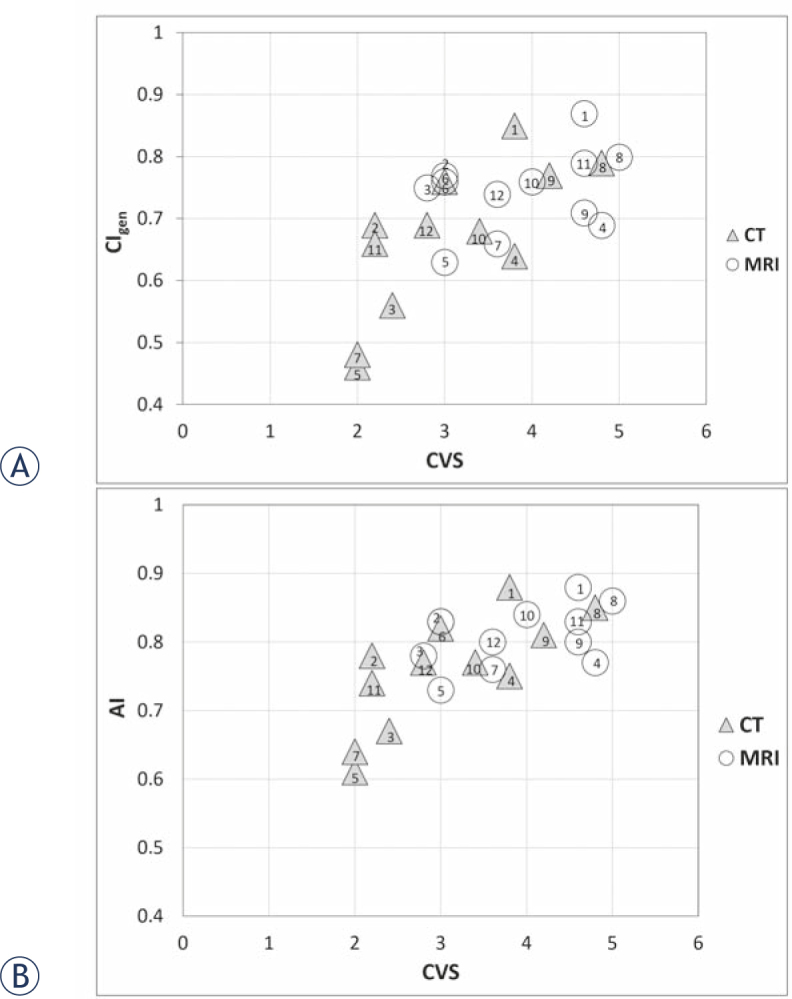
Mean CVS was 3.88 +/- 0.99 and 3.05 +/- 1.07 for MRI and CT, respectively (p = 0.001). Mean volumes of CTV were similar: 154 +/- 26 cm on CT and 152 +/- 19 cm on MRI. Mean CI and AI were superior for MRI when compared with CT (CI: 0.74 +/- 0.07 vs. 0.67 +/- 0.12, p = 0.007; AI: 0.81 +/- 0.04 vs. 0.76 +/- 0.07; p = 0.004). CI and AI increased with increasing CVS. Mean IDD was 3 mm +/- 1.5 mm and 3.6 mm +/- 2.3 mm for MRI and CT, respectively (p = 0.017).
When compared with CT, MRI improved visualization of post-lumpectomy changes, reduced interobserver variation and improved the accuracy of CTV contouring in patients without clips in the tumour bed. Further studies with bigger sample sizes are needed to confirm our findings.
在乳腺癌手术中不放置夹子于瘤床内,给确定保乳手术腔临床靶区(CTV)带来了挑战。我们旨在量化在无夹子患者中基于CT和MRI的CTV分割的观察者间差异及准确性。
本研究纳入了12例接受保乳手术和放疗的乳腺癌患者的CT和MRI模拟图像。5名放射肿瘤学家记录了两种模态下的腔可视化评分(CVS)并勾画CTV。由一名资深放射肿瘤学家勾画专家共识(EC)轮廓,参考所有观察者的意见。计算观察者间体积差异和广义符合指数(CI)。通过准确性指数(AI)和轮廓间距离(IDD)量化与EC轮廓的偏差。
MRI和CT的平均CVS分别为3.88±0.99和3.05±1.07(p = 0.001)。CTV的平均体积相似:CT上为154±26 cm,MRI上为152±19 cm。与CT相比,MRI的平均CI和AI更优(CI:0.74±0.07对0.67±0.12,p = 0.007;AI:0.81±0.04对0.76±0.07;p = 0.004)。CI和AI随CVS增加而升高。MRI和CT的平均IDD分别为3 mm±1.5 mm和3.6 mm±2.3 mm(p = 0.017)。
与CT相比,MRI改善了保乳切除术后改变的可视化,减少了观察者间差异,并提高了瘤床无夹子患者CTV勾画的准确性。需要更大样本量的进一步研究来证实我们的发现。